Category: Becoming Family

  • Our Son is a Person

    I know we tend to pickle memories in a brine that renders them more rosy-shaded than blood-red.   Nonetheless my journal is a record of how I viewed my world at the time, a primary source with hopefully less cherry-picking than my mind might remember now.  Still, reading those journal pages 25 years later, it seems they might have been wrapped in pink cellophane, oh yes, the ‘honeymoon period’.  And I am not alone, at least as far as I could tell from the one or two books I came across in those early years.  One book I remember was written by a woman a year or two after adopting her ‘forever child’. The book was rosy from cover to cover.  We would have written the same and if Kisses from Katie[i] is anything to go by, people still are.

    Recently I heard the Avett Brothers on Jimmy Kimmel singing a song that asks, “How long is now?”. The song, full of hope and happiness, answers with the word, “Forever”.  It brought this time to mind, singing of the wonderful days in a lifetime.

    This post will offer vignettes of that good time as I seek to establish something that may seem obvious but, at perhaps a less than conscious level, is not always firmly embedded. Yasik is person, not merely a set piece or accessory in the arrangement called family.

    I was wondering how to approach understanding who Yasik was showing himself to be as our son and how that might help to reveal his perception of himself and his new world.  I googled with the words that came to mind: personality traits, that sort of thing.  Google led me to philosophical sites of all things: the idea of personhood.[ii]

    It appears we as persons are physical and mental beings who develop networks of beliefs that impact how we calculate and think about our environment and social relationships, using reflection and language to make autonomous choices and engage in actions. My journal entries allow me to work backwards from Yasik’s actions to uncover the person he was/is.

    But why examine such abstract philosophical and psychological concepts?  I had been considering sharing some bits from the journal that I later recognized were best kept private to the family. “Yeah but …, No but…” CHILD CATCHERS: rescue, trafficking, and the new gospel of adoption[iii] by Kathryn Joyce deals with a variety of movements that have led to bartering in orphans for their souls, for money, for prestige, or to fill some personal hole in their lives.  Christians rescuing heathen, governments looking for financial gain or political pawns, couples looking to place a family portrait on the mantle.  John Brooks in The Girl Behind the Door[iv] says, “We treated Casey as if she were our new pet”. At times in the ‘honeymoon period’, as I bring forward in the post Parents? Yet Tourists?, our child was our pet. We may not have seen our child as a commodity, but it can’t be denied that some part of us, wanting family, did not initially see our child as a distinct and individual person but as a piece to finish a look we imagined completed our image of ourselves and our lifestyle.

    Perhaps we can hone an awareness of the orphan as a person in his or her or their own right by thinking very specifically about what makes each of them a person. Perhaps then we will recognize each child caught in the liminal (a word new to me but I like its eeriness) state of orphan as an individual whose personhood must be valued.

    Physical being

    Numbers-wise there was not much of the ‘physical being’ about Yasik at the start: essentially 40 inches by 40 lbs.  But whatever little there was, it was packed into a well-proportioned body, capped with soft blond hair.    We had a cherry tree in the front yard with branches like big arms about four feet off the ground.  Dave tucked into the arms one evening to hide in a game of Hide and Seek but those 40 inches of bursting energy were just not up to the hunt. Dave sat right in front of Yasik in the cherry tree, but 20 inches short of the tree’s arms, he could not see Dave.

    Where it mattered, of course, and especially with the adjustment a pair of glasses made, Yasik could see just fine.  We watched a video with Yasik one evening about where kids come from. It made the observation that a woman has breasts, showing a cartoon woman with straight out breasts and nipples.  Later I said to Yasik, “See, I have breast too”.  He said, “No, yours don’t stand up.”  He could see. Yasik could hear (he loved listening to music with earphones) which was later confirmed as hearing issues are usually checked as part of an assessment of learning difficulties; Yasik could smell (well we assume so for I have no concrete examples recorded); Yasik could taste (at first only familiar foods – which shows discrimination, right?); Yasik knew the message of touch (holding our hands and cuddling); and that sixth one, proprioception, appeared to be working just fine as his very effective fine and gross motor skills demonstrated despite Orphanage Risk Factors’ mention that often institutionalized kids are clumsy.  From leaping around on the park dragon to hitting the T-ball to biking, he showed skill and prowess.  Of course, there was that one time just after Yasik got comfortable on his bike, we biked around the block. On Braid St. he biked into a telephone post. He got a bit disgusted and said, “Tomorrow they have to move it over there” – meaning across the street. But clumsiness or awkwardness of movement have never been evident.  He knows where his arms and legs are and where they are headed – exactly where he wants them to go.

    And as for that one bug-a-boo, size, the material on Orphanage Risk Factors notes that institutionalized kids make size gains within months of adoption. I noted sometime after Christmas of that first year that “he keeps growing.   He wants to be measured a lot to check if he’s grown and usually he has – he is growing steadily but he is still the littlest kid in the school”.   Attaching in Adoption: practical tools for today’s parents takes concern for size seriously, saying children can feel embarrassed about being short.  They may see it as mocking their drive for independence from being needy[v].  Getting glasses centered his right eye but being little was an on-going concern.

    Notes from our ‘getting to know Yasik’ meeting with orphanage staff say Yasik had dealt with rickets, poor nutrition and a lack of Vitamin D due to little exposure to a world beyond his crib. He also had what they called an infant allergy or intolerance to sweets. The staff assured us the rickets and allergy and their after effects were now gone, as is most often the case once diet and exercise needs are met.

    He did have a secret power though – when chicken pox banged at the door, the doctor thinks the resistance to infection spawned in the orphanage made him quite invincible to many childhood illnesses. Other than a mild diarrhea, he was free to play in the park for the week he was quarantined from school. His body was also well adjusted to the rhythms of life for he slept well, ate well, especially sausages, piroshkies and fruit in the early months. The fruit kept things humming so well that we would occasionally ban apples. Loving fruit, Yasik would have us check to see if his poop was firm enough to lift the apple ban.

    Mental being

    And the ‘mental being’?  A Google definition says it is about memory, emotion, intention, desire, pain experience, perception, and belief. I would like to add as a separate concept, the gift of curiosity we are given.

    For whatever emotional, psychological or neurological reason, Yasik says he has no memory of his life before the flight to Canada. Yet ….. while we waited for our pre-dawn flight home in the Moscow airport, facing out into flat river valley, a harvest moon arose.  It was huge.  One evening, a few months into his first year with us, he and Dave were on the computer.  Dave was making supper and Yasik was playing on the computer. A large moon came up on the screen.  Yasik called Dave over and pointed to it, “Papa that is where Yasik is from”.  He explained that “They pulled the string” (like maybe a bus stop string?) and he came down on an airplane.  His memory system was doing what memories are to do – providing him with a narrative. He came from the moon.

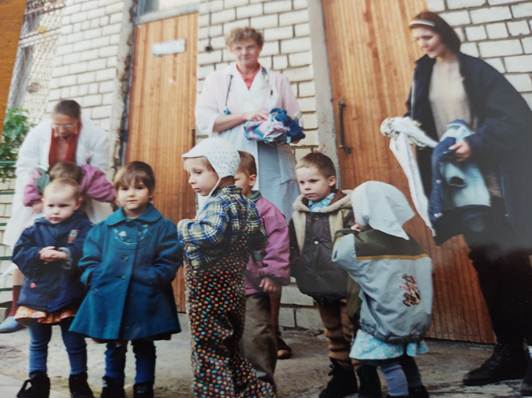
    It is the only memory he shared other than recognizing the little kids pictured waving good bye to him from the orphanage front porch.  Sadly, or simply the by-product of embracing a new life, there came a day when he no longer wanted to look at their pictures before bed.  John Brooks talks of the same with his daughter, Casey.   John and his wife Erika had created a “scripted fantasy story” about Casey’s bio mom loving her but wanting her to have a better life and so the Brooks “went all the way to Poland to find” Casey. (I bet they dragged that word ‘all’ out).  But Casey showed little curiosity about her bio family or the orphanage, or Poland[vi].  And yes, more could be said re: the fantasy story and magical thinking as per the Child Catchers: rescue, trafficking, and the new gospel of adoption[vii].

    We could not deny he had emotions either, from robust anger to sweeping happiness.  Angry that he must obey, laughing so freely when happy, yelling, “Yee Haw” while biking, excited and giggling playing Hide and Seek. He had us outside, having one of us hiding while he had the other counting and helping him hunt, but it was all his when the hunted one was spotted as he broke into a determined run to kick the can; he burst with pride at handling bumper cars with Kyle; he entered into T-ball games wholeheartedly – no standing on the sides, no matter who played. Yet come the evening, he slipped into cuddly mode.

    Yasik fell from a stand at his last T-ball game and he was leaning against the fence trying not to cry. Dave went over and picked him up from behind. He turned into Dave’s neck and cried his heart out. But again, all in the same day, he might punch your bum and leap on you. He would leap on my back while I was crouched at the fridge and get me in a strangle hold.

    Erik H. Erikson, student of life, according to Daniel Levinson[viii], and person who never knew his bio-father and never felt fully accepted by his step-father, designed a theory of human life rather like a train on a railway line with 8 stations along the way.  Yasik should have, at this point, passed the stop of Trust vs. Mistrust (infant) and Autonomy/Independence vs Shame and Doubt (toddler) and if all was going well, was in the stage of Initiative vs Guilt (pre-school).  Orphanage Risk Factors suggest that often children who begin life in an orphanage are emotionally delayed.  So, was the train of life carrying Yasik getting to each stop on time and leaving on time?  Can adoptive parents even tell this early in an adoption? Were we going to see Yasik trusting us as his parents? Sara Nović saw her adoptive son’s freedom to say ‘No” as “[trusting] us enough to know we wouldn’t disappear at the first sign of non-compliance.”[ix]  Was he confident enough to take up challenges?  Was he becoming more and more skillful and able to make decisions that show a growing control of his impulses?[x]

    Not to gloss over the Orphanage Risk Factors I have noted here and there, I might add that we did watch Yasik self-soothe by rocking on the couch while watching TV or listening to music and when in the car.  I’d also say there was some self-parenting when he could get a bit bossy, telling us to stop doing something that irritated him or becoming indignant when disciplined.  But he was not having obvious problems with impulse control other than making sure we knew his negative opinions as clearly as his positive opinions.  He did not come to us cowed by orphanage punishment though he would show initial hesitancy when encouraged to try new things like testing out the slide at the playground or learning to ride his bike. Nonetheless, there was no evidence of a ‘learned helplessness’ for with encouragement, he tried whatever challenge was offered.   Was he indiscriminately friendly? I don’t think so for it took little for him to be willing to make friends.  When visiting in the home of his buddy, the buddy’s mom found him to be more cuddly than her son. But there was no going off with strangers or seeking a stranger’s attention.  And if you watched him watching ‘Forrest, Forrest Gunk’ you could rest assured he was able to hold a concentration or focus. He was acting like a happy little boy. He seemed to have enough trust and independence to beetle on into anything.

    Maybe the mental being marker of intention will provide some answers. Dave’s birthday came along in March.  Yasik and I went shopping for a gift for him.  He got Dave a plastic foldable set of swords – for lots of sword fights with himself. On another day, Dave suggested Yasik pick flowers for me.  The next day Yasik was mad at Dave for a reprimand.   On the way to school I told Yasik that Dad did so because he loves him.  Yasik goes “Oh”, stopped and picked a buttercup, saying, “This is for my daddy”.  As an afterthought, he picked one for me so I picked one for him and again he said. “Ooh” – both ‘Ohs’ in awe. (I kept that little flower in the journal for many, many years).

    Any organism, if it is alive, demonstrates desire, so it can be no surprise that desire burbled in Yasik’s breast.   Right from the start we could tell he was into long-haired girls.

    We were visiting friends in Chilliwack whose only child was a beautiful, long-haired girl. Yasik fell in love with her, not reciprocated of course, for she was several years old than him, but she played with him and that was good enough.

    I have read here and there that curiosity is a special gift tucked into the bundle of personality traits of the lucky. I am not so sure; it seems to me that whether it is slipping into a shop to see an item we are dreaming of or questions we have about the connection between nature and nurture which leads us to Nobel prize honours, we likely each have some measure of curiosity.  Even our dog shows curiosity most days, sticking his nose in here and there on our walks.  Yasik too, has always poked his nose into things around him: how to drive the car, checking out what might be hidden in dense bush, even if it meant getting dirty to find out, figuring out how to help some fish get upstream.

    It is harder to pin point his experience of pain for he rarely seemed bothered by confrontations with pain. Much of what would have others cry out seemed to bounce off him. Or maybe his physical dexterity came to his aid, allowing to him slip past most potential accidents.

    Perception it seems is the expression of the physical and genetic attributes as they entwine with the mental attributes which together lead to a way of regarding, understanding or interpreting something.  Or better yet, we as persons are physical and mental beings who develop networks of beliefs that impact how we calculate and think about our environment and social relationships, using reflection and language to make autonomous choices and engage in actions, with the right to be accountable for our choices.

    I think Belief, in a narrow definition, is chain-linked to perception so will check it off the list as essentially being dealt with as perception.

    I hope to discover Yasik’s attribute of perception as I work through the next few posts.  Other than that, the bases are covered.

    So yeah, he is a person.

    Footnotes


    [i] Davis, Katie with Beth Clark   Kisses For Katie: a story of relentless love and redemption  Gale Cengage Learning, 2011.

    [ii] Camilleri, Adrian. “What are the Characteristics of Personhood?”  Philosphymthttps://philosophymt.com/what-are-the-characteristics-of-personhood/.  January 7, 2022.

    [iii] Joyce, Kathryn.    the Child Catchers: rescue, trafficking, and the new gospel of adoption.   Public Affairs,2013, 67

    [iv] Brooks, John   The Girl Behind The Door: a father’s quest to understand his daughter’s suicide.  Scribner, 2016.

    [v] Gray, Deborah D.  Attaching in Adoption: practical tools for today’s parents. Perspectives Press, Inc., 2002, 37-39.

    [vi] Brooks, John.   The Girl Behind The Door: a father’s quest to understand his daughter’s suicide.  Scribner, 2016, 55-56.

    [vii] Joyce, Kathryn    the Child Catchers: rescue, trafficking, and the new gospel of adoption.   Public Affairs, 2013, 75 – 127.

    [viii] Levinson, Daniel J.  The Seasons of a Man’s Life. Harper & Row, 1979.

    [ix] Nović, Sara   Mother Tongue: a memoir   Random House, 2026, 219

    [x] Wade, Carol et al.  Psychology: custom edition for Thompson Rivers University.  Pearson, 2007.
  • Stick to a Routine

    Institutions of all sorts dress themselves in routines. It is certainly a given for orphanages whether George Mueller’s Ashley Down in 1849 or SOS Children’s Villages today.

    Routine at Ashley Down Orphanage 1849 – 1958.[i]

    TimeActivity
    6:00 AMWake-up, washing, dressing, and chores (making beds and cleaning floors)
    7:00 AMMorning preparatory work – girls at knitting or sewing, boys reading
    8:00 AMBreakfast
    8:30 AMMorning devotion (Bible reading and prayer)  
    10:00 AMSchool commenced, covering subjects like reading, arithmetic, geography, and hymn singing
    1:00 PMDinner (the main midday meal)  
    Afternoon to 4:00 PMSchool resumed until 4:00 PM, followed by an hour and a half of play or outdoor exercise
    6:00 PMTea
    Evening“Useful work.” Girls worked on their needlework and mending; boys were assigned to gardening or learning trades
    8:00 PMYounger children went to bed.  
    9:00 PMOlder children went to bed  

    Routine at a SOS Children’s Village in Tanzania, 2023.[ii]

    TimeActivity
    6:45 AMWake-up and morning prep
    7:30 AMBreakfast
    8: 00 AMSchool starts
    2:00 PM  School is out – play, naps and homework time
    6:00 PMSnack time
    7:30 PMDinner time  
    EveningRelaxation
    9:00 PMBedtime

    Routines in Russian orphanages

    Were the orphanage routines in Russia in the 1990s as airtight as the George Muller Orphanages’ routine or did they resemble the routines of SOS Children’s Villages today? Did Russian orphanages include education and leisure or creative activities as well as food and bed times?

    Human Rights articles affirm that Russian orphanages do offer education as well as meeting the physical need of the children.   Nonetheless, a study of two St. Petersburg orphanages reported a 2 care-giver to 4 child ratio. Staff at these orphanages worked 40-hour weeks.  Routine is implied, even if possibly weighted in favour of staff demands over child needs of individualized care.[iii]

    One day doing some ‘gentle art of Swedish death cleansing’, I rifled our ‘important papers’ box. I came across some notes I took in the one meeting we had with staff before Yasik became ours. His schedule may have been:

    TimeActivity
    7:30 AMWake-up, wash, dress, exercise
    8: 00 AMBreakfast
    8:30 AMLessons: drawing, clay modelling, constructing houses, playing with cars, learning poems by heart – education for two- to four-year-olds
    12:00 AMLunch
    1:30 – 3:10 PMToilet and nap
    3:30 PMSnacks of cookies, buns, yogurt and fruit
    4:30 – 6:00 PMWalks, swimming, being read to
    7:00 PMDinner, games, cartoons, toilet
    8:30 PMBedtime

    His routine appears not so different from today’s SOS Children’s Villages, not even so far off from George Muller’s orphanages.

    Routines for Families

    And not so different from the way responsible parents anywhere in the world manage the lives of their children.   There is no ‘Breaking News’ to the place of routine in the lives of families whether biological or adoptive. A routine aids in meeting the demands on the lives of children and the demands on their parents. Routine is a glove slipped on whether a child has never known a conflict-filled home or is coming from a life filled with destabilizing events.

    Routines for adoptive families

    I doubt there is a manual for adopters out there that does not urge routines.  “Routines provide essential predictability, but the quality of relationships within them determines their true impact on a child’s development”, according to Grok.

    Most offer advice similar to this:

    Children crave structure and routines. It helps give them a sense of control and allows them to develop trust. Having set bedtime rituals for a younger child, or a weekly family movie night for an older child, are great ways to establish a connection. Routines establish a solid foundation to grow from. In turn, your child will bond with you more easily![iv] 

    The Adoptive Parents’ Handbook quotes a researcher:

    Children who have experienced complex trauma frequently have lived in an environment void of structure and routines.  They form a perception that the world is an unpredictable and dangerous place, and their capacity for developing competencies though self-exploration and mastery become inhibited by fear.  One of the key principles for restoring a sense of safety for a child is implementing predictable daily routines that establish safety, help children organize experience, and develop mastery.[v]

    Routines shifting from institutional to family

    How does a child whose earliest life experience has been shaped by institutional routine see becoming part of a family routine?  How is ‘family routine’ different from institutional routine? Is it all so different?

    Free of jet lag, adoptees will get up more or less at the same time, at least on week days.  They will dress, eat and head off to whatever the day demands. They will be given opportunities to play and regular times depending on the whether it is a week day or a weekend. They will eat at roughly the same times and head to bed at times encouraged by child authorities the world around. Routines are accepted as part of any well-functioning life.

    The difference is that they will do so with less people and a higher adult to child ratio.  Many will be in a 2 parent to one child ratio – much more parent than peer orientation.  The experience will be new; these new staff members are strangers; there will be adjustments but hey, the new staff have come bearing gifts and goodies and are offering lots of attention.

    During one pre-adoption interview, I volunteered that having a bio-baby was not fully excised from my mind. Our case manager’s eyebrows went into steep arch.  No, no, no. We could not be thinking of having a child, as if there was even a serious possibility of a baby from my past prime body. Our sole focus must be given to this child. I promised to go on the Pill.

    And we, with little conscious thought that routine was a must, slipped into family routine: morning, daytime and evening musts and wants, decided both by us and him. He wanted time to watch Forest Gump. We wanted to tuck in some educational moments, working with Yasik on the alphabet. Well, we had bought this cute little easel to hold big paper.  So OK, begin to establish routines as soon as needed, but the whole perfect-parent-molding-the-perfect-child plan might need to be spaced out a bit

    We found a night time routine that worked for us: play, watch a video, bathe, read a bit,[vi]kiss a lot.  Born for Love says for someone who has lacked such attention is, “Like an addict with a tolerance, it takes a higher “dose” to get the same effect”.[vii] Yasik initiated the kisses as easily as we did, taking our faces in his hands or blowing a kiss at us and beaming.

    We did put together a photo album of the orphanage and the kids there.  He looked at it often in the early days.  I would end the evening with a little prayer to ‘Dear God’ with him and he was out.  We were not inclined to incorporate church-going into our life style but I wanted Yasik to have some awareness of a god. Praying was what I did and passed on to him.

    Routines to thwart

    be

    What happens in an institution when a child doesn’t want to comply with the routine? Having too much fun at play time, dawdling over a meal, not wanting to go to bed? It can be called ‘being silly’; it can be called ‘non-compliance’.  It can elicit a happy face or one of those downward dog faces.  It can be a good laugh; it can trigger an appointment with the behaviour changing squad shouldering back packs filled with therapy tactics, empathic or draconian.

    Yasik certainly did his best to thwart family level efforts of routine barely 24 hours away from his daily experience of orphanage routine.  In a whole new world of light switches and tv remotes in the apartment in Russia, eating and sleeping were not high on his agenda. Being given a whole bedroom and all its wonders made sleep seem even more unfair. Other parts of routine were more acceptable, at least if the food was familiar.

    For all those little attempts to adjust routine, for the most part Yasik knew he was sticking to a routine. When we later began to ask Yasik what he did at school, he seemed quite accepting, quickly recognizing that there was routine, “Work, work, play, work, play, play, work.”  He’d accepted that everybody in his world was sticking to routine.

    And our routine was given the ‘stamp’ of approval by our social worker/case manager. The first post-adoption report put our early days with Yasik in social workese,”[Yasik] likes to have structure”.  She knew what the adoption advice manuals promoted. We were all comfortable with slipping on the glove, sticking to a routine.

    Footnotes             


    [i] https://www.facebook.com/watch/?v=367933023629309   or https://www.mullers.org/history

    [ii] https://www.facebook.com/watch/?v=367933023629309   or https://www.mullers.org/history

    [iii] Tsvetkova, L.A., Grigorenko, Elena, L., Rifka J. Muhanedrahimov, Arintcina, I. A., Solodunova, M.Y., Anikina, V.O., Vasilyeva, M.J., Chernego, D.I.   “Structural characteristics of the institutional environment for young children”. Developmental Psychology, Volume #9, 2016. https://psychologyinrussia.com/volumes/?article=5351

    [iv] https://www.adoptionchoices.org/bonding-with-your-adopted-child/

    [v] Tantrum, Barbara Cummins. The Adoptive Parent’s Handbook: a guide to healing trauma and thriving with your foster or adopted child. North Atlantic Books, 2020, 85-86.

    [vi] Szalavitz, Maia, and Bruce D. Perry, M.D., Ph.D.  Born for Love: why empathy is essential and endangered. William Morrow, 2010, 312.

    [vii] Szalavitz, Maia, and Bruce D. Perry, M.D., Ph.D. Born for Love: why empathy is essential and endangered. William Morrow, 2010, 135.

  • Forming a Family 

    Library shelves in the 21st century continually showcase new books being written about adoption scandals coming to light in countries from China to Canada to Argentina to
    Britain. Each speaks to horrors that make international protections of vulnerable children understandable.  In 1997 we could not have imagined following the dots from the need for such protective measures to our personal experience of adoption. When that young judge in Russia pronounced us acceptable parents, we understood that Yasik was indisputably our son.

    Forming a Family involves interviews and paperwork

    That heavy word ‘however’ now comes into play. At least in the language of legal documents, he was not yet entirely our son. We likely huffed and puffed about that revelation at the time, but as I write today, I understand. A mere four days into being family in Canada, we were told we also had another 10-day wait period before Yasik was truly, truly, truly our son, perhaps part of the wait period begun in Russia. 

    In all the joy of those days, months and years of the ‘honeymoon period’ the uncertainty continued to rattle, a reminder that adoption was its own kind of family. Yasik became our son in 1997 but not until September 2000, having completed 5 interviews, at the going rate for a social worker, and the cost for translation to Russian, were we assured there would be no more post-placement interviews. 

    The BC Adoption Act and Financial Administration Act: Adoption Regulation, last amended March 30, 2022, appears to request only one report now. 

    Our first interview/report in November 1997 concluded with this statement: “I recommend that this placement continue to proceed.  It appears to be an excellent match and all are enjoying forming a new family together”.  

    What if it had not been recommended to ‘continue to proceed’ three months after Yasik came into our lives? 

    Little caveat here: after the five interviews, release from yearly interviews came when Dave wrote to the adoption agency that we thought we had made sufficiently plain that Russia need no longer worry about Yasik’s unshakeable place in our hearts and lives.  The BC adoption agency wrote back to say that the number of post-adoption reports came at the request of Russia which had experienced a few ‘rehomings’ or returning the adoptee to Russia.  We were but a part of a greater concern for the welfare of vulnerable children and should be grateful that Russia was doing its homework.

    Added to the interviews, in this two-week parental leave, we began to get Yasik’s Canadian paper work together when we ran into one of the hiccups I had noticed at work particularly with Sri Lankan students.  At the top of his landing papers, the government had written Yasik’s name using the Cyrillic alphabet.  At the bottom of the paper his name was written in the letters we call the ‘right’ ones.  The government was going to use the letters at the top on his citizenship card and his care card.  The person on the other end of the telephone would not budge, telling us that it would require a change by an office in Victoria and would cost $225.00.  Immigrants with limited financial resources and hesitancy to make waves regularly found themselves with names that included the tribal name, a part of their name these prospective new Canadians did not use even in their former country. This would add letters to a name which then became too long for computers to accommodate. But we were people much more secure in our rights as Canadians.  Dave called Victoria and told them quite firmly that there was no sense to using the Cyrillic alphabet in Canada.  The preferred spelling at the bottom of the page was as clearly written as the Cyrillic.  The voice on the other end of the phone acquiesced. I have not discovered if this remains a problem for the newly arrived.

    Forming a family involves hesitancy

    My journal can be annoyingly honest at times. It admits that both Dave and I did have an ‘adjustment’ moment wondering if we could really do this, even wondering, did we want to!?!  Yes, it warrants an exclamation mark accompanied by a question mark.  Note though it was a ‘feeling’, not anything we acted on for the next line goes on to reassure that the feeling petered out.  Yasik had the resolution “weighted unfairly in his favour”.  He beamed at us and it was game overDr.Bruce Perry tells us our brain reward system sinks us.

    What could prompt parents to give up sleep, sex, friends, personal time, and virtually every other pleasure in life to meet the demands of a small, often irritatingly noisy, incontinent, needy being?  The secret is that caring for children is, in many ways, indescribably pleasurable.….  What we call “cuteness” is actually an evolutionary adaptation that helps ensure that parents will care for their children, … the important neurobiological “glue” that bonds and creates healthy relationships[i].

    And now it was the first week of September, 1997, the September week that Mother Theresa died, and even more absorbing for the globe, Princess Diana died. Over a decade later, we would share another eventful week with the royal family.

    Forming a family involves concern over deviations from expectations 

    There were two disconcerting pieces to this otherwise wonderful beginning.  I noticed at the park how quickly other children pointed out how small Yasik was, his inability to speak English and that he had one lazy eye.

    With this, and too readily for Dave, Yasik would at times hit or try to bite me in unacceptable excitement.  Where did the biting and hitting come from? 

    Let’s get the hysterical response out of the way first. Yasik had been institutionalized in his most formative years; if he was hitting and biting, he must have RAD, reactive attachment disorder, so say the fear-mongers. This ‘diagnosis’ for adoptees ‘acting up’ was one of the first I heard.  Was Yasik being a bully?

    Initially, as adopters sought to understand their adopted children who were not acting particularly perfectly, RAD was a handy blanket explanation. In time the messaging was studied. Now adoptive parents are warned against jumping on this bandwagon too quickly. It is considered by many researchers to be rarer than first thought[ii].  For us having to deal with a couple of tantrums would have made rushing to a diagnosis of RAD ridiculous. 

    Was Yasik simply trying to take care of himself as he understood self-protection, a survival response learned in the orphanage? Hold On To Your Kids led me to wonder if this was a learned behaviour in the orphanage environment where children would of necessity be more peer-oriented than parent-oriented in learning social behaviours[iii]. Attaching in Adoption says, “Children who lived with busy orphanage workers or with depressed or drug-affected birth parents learned to get louder, more persistent, more irritating, or more charming, to get basic needs met … [therefore]“The rule of thumb is that, when first placed, children will relate to new parents in much the same way that they related to former parents or orphanage workers[iv].

    Or did it come from the trauma of the first four years?  “The aggression and impulsivity that the fight or flight response provokes can … appear as defiance or opposition, when in fact it is the remnants of a response to some prior traumatic situation ….[v].  Our minds default to choices based on associations to memories.

    The brain tries to make sense of the world by looking for patterns.  When it links coherent, consistently connected patterns together again, it tags them as “normal” or “expected” …[vi].

    Orwas this anti-social behaviour a child’s way to express the separation/the strangeness of all the newness jumping up in front of him like goofy characters on a subterranean canal ride at a theme park, an inappropriate response but perhaps the only one he knew.  Maybe hitting or biting were simply overload reactions to not having enough language to cope.   How could he ‘use his words’?[vii]

    Or was Yasik testing a love he did not yet understand or trust? How does a child understand a parental love he or she has never yet experienced?  How is trust generated in someone who has only ever been a client, not a family member? Pretty much every book I’ve read about nurturing an adoptee will make note of children who test boundaries as a way to test the strength of the love being offered to them[viii]. Appearing to prove they are not loved or loveable but yearning deep within to be proved wrong. As Bruce Perry says, it takes a whole lot of love but the message of love can find secure hold in a hungry heart.

    Some of Dr. Perry’s understanding of the need for a whole lot of extra loving came from watching a caregiver named Mama P. She saw even older children as yet emotional babies still needing loving cuddling to allow catch up for those areas of a loved-deprived child’s psyche still underdeveloped[ix].

    Our response to this behaviour: at first when he hit out, kicked, spit, slapped or punched, we held him down, put him in bed and even spanked him once.  He would cry but then calm down and all would be fine again for our little newcomer with little language living in a world still very strange to him.  By the end of the first week, we hit on the ‘novel’ idea to put a chair in a corner and have him sit there to cool down. 

    Attaching in Adoption says “If children throw tantrums, hold them close…. to … comfort them”.[x] 

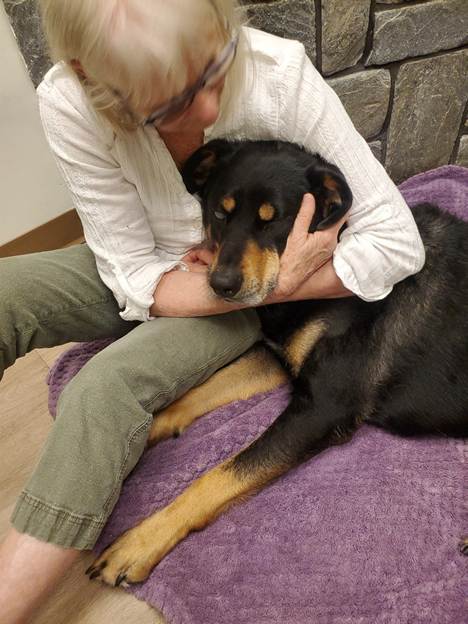
    Brodie in need of one last cuddle, Oct 08, 2020 – June 23, 2026

    Born for Love reminds parents, when your attachment is still insecure then

     … social punishments like a “Time-Out” [can be] less effective.  Being less loved – or having repeated early experience of loss … can also make loving itself harder and less satisfying.  Like an addict with a tolerance, it takes a higher “dose” to get the same effect…. neglected children or those with other attachment disruptions are much harder to soothe or to teach….[xi]

    Were we just plain lucky that one or two opportunities to explore a time out and a nod toward the chair led Yasik to cool it?

    I have come back time and again to this encouragement from Perry: “although early deprivation is damaging, the worst outcomes can be mitigated”. He is referring to monkeys here … but then he finishes with, “Fortunately, this is often true for humans as well.”[xii]

    Forming a family involves social dilemmas

    These first two weeks as a family came between the end of summer classes and the beginning of the fall semester; there was no opportunity to access my union’s allowed three days ‘parental leave’ for adopters.  It was time for school. 

    Luckily I guess, that particular year I had evening classes so the first days of September gave me a schedule that allowed me to be at home with Yasik in the morning.  Dave dropped some of his course load, taking only morning classes three days a week.  Yasik’s needs were directing his art education. I stuffed Yasik into his car seat and worked against afternoon homeward bound traffic to Emily Carr University, picking Dave up. He took the driver’s seat and headed further into Vancouver to my school after which Dave and Yasik caught the bus home while I taught.  Two weeks into the school year with this schedule and we furrowed our brows. Perhaps we ought to just see about a possible kindergarten for Yasik.

    We called the school to make an appointment, and Yasik was a new kindergarten student by the end of the day.

    The journal says “And childhood is over – the staff at the community school down the street urge starting kindergarten as best for him for socializing, school prep, and ESL (the kindergarten teacher spoke some Russian).  And he has been watching the kids at the park – we feel he is ready”.  We would be keeping our promise to the Russian judge for this was not (God forbid) abandoning him to day care.

    And what do the experts say about that: most say don’t rush into a wider social world. Keep your child close for enough time to build a secure sense of family. Might sending Yasik off to an institutional setting, even one as cozy as our little community school be heading right back into a peer-oriented, rather than family-oriented, environment?[xiii]  Some specifically adoption advice books were quite blunt: “As a new adoptive parent you should take time off from work after your child comes home… building trust is a process that cannot be rushed”.[xiv] Even in the face of “A social dilemma [which] already exists about the balance of career versus adequate time for infant attachment.  When older children are adopted, there is even less appreciation for the generous amount of time needed for parents and children to form attachment.[xv]

    For us specifically, the ‘social dilemma’ seems to have come down to bowing to the dollar over the hopes of the heart strings.  We had to find a way to pay off the adoption debt and the mortgage and Dave’s education, and the life we promised to provide this child, but we did also believe we would be meeting Yasik’s language needs and the social needs we understood a child of his chronological age needed.  And once again we were working with our lack of awareness of the emotional impact of his past.

    Adopting Older Children shrugs a bit “You also need to give yourself permission to not be a perfect person or a perfect parent.  Sometimes you will just be a “good enough’ parent and that’s okay”.[xvi]

    We chose to send him to kindergarten.

    Footnotes


    [i] Perry, Bruce D., MD, PhD, and Maia Szalavitz  The Boy Who Was Raised As A Dog: and other stories from a child psychiatrist’s notebook.  Basic Books, 2017, 90-91.

    [ii] Mercer, Jean   Understanding Attachmenty: parenting, child care, and emotional development   Praeger, 2006, 109-112

    Perry, Bruce D., MD, PhD, and Maia Szalavitz  The Boy Who Was Raised As A Dog: and other stories from a child psychiatrist’s notebook.  Basic Books, 2017, 229

    [iii] Neufeld, Gordon, PH.D. and Gabor Maté, M.D.  Hold On To Your Kids: why parents need to matter more than peers.  Vintage Canada, 2005, 65.

    [iv] Gray, Deborah D.  Attaching in Adoption: practical tools for today’s parents   Perspectives Press, Inc., 2002, 81-2, 24

    [v] Perry, Bruce D., MD, PhD, and Maia Szalavitz   The Boy Who Was Raised As A Dog: and other stories from a child psychiatrist’s notebook.  Basic Books, 2017, 52.

    [vi] Perry, Bruce D.. MD, PhD, and Maia Szalavitz   The Boy Who Was Raised As A Dog: and other stories from a child psychiatrist’s notebook.  Basic Books, 2017, 26

    [vii] Gray, Deborah D.  Attaching in Adoption: practical tools for today’s parents   Perspectives Press, Inc., 2002,73

    [viii] Mercer, Jean   Understanding Attachmenty: parenting, child care, and emotional development   Praeger, 2006, 119

    [ix] Bruce D. Perry, MD, PhD, and Maia Szalavitz   The Boy Who Was Raised As A Dog: and other stories from a child psychiatrist’s notebook.  Basic Books, 2017, 152, 153.

    Gray, Deborah D.  Attaching in Adoption: practical tools for today’s parents   Perspectives Press, Inc., 2002, 275

    [x] Gray, Deborah D.  Attaching in Adoption: practical tools for today’s parents   Perspectives Press, Inc., 2002, 231

    [xi] Szallavitz, Maia, Bruce D. Pery, M.D., Ph.D.  Born For Love: why empathy is essential- and endangered   William Morrow, 2010, 135

    Tantrum, Barbara Cummins. The Adoptive Parent’s Handbook: a guide to healing trauma and thriving with your foster or adopted child. North Atlantic Books, 2020, 78

    [xii] Szallavitz, Maia, Bruce D. Pery, M.D., Ph.D.  Born For Love: why empathy is essential- and endangered   William Morrow, 2010, 56

    [xiii] Neufeld, Gordon, PH.D. and Gabor Maté, M.D.  Hold On To Your Kids: why parents need to matter more than peers.  Vintage Canada, 2005, 33, 65.

    [xiv] Bosco-Ruggiero, Stephanie, MA, Gloria Russo Wassell, MS, LMHC, and Victor Groza, PhD Adopting Older Children: a practical guide to adopting and parenting children over age four  New Horizon Press, 2014, 67

    [xv] Gray, Deborah D.  Attaching in Adoption: practical tools for today’s parents   Perspectives Press, Inc., 2002,22

    [xvi] Bosco-Ruggiero, Stephanie, MA, Gloria Russo Wassell, MS, LMHC, and Victor Groza, PhD Adopting Older Children: a practical guide to adopting and parenting children over age four  New Horizon Press, 2014, 222

  • Émigré to Immigrant

    Checklist: get landed

    Taking Yasik through immigration, Dave was asked, “Is your wife landed?”  Dave assured him, “Yes, yes, she is just over there, waiting by the luggage”.  The customs officer tried again, “No, is she landed?” And Dave proudly repeated, “Yes, we both went to get our son and she is waiting by the window.”  Did the officer’s training finally kick in?  He clarified, “No. Is she a citizen?”

    davevincent.com

    And we were back in Canada.  My parents, brother and his family, sister and her husband were there to pick us up and hustle our son into his new family, taking pictures, hugging and talking.  We felt so full at this moment, with love, family, satisfying occupations and interests, sufficient money coming in to keep the roof over our head and the bills paid.  We drove home to find my sister, Barb, had streamers, balloons, welcome signs, new toys, clothes, a car seat, and a big meal ready….  Book after expert advice book on adoption cautions against overstimulating a new adoptee with people, parties and presents, just so you know.

    After eating, we gave the wrapped toys to Yasik to open.  He picked up a gift but the wrapping stumped him.  Goggle told me only recently that generally Russian gift giving etiquette says that cheaper gifts are not expected to be wrapped in paper, only expensive ones. It is safe to say that any gift he may have received up to that point came unwrapped.

    For most of my twenties and thirties I lived in other cultures.  At work I often talked with our foreign-born students about their experiences and the impact of culture shock on their hearts, minds and bodies.  Nor was I personally a stranger to culture shock.  Yet it did not occur to me or any of the other adults in the room, half of whom had dealt with as much culture shock as I, that Yasik, now in Canada for roughly three hours might be dealing with this phenomenon as well. It was merely cute that he needed his 3-year-old cousin, Kyle, to show him what to do with gift wrapping. Were Dave and I given any heads up about an international adoptee’s perspective on a new culture?  Not likely as our adoption prep seminars focused on adopting locally.  And remember, we had little time to prepare for an international adoption.  Does that hold up as an excuse?  Adopters today appear to have much more information to prepare them.   Try a quick Google search for sites dealing with international adoptees and culture shock. You will find advice giving adoption sites and journals providing research of the issue.

    Happily in this case, a little culture shock didn’t slow Yasik. He studiously set about practicing the gift unwrapping lesson Kyle offered. Any diffidence at being the center of attention in an unfamiliar social setting disappeared. The little gift-wrapping hiccup turned out so positively for him, he moved on to giving his new Aunt Rena Russian language lessons, laughing at her pronunciation.  Some of our family’s first observations were that the orphanage must have taught him manners for he was polite.

    After the meal as everyone prepared to leave, Dave scooped Yasik up, thinking he might have fun helping Dave move our vehicle out of the way.  Yasik burst into tears.  Given the lack of sleep and jet lag it shouldn’t have been a surprise but I noted the outburst in the journal because the tears stopped as soon as Dave returned from the driveway.  This was one party he did not want to leave. Or could we dare to imagine it was an attachment hook we could hang hopes on?

    My mom and dad gave Yasik a teddy bear almost as big as him.  Dave found him at 4:30 a.m. the next morning hugging and talking away to it.  Studies in Attachment began early in the twentieth century.  Dr. Rene Spitz a psychoanalyst studying hospitalized infants

    [observed that] these babies [abandoned infants who received little individual attention in group care] developed odd reactions to strangers, .… the usual behaviour was replaced by something that could vary from extreme friendliness to any human partner combined with anxious avoidance of inanimate objects to a generalized anxiety expressed in blood-curdling screams which could go on indefinitely”[i].

    But he liked his teddy….

    Checklist: look for kid fun, visit the dentist, visit the doctor

    Having only a few days left of ‘parental leave’, we tucked in some family picnics and we slipped quickly into what most families in our neighbourhood seemed to do; we took him to the playground.  Other than a bit of experimenting with a play water pump on the periphery, he simply stood to the side holding our hands, watching other kids playing.  Getting him to actively engage took commandeering Kyle and climbing ourselves up the no-thrills slide the length of our own bodies.

    We tucked in some introductions to our friends as well in those first days. As the first post-adoption report notes, initially Yasik “appeared reluctant to let [his parents] out of his sight“. Yet Yasik was quickly overcoming shyness around others.  One relationship that particularly warmed our hearts was with Tony who himself was raised in Canada’s early adoption and foster system, one that was very difficult for him (SeeA Canadian Story of Adoption in the 1930s, Becoming Family). Tony showed Yasik his bee hives and he went home with a jar of fresh honey.

    The honey bit is not a segue way into a dentist visit. Yasik’s first dental appointment was on the checklist regardless. He seemed to take lying in the dental chair in stride but he looked to me so defenseless that I found the experience more emotional than I had expected.  He did not have the language needed to understand what was happening or to express his thoughts about what was happening.  Heart strings were pulled and then snapped back a bit.

    It was also actually imperative to introduce Yasik to our family doctor. The Hague Convention requires countries, of which Russia is one, to provide a translated medical report but adoption handbooks warn that this could be incomplete or possibly even inaccurate[ii].   Our pre-adoption medical report listed convergent strabismus (glasses were needed), adenoids enlarged (left to re-adjust on their own), dermatitis (never noticed it), speech delay (normal), short for age.  His motor skills were in line with his age as were his eating and sleeping habits.

    Our doctor agreed that other than being small for his age, a common side effect of orphanage life, he was quite healthy.  It was the doctor’s opinion that he may have built up a strong immunity by more exposure to bacteria and whatever else did not have to battle Purell.  And that seemed a good conclusion for he was never sick with any of the childhood plagues other children battled each year.  

    Odd, isn’t it?  Impervious to bacteria yet not getting enough nourishment to meet standard growth charts.  And it isn’t merely a matter of a lack of veggies and salmon as the experiment conducted by the German king, Frederick II, demonstrated in the 13th century.  His curiosity about the development of language led to his forbidding care-givers in an orphanage to speak to or hold the infants in their care.  The babies all died. Updating from the 13th century, here is a rather unequivocal research statement from the Psychology In Russia journal: The research literature suggests that institutions for children left without parental care do not provide environments that adequately promote children’s development, and that characteristics of orphanages should be considered as an environmental factor influencing developmental difficulties in children living in institutions and later in post-institutional families.[iii] Institutionalized children come into their adoptive families often pre-packaged with deficits biological, psychological and social. What was that doing to our son’s young heart, mind and body?

    Born for Love gives Chapter Three[iv] to an examination of the repercussions of early life in an orphanage.  The focus in this chapter is a girl adopted from a Russian orphanage but some of the research behind her story is taken from studies of Romanian children who spent their early years in orphanages during the time and under the experiments of President Nicolae and Deputy Prime Minister Elena Ceausescu. Not to sound like a snob but the deputy prime minister came equipped for this research with an elementary education and likely a doctorate obtained with the help of a professor. One of the charges for which they were ‘summarily executed’ as the saying goes, was the claim of their ‘research’ “that children will develop just fine without individualized attention and affection”.

    The 25-year study at SFU on the Romanian orphans meets the appropriate definition of research. A paper which came out of this study under a heading titled “Physical Growth”[v] says:

    While the malnutrition of institutionalized children contributes to their growth deficiency, another contributing factor may be the poor quality of interaction and stimulation offered by the low caretaker-to-child ratio in these institutions.  This type of growth deficit, known as psycho-social dwarfism [now referred to as psycho-social short stature], can be very serious.  However, upon removal from stressful or neglectful conditions, children suffering from psycho-social dwarfism tend to make tremendous gains in both height and weight….

    Contrary to Deputy Prime Minister Elena Ceausescu’s ‘research’ findings, this article and others in this search make the point that lack of nurture in infancy and early childhood compromise physical growth. 

    Quoting Little Britain’s Vicky Pollard’s “Yeah but, No but…”[vi], it’s nice to be able to rebut that this can be mitigated once a child is placed in nurturing care.  At our first post–adoption interview it was noted that Yasik “appears to need much cuddling” but that over the course of the three years of post-adoption interviews he went from 39.5 inches to 47 inches.  Okay, so still not the class giraffe but also not the only one in the front row of the class photo.

    Checklist: Forget the past?

    We don’t know how much Yasik understood of his situation as a ‘social orphan’, for about those years, Yasik continues to say he remembers nothing or next to nothing before the jet ride to Canada. Did stress or even trauma from the first four years shrink his hippocampus, or put him in a dissociative state in order to cope with the lack of consistent nurture?[vii]  Yasik had definitely experienced physical and emotional neglect, likely physical and emotional abuse, and had definitely been exposed to domestic violence and household substance abuse.  See Orphanage Risk Factors for more on this issue.

    Is it not possible to think that becoming a member of a family in a strange new world has added a further level of stress, however delightful the stress, to a young and still developing mind.  The stress of transition to an entirely new life, now heaped on top of separation from first caregivers and accustomed living conditions, abusive or otherwise, may stymie memory.  And then again, a young brain still developing, may not have retained these memories.[viii] 

    Two strangers are what he perhaps came to understand he was to hope for.  I have read here and there that for children in institutional care, the hope of having parents is the Holy Grail. How is a Holy Grail imagined to a 4- or 5-year-old?

    All of these strangers’ attention is solely on him and any desire he manages to communicate, but everything is new and mostly impossible to explain when these two strangers have neither language or culture awareness to reach out to him.  Attaching in Adoption cautions: “The comfort and competence that children feel in their own culture is lost as they enter a new surrounding”[ix].

    Checklist: start the re-education program

    Those shoes Yasik wanted to put on the moment he awoke in Moscow. We bought him new runners and tried to make the shoes disappear for they were already cramping his toes.  That evening we got the shoes off him and set them by the door. He wailed.  He seemed to have the idea that taking off his shoes meant bed time, probably an orphanage routine. The wailing stopped when no one headed him off to bed. Taking his shoes off at the door like a good Canadian became a new routine he comfortably settled into.  Like a proud mother, I also note in the journal that he was happy to help with household chores.  And like a proud mother who believed in education I have noted that in those first few days we taught him A and B.

    Yasik had now moved from émigré to immigrant in less than a week.  He had moved from an orphanage setting to a residential home, no one but him in a large bedroom.  Routines had been dismantled and recreated; cultural changes had been made with absolutely no orientation; no one spoke the only language he knew other than about 10 words to cover the necessities of life; he was interacting with two strangers whom he had been told are his mama and poppa; little of the food was familiar other than macaroni and sausages, and what about jet lag? All this newness at every hand and he was handling it entirely alone.

    Footnotes


    [i] Mercer, Jean.  Understanding Attachment: parenting, child care, and emotional development.  Praeger, 2006, 33-34.

    [ii] Bosco-Ruggiero, Stephanie, MA, Gloria Russo Wassell, MS, LMHC, and Victor Groza, PhD.  Adopting Older Children: a practical guide to adopting and parenting children over age four. New Horizon Press, 2014, 162.

    [iii] Structural characteristics of the institutional environment for young children. Developmental Psychology, Volume #9, 2016

    [iv] Szalavitz, Maia, and Bruce D. Perry, M.D., Ph.D.  Born for Love: why empathy is essential and endangered. William Morrow, 2010, 53.

    [v] Le Mare, Lucy, PhD, Karyn Audet MA

    A longitudinal study of the physical growth and health of postinstitutionalized Romanian adoptees

    file:///C:/Users/jacka/Downloads/A_longitudinal_study_of_the_physical_growth_and_he.pdf,

    ‘Psycho Social Dwarfism’ https://pubmed.ncbi.nlm.nih.gov/6741153/ 

    [vi] BBC production, Little Britain

    [vii] Perry, Bruce D. MD, PhD and Maia Szalavitz   The Boy Who Was Raised As A Dog: and other stories from a child psychiatrist’s notebook   Basic Books, 2017, 49-50

    Szalavitz, Maia, and Bruce D. Perry, M.D., Ph.D.  Born for Love: why empathy is essential and endangered. William Morrow, 2010, 255

    [viii] https://www.healthline.com/health/why-cant-i-remember-my-childhood

    [ix] Gray, Deborah D.  Attaching in Adoption: practical tools for today’s parents   Perspectives Press, Inc., 2002, 149

  • Introductions

    And then it was time to take one last trip through Moscow in the middle of the night, arriving at the airport when a full moon was filling the waiting room. 

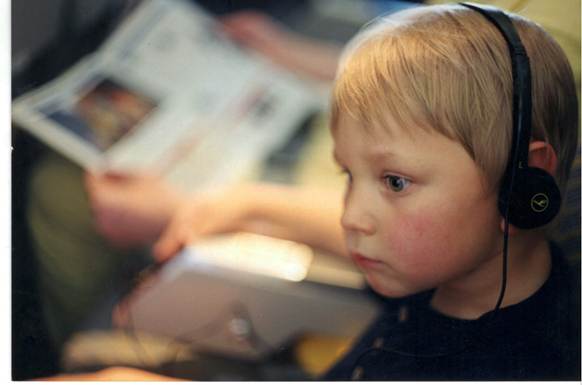
    The airplane offered even more technical curiosities for Yasik.  We caught the wonder of earphones in the picture included here.

    While waiting in Frankfurt for our next leg of the trip, we met an American couple who had just adopted two kids and a woman who came across as a self–appointed authority on orphanages.  She was part of a church mission to help orphanages by setting up children’s camps.  At that time Russia was quite open to foreign help, religious or otherwise.

    One last leg of the flight and we were back home in Canada. Well, two of the members of this new nuclear family were returning home.  The third member was only about to be introduced to a new home.

    Yasik

    So let me jump off that word ‘introduce’ and take a moment to do just that. I have shared fairly liberally what we knew/came to know over time of Yasik’s background. I will round out what has been shared with some of the physical data of the child Dave carried off the airplane: Yasik was 35 inches tall and weighed 35 pounds, roughly the weight of our one-year-old niece and shorter than our three-year-old nephew.  He had convergent strabismus in his left eye.  He had soft, very light blond hair, a perfect nose and a tad over blown ears.  His eyes remain hazel brown even though his passport has them marked down as green.  Like I said, he was beautiful.

    And the other two in this family?  As I have exposed Yasik, it is only democratic to provide a basic sketch of Dave and me.  Dave first.

    Dave

    At the time of our adoption, Dave was 40, five foot 11 inches, not overweight but not skinny either as he had given up smoking the year before.  Our adoption home study says he has “blue eyes and glasses, balding short reddish blond hair”. 

    He was born in Calgary, Alberta to a couple whose marriage barely made it past his birth, their second child together.  At the time of the home study, we understood his mother’s heritage was Metis and his father was of Scottish heritage.  He remained with his mother who moved on to various uncles, two more marriages and 3 more children, half siblings to Dave and his brother.  His relationship with his biological father was not much more than a single letter.  The first step-father was simply criminally abusive.  The second step-father, who legally adopted Dave and his siblings, was anyone’s definition of a dedicated, working-class father, although it is possible to say that a man Dave met later in life offered the kind of mentoring that qualified as the most impactful fathering of all.  His mother, coming into a loaded adulthood poorly prepared, was, at times, supportive and, at times, unable or unwilling to be the mother she needed to be.

    In his late teens Dave sustained a serious car accident which left him with visible facial scars and two years of intensive rehabilitation mentally, emotionally and physically, but as he healed, he was imbued with a strong desire to get back into life. He went on to train in welding and motorcycle technology even while still paying for the impact of his childhood and accident by going into a marriage ill-prepared and rather quickly abandoned.  He also had many years training and working with challenged people which is where we met.

    For a year or so we were little more than passing acquaintances. One fine morning he came to the group home to pick up a client for a day program. I was finishing up a night shift before heading off to the school where I taught. In greeting, I mentioned I was soon leaving the group home.  He came back with an offer of a ‘farewell’ coffee on a Friday evening; we went for a drive that led to some house hunting, marriage, and moving into a house together a little over 3 months later.  And whew …., this usually ill-advised route to marriage worked for us.  A year after we married, Dave was accepted into Emily Carr University of Art and Design (ECUAD); he was going to school full time, working a weekend shift with a challenged client and practicing his interests in art and motorcycles in his spare time at home.

    He was about to start the second year of study and part-time employment when we flew off to Russia.

    Gail

    And me?  In preparation to writing this post, I wrote some preliminary notes and went off on a rampage about the religious world I was born into.  I will spare the reader.  In August 1997 I was 47, 5 foot, 6 inches tall and respectable weight-wise.  Our adoption study says I had, “long brown hair with bangs, green eyes”. 

    I was born in Chilliwack, BC, to a couple who remained married their entire lives but were not well-equipped to maintain a healthy marriage.  Both my parents had a few generations to deepen their Canadian roots but as was common in the 50s held on to their origins: mother’s family were British and Scottish; Dad’s family were German and Polish.  Guess which one in post-war Canada was a source of pride and which one was best whispered? 

    Both came from families somewhere between fundamentalist and evangelical Protestantism.  Whenever a question arose about what choice to make about most things from daily activities to finances to things more global, the tilt was toward the fundamentalist explanation of God’s truth.  Was bowling a sin? Most definitely, until, of course, someone thought it was possible to skirt around the sinful dangers. 

    But we were a family and each of us, myself, my brother and two sisters, knew that our parents loved us and wanted us to be happy.  Maybe they were too unsophisticated to be able to guide us toward to a conventionally successful future, but they would have resisted little of our inclinations, other than what was ‘evidently’ evil.  Mini skirts made Dad squirm; drugs freaked him out. 

    I use the plural for this part of my life because we siblings were each a year apart.  We all finished high school more or less and moved on to likely Canada’s largest fundamentalist Bible School.  We each graduated and went into missionary service.  I was in Northern Canada with my youngest sister and then we two joined my brother and other sister in the Philippines.  

    In what can only be considered ironic, it was getting up close and personal with the human beings we were attempting to rescue from the grasp of hell, that shook my understanding of such a mission. These were good people I could no longer see a loving God condemn to hell. Even if I worried that God was holding a flaming lightning bolt over me, I had had enough. 

    I returned to Canada and enrolled in Simon Fraser University along with my brother and one sister.  We each found jobs caring for the challenged and settled into completing our studies until two years before Dave and I married.  In those two years, although I continued working in a group home, I also began teaching in adult education in Vancouver.  I lucked out, finding a career I had only dreamed of in the days when I was certain God would not hear of me leaving what I had believed He considered the highest calling.

    I was about to return to a full-time position as a high school English teacher when we flew off to Russia.

    Ahhh ….. and a Canadian government site for prospective adopters offers a summary of the average adopters: over 30, generally financially stable and with no parenting experience.  Sounds like we were pretty normal and ready to go.

    But maybe the African proverb “Tell me who you love and I’ll tell you who you are” is enough info.

  • Parents?  Yet Tourists?

    Morphing into Parents

    Unsurprising I suppose. Leaving Yaroslavl for Moscow, Yasik’s maiden voyage in his new family, he sat quietly in Dave’s arms at first. I sat quietly as well but Dave knew where my quiet was coming from. He bent to my ear to encourage me not to be shy while he and Yasik played это и то — This and That.  Must have seemed odd to the two in front that I was holding back. I did not yet quite know how to open the door to motherhood.

    I may not have been the first uncertain parent the orphanage staff had ushered into parenting for a large number of we adopters are parents who have yet to actually parent. Likely aware of this, the staff sent Dave and I off with a warning against feeding Yasik while driving for he would vomit.  No fear on that score. It had yet to occur to me that food should always be on the list of standby items for a kid. The driver, Alexi who may have been a father, and the translator, Tatiana, must have brushed off the no food warning for before the trip was over, they had given him 3 bananas and a candy. Tatiana later played a hand slapping game with him and he warmed, losing his shyness, and surprising us by laughing out loud, talking and teasing. In a bit, we were too. 

    Quickly we moved to overly rambunctious. Soon Yasik lost enough shyness to playfully hit me. Oh God, barely an hour into parenting and we’d lost control of our child.  Added to that, at one point on the trip, Alexi stopped for a cigarette break and Yasik needed to pee.  With Dave’s help.  Pants pulled up, we climbed back into the van and Yasik yelled to the driver to get going again.  The driver shrugged, laughed and returned to the van and off we went again. Dave’s shoulders refused to shrug. He worried that in mere hours we were undoing all the orphanage niceness and order. But hey, Yasik never settled to sleep and we were learning more Russian than we planned – don’t get excited, we are talking more than 2 or 3 words.

    The drive back to Moscow, as return trips often seem to do, passed much more quickly, pulling out all the sweet memory stops: a beautiful prairie sunset and a harvest moon. We got back to the apartment and Yasik ate only an apple and had some water, all the while talking and poking around, exploring the little apartment.  We showered him, got him pee-ed and into bed in a room adjacent to ours after covering the bed sheet with a ripped-open plastic bag. Parenting instincts were perhaps kicking in.

    We read to him but that was pointless for every few minutes Dave was flipping through the dictionary for words we couldn’t figure out how to pronounce right anyway.  Yasik just looked at us.  The barrier was bigger than we thought I wrote in the journal.

    I gave him a flashlight with low batteries.  It began to waver so Dave put a new battery in and Yasik was off and playing shadow animals and faces and NOT slowing down.  He said something to Dave and Dave said, “Nyet”.  We left. Moments later we thought we heard him cry and both leapt up.  He had us on a marionette string. I went through the living room and into his room to turn the flashlight off and only succeeded in showing him how to turn it on, which he did. So what do you do? Rather than going all strict parent, I started laughing and had to duck out. Later we pulled it together into parent mode, going back onto the battlefield to turn the flashlight off. I stayed and held his hand. When I checked on him in the middle of the night, he appeared to sleep well. 

    6:30 am and Dave couldn’t wait so brought him in with us.

    Dave’s expression of waking to our first day with our son:

    And I knew that we were not alone

    when I put my arms around your waist

    My heart, I felt would burst

    As we kissed

    In that cold room in Moscow

    I felt we were more than two

    And as the tears fall now

    Running down my face

    I hear his voice

    and I can feel your

    Body so close to mine

    In that cold room in Moscow

    And I love you.

    We had breakfast only after he got his shoes on, with his PJs.  Was he, as John Brooks suggests in The Girl Behind the Door, our new pet?[i]  Maybe.  Surely there is some of that for every parent, biological or adoptive, in the honeymoon period. So why not enjoy the happy surprises that come with this new venture?  I say that because those days were a honeymoon for us. I also recognize that Brooks is making the point that in doing so we may have been detrimentally oblivious to other, less obvious, needs our child had. Brooks goes on to say that later on their first night with their baby, they wanted to sleep so parked the infant in front of a TV, likely was not her orphanage night time routine.  They might have more deeply met their child’s needs by simply holding her until she fell asleep.

    It also strikes me here how much I mention Yasik talking when later we will deal with questions of the use of language for communication.

    Stereotypical tourists too

    We spent the days waiting for the adoption process to be completed mostly playing tourist.  On the Metro, people gave up their seats to me and even to Dave when he was holding Yasik.  One woman gave Yasik a 2-inch-long chocolate and he popped the whole thing in his mouth.  She thought that was fine and went on to tell us that she had 7 children.

    On our first full day as parents, we visited both of the largest art galleries – the Tretyakov and the Pushkin- and were quite simply blown away.  The Pushkin had 5 soul-satisfying Van Goghs. 

    All of this demanded over 4 hours of walking with a 4-and-a-half-year-old boy who had known us only a day or two.  The paintings didn’t do much for him but the big pieces of sculpture caught his attention, and being 4 1/2, he managed to put us in apology mode with security more than once.  Next stop: MacDonald’s, where probably for the first (and last) time, Yasik was more interested in feeding the chips to the pigeons than tasting the wonders of a kid’s pack himself.  And this will sound obviously naive, but Yasik took us by surprise with his speed at darting away from us to chase a pigeon and try, like Dave, to get them to feed out of his hand.  We quickly began to tighten our grip on his tiny hand. 

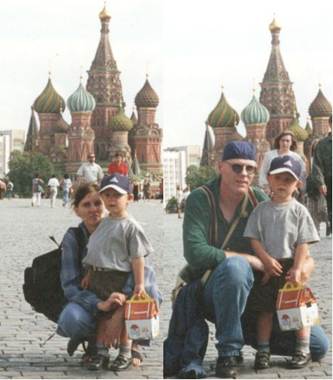
    True to tourist protocol, we ended this fairly long day with Red Square pictures.  When we returned to the apartment Yasik conked out and slept about 12 hours though to this point the only solid meal he had was at breakfast.

    In true tourist fashion we blitzed a market for matryoshka dolls and naively drank water our bodies had not prepared for.  Once home Dave and I broke out in boils. Yasik’s body was well seasoned.

    We also managed some cultural blunders. Dave offered to tip a waitress one breakfast. The waitress pulled back as quickly as someone confronting a rattle snake. Our guides immediately stepped in and ushered us out of the cafeteria, but offered no explanation. Larissa, the landlady, was inundating us with food at the apartment.  When we couldn’t eat it all (the bread was amazing) I threw it down the toilet, the only way no one would know we didn’t eat it because the garbage would be gone through, likely causing a situation unsettling for the landlady.  We are just lucky we didn’t plug the old toilet. Not wanting to offend can lead to questionable actions. Larissa did see some food in the garbage one day and left a note asking us to let her know if it was too much.  Turns out the simple solution for our culture would have also worked in her culture.  So, we did tell her and that was the end of the wonderful bread.

    Completing Documentation

    We were picked up early the following day by the driver, Alexis, Tatiana, the facilitator and a new translator, Anna.  Anna was young, well-educated and full of hope for the future of Russia.  She had moved from Yaroslavl for the prospects Moscow offered, to become what they referred to at the time as the ‘new Russians’. She was a sharp contrast to the translator who helped us in Yaroslavl, someone with the same education, yet who wanted to emigrate, seeing little hope for a better future in Russia.

    We were taken to the Canadian embassy for Yasik’s visa.  Here because of whatever contacts or methods Tatiana had at her disposal, she and Dave moved directly to the front of the line in a crowded office.  It reminded me of other times I have experienced preferential treatment as a foreigner.  Yet, tidily enough, it yielded another stamp of certainty that Yasik was now our son.

    Establishing Parental Roles

    About two days in we could already see or were groomed by our own upbringings to see that either Yasik had led us or we had led Yasik to assign us roles.  Very quickly Yasik took ‘Nyet’ well from Dave and played with him; he cuddled up to me.  I wrote in the journal two days into our family experience, “So I’ll nurture, Dave will lead – whether we want to argue roles or not or try to bend the roles or whatever – they are still there; by instinct he or we have placed us so his life is complete and secure”.  Yes, it is not a Duggar family message of a wife with Nancy Reagan’s smile pasted on her face and obedient, modestly dressed children under the stern but wise and responsible husband’s umbrella, but for traditional or psychological makeup, cultural, societal, whatever, it is what it is.

    Looming Threats?

    Bouncing, giggling, chattering in Russian and making sure he had those shoes on, Yasik started each of these days.  One of those last days in Moscow, in the midst of these happy little family moments, Larissa came over for the rent, bearing gifts of food and a book of Pushkin for Yasik.  While we settled the payment, she talked with Yasik in Russian. Yasik, who moments before had been giggling, broke into fairly hysterical sobs. We were shocked for a moment and then I picked him up and took him into the bedroom.  He continued to cry for quite a while, hanging on to me.  He quieted and said, “Poppa”, so I took him to where Dave was giving the rent money to the landlady.  She talked to him again, and again he started to cry.  Dave took him and I ushered the landlady out.  Had she suggested to him that as an adoptee he was a lucky little fellow who better not screw up for then he would be sent back to the orphanage, losing his mama and poppa?

    When I joined Dave and Yasik in the bedroom again, Yasik began to quiet, though we too were by now emotionally swamped.  To divert him, we walked to a nearby park.  Yasik didn’t try the swings but then I don’t remember seeing a playground at the orphanage so perhaps he was not about to attempt the unfamiliar.  Instead, he chased the birds and when some Russian kids approached, he and Dave played ball with them and flew the paper airplanes we had brought.  We left the planes with the kids and they responded with a polite thank you.  When Yasik piped up with ‘Ka Kas’ we took off for the apartment. 

    The landlady stopped by once more with an art book and candies and this time Yasik warmed to her but we never received an explanation for the outburst.  We were only left with an awareness that for Yasik this was a much more emotional time than we had comprehended.

    Yasik also managed to give us a further scare one afternoon by hanging over the little balcony before we caught him.  That night my body tightened with the memory of a time a child in my care was almost blown off the roof of an old church in the Philippines.   Dave, too, already asleep, began to twitch and heave short, panicky breathing.  He’d had a night mare of falling while trying to catch Yasik who was about to fall.  We were rushing head long into parental fears.

    One or two more days playing tourist, and though we didn’t realize at the time, enjoying the larger portion of our maternal/parental leave, we were coming to know our son as bouncy and curious about everything that had a switch or button or handle.  Turning on light switches remained a fascination for several days. 

    As we packed to return to Canada, we were surprised to find a couple of Yasik’s new toys missing, none which had been taken out of the apartment.  We found the toys stuffed behind the old piano in the living room.  This was our introduction to what I have since read over and over again as a side effect of orphanage living, the habit of hoarding or simply claiming something and knowing the only way to hold on to it would be to hide it from the other kids. Here’s an odd bit on the problem with ‘hoarding’: a Scottish contestant on America’s Got Talent [ii] gave a performance as a ‘regurgitation artist’.  He had learned to swallow things to hide them from other kids at the orphanage. Apparently it has led him to a “busy touring schedule” Wikipedia says. Still, to be fair, I wonder if there are any set of siblings, bio or adopted, who don’t try some level of hoarding with toys not clearly designated.

    Footnotes


    [i] Brooks, John   The Girl Behind the Door: a father’s quest to understand his daughter’s suicide   Scribner, 2016, 182, 183

    [ii] ‘Regurgitation artist’ America’s Got Talent   June 2, 2015

  • Court Proceedings

    Of course, fireworks were exploding. Just not in celebration of a birthing bathed in mothering hormones.  It was becoming a family by adoption, exploding with happiness hormones.   

    I end Bonding/Attachment suggesting that while writers I have read may use the words ‘bonding’ and ‘attachment’ somewhat interchangeably, I may as well stick with the one that sounds like a boat anchor rather than fireworks and happiness. Clunky or not, ‘attachment’ is the broad term that covers becoming a family whether via a birthing or by adoption. And both modes of becoming family can be celebrations. Bits of twigs, moss, plant fluff, lichen and spider silk caught and carried by a little hummingbird to build a nest must be a joy to find.  Children no longer in the care of biological parents may be a joy to find for adopters’ nest building.

    Ok, Attachment it is

    Attachment as a concept is most often associated with John Bowlby.  His findings focus on a “child’s tendency ‘to seek proximity to and contact with a specific figure’ when afraid, sick, or tired….”[i] an inborn desire to seek closeness to protective adults.  That takes care of what the child sees attachment to be.

    And adults? What does the term mean for them?   “’More broadly speaking, attachment may be defined as ‘lasting psychological connectedness between human beings’”.  Jean Mercer settles on defining attachment as “emotional ties” and “beliefs and ways of thinking about relationships” to form an “internal working model of emotion and social relationships[ii].

    We had signed a file full of documents and in less than 24 hours would stand before a judge and upon the drop of her gavel, we would be a family.  Yasik had been told after we left that first afternoon that he now had a mama and papa.  What meaning did he attach to those words?

    That evening he gave away the toys we brought for him. In celebration or because he had been nurtured in the orphanage setting to share? Had Yasik already been learning empathic social relationships in a place not usually known to encourage healthy social relationships?  Was the orphanage actually a caring, vibrant social network, a good environment for the nurturing of empathy and attachment?[iii]

    Attachment: preparation

    After that sweet little smile through the banister, we returned to the hotel to have supper with Alexi, the driver, Tanya the facilitator and the translator, Elvira, realizing that while they were shy about speaking English and therefore appeared to ignore us, they were actually very kind, thoughtful and helpful. Putting all the parts of completing an adoption: the paperwork, arranging our flights, housing and Moscow interpreters, as well as organizing the court appearance, made one adoption a large operation.

    At the meal Elvira gave us a heads up that Dave would be expected to give a little speech about how we felt about this opportunity to adopt Yasik and to request that our paper work be expedited.   We also learned we would likely be in Moscow longer than we had initially understood to complete Yasik’s paper work. More time to play tourist and shed dollars, but perhaps also to help ease Yasik into family. 

    Attachment: appearance and interests

    The three sharing this meal with us also noted that Yasik looked a fair bit like Dave and shared his interests in vehicles, music and art. Nice.  I was later assured Yasik had eyes the same colour as mine.  It is worth wondering about: this interest we have in family looking like us or fitting the proverbial ‘like father, like son’. I have wondered about the need to find resemblance to family as a kind of reassurance of our personal identity.  Yet it took only a picture emailed to us of Yasik’s biological siblings to determine they were indeed his siblings.  For those who do not share similarities with their adoptive families this is often a primary issue in their search for personal identity. “As Swedish as Anybody Else’ or ‘Swedish, but Also Something Else’?”  speaks to this issue for the non-causasian adoptee, nicely encapsulated in the title.[iv]

    Attachment: the honeymoon begins

    After a stroll alongside the Volga, we went to bed.  Well, actually after Dave prepared what he understood he was expected to say in court.  That done, we flopped onto our separate single beds, maybe a bit high and free to daydream. Yasik was almost ours and he was more than we had hoped for.  The journal also notes that we each took a Sudafed tablet.  Did the Sudafed stimulate that daydreamy feeling?  Or was this a peek at what the early days of attachment/honeymoon period feels like?  A kind of falling in love.

    Attachment: the legalities

    Adoption day was a beautiful early fall day, August 19, 1997.  We were driven directly to the court for the region of Yaroslavl.  The marble steps up to the court were worn to uneven dips.  A very old building. Dave was still muttering the phrases he needed to say; Elvira, the translator, was building up to a nervousness I wondered at but did not understand.  This may have been a building that spoke power to Elvira but it lacked the power to gain a fearful respect from naïve tourists.  We would more likely have picked up Elvira’s vibe had it been a Canadian court.  A traffic jam had delayed proceedings, the prosecutor looked bored, most in the room were women. When the judge was heralded and appeared, she was hardly more substantial than the wizard of Oz behind the curtain. Still… she managed to feed Elvira’s fears and spook Dave and I somewhat when Elvira relayed to us that the she had been admonished to tell the truth or be prosecuted.

    Dave was called first.  He was asked how long we had been married, what our jobs were, after which he recited his memorized speech to request an early dispatch of paperwork.  The judge smiled at his earnest tension.  I stood next to give my name and affirm I was a Canadian.  I sat back down and Dave was asked to rise again.  “If you both work,” the judge asked, “how do you plan to care for Yasik?”  Dave told her we had a plan to reorganize his classes and that between our schedules, Yasik would never be left alone.  And other than one afternoon when we left him at the after-school care which did not please him, he was always with one or the other of us, or with extended family or friends.  Although I am sure the question is part of the suggested adoption interview questions, there is a bit of irony in this young judge’s question.  It was being asked by someone whose cultural attitude to adoption leans toward dropping off children at an orphanage while parents deal with other life stresses, a trend particularly encouraged in the Soviet period.

    Dave sat down and I was asked to pop up again. The judge asked what we thought of Yasik. I choked and only managed to respond with “Wonderful”. Elvira misted over and Dave caught a smile on the judge’s face. There may be vitriol at the highest political levels over adoptions but person to person, however much suspicion has been whispered in our ears, we found Russian people are as human as any Canadian — a little ‘duh’ here. Too often, unquestioningly we do drink the Kool-Aid because somewhere in our psyche we have the impression that Russians are not too be trusted nor respected as we might our own good people, something to be further tested by current political tensions.

    The judge turned from us, giving the floor to the prosecution and defense who each offered their conclusion that all appeared in order to them. Writing this now I wonder who procured the defense. I remember no discussion about the need for a lawyer, again a nod to the detail involved in a single adoption. The judge rose just as he or she would do in a Canadian court, telling all that she would consider her decision and left for a few minutes. My journal says that Tanya was passing out chocolates and flowers while we waited on the judge’s deliberations. The judge returned and declared that we were Yasik’s parents. The first seal on our adoption. Tanya and Elvira hugged and kissed us, wishing us “Good Luck”.

    Attachment: assumes some detachments

    There were still details, details, details.  One detail that was given absolutely no thought by either Dave or I in our naïve happiness concerned the question of the legal status of parental rights belonging to Yasik’s bio parents.  No one denied that Yasik’s bio parents were still among the living.   Yasik was in the orphanage under the designation ‘social orphan’, someone who has at least one living bio parent.  Had his bio parents actually given up their rights as I wonder in The Adoption Procedure in 90s Russia?

    We were told, at the time, that Yasik’s mom didn’t come back to the hospital after a visit or two so the government took over guardianship.  For many years I tried to assure Yasik that her visits suggested she did care for him and placed him in government care because it was best for him, a narrative that works for adopters.  In his teens, Yasik he let me know he didn’t buy that story.  Only after connecting with Yasik’s bio sister in 2020 did we learn that Yasik’s bio mother, Gurina, went to the hospital to try to get social services money for Yasik which she was denied so she quit on him. 

    August 19, 1997 we only knew that Gurina ‘moved around a lot’.  Our legal standing in adoption was based solely on the Family Code of the Russian Federation, signed by Boris Yelstsin in 1995.  All that applied to Yasik was one line, the final point in Article 130 of the Family Code, “for reason recognized by a court as not live with the child and shirk duties involved in his/her upbringing and maintenance, for over six months”.

    At least this verifies that the adoption was legal. Small comfort, for it was affirmed by what is actually quite tenuous: he had not been in his bio parents care for ‘over six months’.  In his case it was now 3 years since he had been in his bio parents’ care. On that final point in Article 130, Yasik, that young judge proclaimed, was our son from now on. On that line alone, a child’s life was irrevocably changed, an attachment secured, an attachment dissolved.

    Recently Dave and Yasik, now an adult, were talking about his adoption. He understands that at the time he was four years old and in government care. He knows his bio-parents had left him in care, yet he said, “I wish I’d had a chance to have a say in the adoption.” I don’t yet know what input he might have wanted in the proceedings, but I sensed his lack of control over his own life. Yes, in a real sense that is the nature of becoming part of any family, but there is a difference between being born into a family and having adults in a court proceeding making the choice for the child. Adoption Unfiltered: revelations from adoptees, birth parents, adoptive parents, and alliesspeaks to this: “It can be alarming knowing that we have little to no control over our lives. After all, from the moment of relinquishment, others have been “playing God”, making decisions over which family we’re placed in, and determining our futures in ways that differ from those who aren’t adopted”[v].

    Attachment: based on court findings

    The conditions of Article 130 were laid out in a paper shared with us by Yasik’s bio sister and her family. Gurina actually came to visit Yasik at the hospital to seek money designated for his care. She stopped coming to visit her youngest son when she was denied this money. A year after we adopted Yasik, the Gurins made an attempt to gain access to money for her children’s care through the court.  Following is a summary of a copy of the actual court documents of this couple’s complaint before the court:

    March 11, 1998 re: the case brought by Gurina L V (age 28) and Gurin NG (age 36) for depriving them of parental rights and exacting alimony for the children’s maintenance.

    The court findings:

    Gurina is a single mother of the two older children.  She married and has two children with Gurin.  At the time of this court hearing the girl born in 1991 was still living with the Gurins.  The other three had been placed in care. The report says, “The son Yaroslav was adopted without his parents’ consent due to Article 130 of the Family Code of the Russian Federation.”  The response to the Gurins’ complaint was to detail “the parent’s neglect their children, do not care for their lives, do not support them”.   Yasik had been taken to the town hospital “due to social reasons”.  The Gurins “have deprived themselves of the parental rights”.   “The son Gurin Yaroslav was adopted without the parents’ consent as they [Gurins] refused to take him home from the hospital”. Yet Gurina continued to ask for financial support after which she said she would care for her children.  Their argument was lack of money though a court investigation found that the Gurins worked at a factory which paid them in food and china to sell for money. To sell the china they needed to travel past the care homes three of their children were in.  Not once did they stop to check in on their children.

     I Love Russia: reporting from a lost country speaks to why the Gurins may have been working at a factory which paid them in food and china to sell for money.

    In the 1990s, during the era of privatization and economic reforms, enterprises stopped paying employees their salaries, systematically, on a massive scale. In 1996, 49.3 percent of workers in Central Russia weren’t paid – elsewhere, this number went up to 69 percent. At the same time, there was catastrophic inflation. Just in 1992, prices increased by a factor of twenty-six[vi].   Yasik was born in 1992 and entered the orphanage about two years later.

    A sister of Gurina’s testified to the Gurins lack of care for their children.  Because the couple could give “no good reason’ for their lack of care the court hearing recommended that the parents be deprived of their parental rights and be ordered to hand over a portion of their wages to the children’s care until the children came of age…. According to articles 69, 81, 84 of the Family Code of Russia, articles 191 – 197 HAS DECIDED: satisfy the claim by the Education and Youth Affairs Department. Deprive Gurina LV of the parental rights to [both her and their] minor children…. the children should be placed under the care of Guardianship and Care body”.  The Gurins were given the option to appeal in 10 days.

    In the short time that Yasik was in the care of his parents, he was found alone in bed un-cared for to the point that social services got involved. It is safe to assume Yasik experienced little of what Julie Holland, MD, brings forward as the way to building resilience in a child: being engaged in loving response to the child’s physical and emotional needs and desires[vii]. More on this in coming posts.

    Unattachment: the costs

    Adoption Unfiltered: revelations from adoptees, birth parents, adoptive parents, and allies also reminds adopters that when the world at large slaps us on the back, telling us how amazing we are for adopting a little waif, we need remember that resume building for sainthood is also a rap sheet for the sins of the first parents, as “flawed and unworthy“.  The child becomes a “lucky-adoptee” and the parents with whom the child will always carry some connection, are endlessly brought to mind with a whiff of lessness. “This causes a split in the [adoptees] hearts and minds that’s very painful.”[viii]

    We must, therefore, temper judgement of Gurina’s asking for financial support to care for Yasik as a condition for taking him home; she may have been in the same difficulty many Russians were in at the time, a mother overwhelmed.  Everywhere in the world there are stories of mothers relinquishing their children when they cannot support them.  In Russia, however, putting a child in care during a time of difficulty is not regarded with quite the degree of negativity that it carries in many other cultures.

    As we exited the court house after our hearing, a radio interviewer waiting outside approached us to ask, via Elvira, what we thought of our experience, what we planned to do and why had we chosen to adopt in Russia. She asked us if Yasik would know about Russia.  Since reading about how to help a transnational adoption go more smoothly for the child and about the Magnitsky Law and the Canadian counterpart, Justice for Victims of Corrupt Foreign Officials Act, the question about retaining ties to Russia carries more weight.   At the time we probably responded with only vague assurances and little understanding of our new child’s need for support as he began to discard one concept of himself, his language and culture, to build a new one.

    We drove with our team or should I say darted about ‘as the crow flies’ on dirt back roads to stand by as Tanya saw to the signing out of Yasik’s life in Russia: the passport office, adoption center, and …? Sometimes we were asked for our signature, more often Dave’s, because it was written on everything that ‘the boy is traveling with his father’. 

    Between stops and while waiting for business to be completed, we talked with Elvira; her English was very strong. We compared teaching experiences, the biggest difference being that she was not merely the teacher but also her classroom’s maintenance person.  She fixed her own roof. At noon we returned to the hotel for lunch.  We talked Perestroika and President Yeltsin’s attempted coup, the dissolution of the USSR, the gulag and the New Russia.  No, of course we didn’t.  Dave and I could only listen and become increasingly aware of how little we knew of the world our son had been part of for almost 5 years, five potent years as far as his own development was concerned.  How Russian was/is he? And how deeply will all these components that make him Yasik impact all that he is and will be throughout his life?

    There were more destinations after lunch for even more signatures and paper wrap–ups. Sort of wish I now knew what all these stops were for.  Finally, around 6 pm Alexis and Tanya were done and returned for us. 

    The orphanage was down a back drive off an alley, fenced in and fronted by unkempt flower beds.  Inside though everything was tidy and warm, if institutional. We were not invited to view any rooms.  We do not know where Yasik slept.  Did he share a bed? Was he in an army barracks-like room of cots? This would have been helpful as we had a bedroom waiting at home just for him.  It is notable to me that when Julia inspected our home before giving the OK for us to proceed with adoption, the one concern she had was if the bedroom we had prepared for Yasik was big enough.  It was the master bedroom in our 1950s era suburban home.  The document we presented as an application to adopt Yasik started with his full Russian name and birth date, and then records both Dave and my full names, and affirms that our birth dates have not changed.  Next, we promised to provide semi-annual reports on Yasik for a three-year period. Then we declared that we own a three-bedroom home and promised “Our child will be living in Love and Care.  His room will be: 5 meters x 4 meters”.  The dimensions are underlined.  This we declared before the City of Vancouver and had witnessed by a notary.  It seemed, at the time, an over-the-top expectation.  How would Yasik handle waking in the night completely alone in a very big room?  He once told us that at the orphanage he slept in a big room with lots of beds and lots of kids. What was the reasoning behind this expectation? It wasn’t long after we returned home that he would wake in the night to crawl into our bed.

    Again, Yasik was brought into the doctor’s office, this time carrying what little remained of the gifts we had given him at our first meeting the day before.  The rather expensive drawing book Dave had given him was now filled with scribbles, the crayon set bedraggled.  Dave wanting the best for his son and this new little son happily accepting.  We dressed Yasik in the new clothes we had brought for him.  I think they mostly fit.  He liked the shoes we purchased the day before, very proper, sensible little things.

    I might put the word NOTHING in caps to stress that Yasik took not one personal item from his first five years of life with him as he left to become a little Canadian in the Vincent family.  John Brooks in his memoir of his and his wife’s adoption memoir, The Girl Behind the Door[ix], wonders if it might not have been a comfort to their newly adopted baby had they thought to ask for some item the baby had to comfort herself.   

    Yasik was shy and quiet during this initiation.  And then came the good-byes. The doctor kissed and hugged us.  I would love to have the opportunity to talk with her now.  A pretty young nurse had tears in her eyes.  Had she been a staff member who had a special relationship with Yasik? Bruce Perry, along with other more recent writers, points to research that acknowledges a childhood in the care of more than one caregiver does not have to be disastrous to a child’s emotional development but does assert that the number of caregivers needs to be small, and above all, consistent.[x]  From the time Yasik was taken to the hospital at around the age of one, how many caregivers did he encounter with shift changes in the hospital? Would there have been the remotest validity in asking whether or not the option for ‘baby-led or demand breast or bottle feeding’ had been part of the care-giving he had experienced, among other considerations that contrast nurturing a baby in an institution to a family home?  How many were part of his daily experience for the approximately two years he lived in the orphanage? What was the impact of the severing of these relationships?

    Yasik had two big, crystal-clear tears holding on the edge of his eyes but he was smiling all the same. Dave and I came into the adoption with months of preparation. Yasik was expected to un-attach from all he knew as family and willingly embrace a whole new attachment within a 24-hour span. Lost & Found [xi] asks about the impact no opportunity to mourn the lost life has on the adoptee. In fact, you the reader cannot help but note that everything written thus far is about Yasik joining our dream, nothing about this process from his perspective, leaving behind a biological family with a mama and papa, a brother and two sisters, and then those he engaged with in the hospital and those he had human bonds with in the orphanage.

    About five children, one being the little Down’s Syndrome girl Yasik had big brothered, were on the front porch to see him off, calling “Das Vadanya”.  Wasn’t it the protagonist in Cider House Rules who watched child after child leave the orphanage, each time wondering why not him this time?  Did any of these children left behind wonder if they too had a waiting mama or papa coming for them?

    We climbed into the back of our get-away van.  Alexi had sad music playing on the car radio. Just a little over 24 hours from a couple to a family. We were about to step from bystanders to parents.

    Yet, as good ole’ Arnie says, “We’ll be baaaack…” for as adopting older children reminds adopters, “adoption is a process and not an event[xii].  Stating the obvious, of course, but a centering reminder all the same.

     Footnotes


    [i] Delaney, Richard J.  Fostering Changes: myth, meaning and magic bullets in attachment theory Oklahoma City, 2006,5  

    [ii] Mercer, Jean Understanding Attachment: parenting, child care, and emotional development Praeger Publishers, 2006, 2,3

    [iii]  Perry, Bruce D. , Maia Szalavitz  The Boy Who Was Raised As A Dog: and other stories from a child psychiatrist’s notebook – what traumatized children can teach us about loss, love, and healing  Basic Books, 2017, 268

    [iv] Lind, Judith “As Swedish as Anybody Else’ or ‘Swedish, but Also Something Else’?: discourses on transnational adoptee identities in Sweden” Adoption & Fostering, Volume 36, Issue 3-4, 2012   (https://doi.org/10.1177/030857591203600309).

    [v] Easterly, Sara, Kelsey Vander Vliet Ranyard, Lori HoldenAdoption Unfiltered: revelations from adoptees, birth parents, adoptive parents, and allies Rowman, 2023, 60, 61

    [vi] Kostyuchenko, Elena   I Love Russia: reporting from a lost country Vintage, 2024, 2         

    [vii] Holland, Julie    Good Chemistry: the science of connection from soul to psychedelics, Harper Collins Publishers, 2020, 122-124.

    [viii] Easterly, Sara, Kelsey Vander Vliet Ranyard, Lori HoldenAdoption Unfiltered: revelations from adoptees, birth parents, adoptive parents, and allies   Rowman, 2023, 40

    [ix] Brooks, John The Girl Behind the Door: a father’s quest to understand his daughter’s suicide   Scribner, 2016

    [x] Perry, Bruce D., Maia Szalavitz   The Boy Who Was Raised As A Dog: and other stories from a child psychiatrist’s notebook – what traumatized children can teach us about loss, love, and healing   Basic Books, 2017

    [xi] Lifton, Betty Jean    Lost & Found: the adoption experience    Harper Perennial, 1988, 41

    [xii] Bosco-Ruggiero, Stephanie, Gloria Russo Wassell, MS, LMHC, and Victor Groza, PhD  adopting older children: a practical guide to adopting and parenting children over age four   New Horizon Press, 2014, 140

  • Bonding/Attachment

    We left the last entry hugging and kissing a child after knowing him three hours, barely comprehending that tomorrow he would be our child. Whether the words ‘bonding’ or ‘attachment’ were in wide use at the time, or whether the pre-adoption seminars at the time used these words, I do not remember.  Scanning my journal again, I don’t see the words on any of the pages I am now writing from (I later found we had been given information).  Yet as we left, Yasik peeked through the banister to smile and wave.  We floated away into the evening on a happy cloud.  I remember Dave and I going for a walk along the Volga in the evening still wrapped in this happy cloud. The journal says we felt Yasik was so much more than we could ever have hoped for.

    ‘Bonding’ or ‘Attachment’?

    This is why I ask:  do people ‘bond’ or ‘attach’ in three hours? ‘Bonding’ is the word most people use rather than ‘attachment’ to describe the feeling they have as they fall in love with their children.  Few would be surprised at my use of it as well.  However, and yes here comes a big ‘But’, asking this question I have begun to discover stuff that may exclude Dave and me from the circle encompassing those who fit the scientific definition of the word.  And whether it sounds like fluffy semantic nonsense or not, I want to respect the work of science because I want an explanation built on empirically accessed information to know if my understanding is as concrete as possible.  To choose to use the word simply because of a feeling is not a stable explanation. 

    Thus far my readings no longer allow me to use the word ‘bonding’.  A distinct line is drawn between it and ‘attachment’ which is where researchers want to go to explain those feelings, even though ‘attachment’ has a more clinical sound than the more passionate ‘bonding’ to explain the feelings Dave and I were sure were ours, and were just as certain cemented a love within us.

    Definitions

    So what is ‘bonding’? Why am I directed to use the word ‘attachment’ rather than ‘bonding’? Are the feelings we had that day merely the squirt of emotion needed to encourage the growth of attachment? Were they really sufficient to leave us with sense of commitment to Yasik as our son that has refused to wane right to the present? We have never questioned Yasik took his rightful place in our hearts then and there and has never been ousted.

    With a question like this, I looked at several different articles to parse out a distinction between these two words. A variety of sources from work by John Bowlby and on into more current study suggests that ‘bonding’ is a parent’s positive and protective feelings for a child, beginning in the womb. So far, other than the infant aspect, we can be included in the behaviour and irreversible shift in our emotional lives.

    But ‘bonding’, suggests Jean Mercer in Understanding Attachment: parenting, child care, and emotional development [i], became a bit of a loosy-goosy term, referring to whatever sweet emotional moment one person shared with usually another person, animal, or even, thing.  The science world was forced to abandon it, though it was supposed to be a word specific to what began to develop in utero via hormone changes and the head start the biological mother gets while her child is in the womb. Yet Mercer returns to the word as a needed identifier, including fathers and parents of adopted infants who have no hormonal changes, nonetheless, “show bonding to the same degree as biological mothers[ii].  Not even the belief about breast-feeding being essential to bonding holds weight for Mercer.  She relegates that idea to persistent myth.  In Thinking Critically About CHILD DEVELOPMENT: Examining Myths & Misunderstandings[iii], Jean Mercer talks about research looking at levels of oxytocin when asking if adoptive mothers bond with their adoptee.  The research found mothers who produced more oxytocin when cuddling with their children showed more delight in their children but then concludes it is not easy to measure how bonding or loving occurs for it is still not clear how important early contact is.  Nonetheless, Mercer allows no denial here that ‘bonding’ can be acknowledged for adoptive mothers (and fathers?) of infants.  Julie Holland, MD, wrote Good Chemistry: the science of connection from soul to psychedelics in 2020. She wants adopters to know that “Yes, oxytocin works on fathers; however, these benefits don’t extend to fathers who don’t get involved.[iv]

    There is, however, denial in Inside Transracial Adoption: strength-based, culture-sensitizing parenting strategies for inter-country or domestic adoptive families that don’t “Match”?

    By strict definition, adoptive parents can’t bond with their children. Bonding is a one-way process that begins in the birth mother during pregnancy and continues through the first few days of life. It is her instinctive desire to protect her baby.[v]

    Offering a tempered rebuttal, Jean Mercer adds this: “Adoptive mothers…ordinarily experience bonding…if [their children] … have been adopted early in their lives.[vi] And with that seven-word caveat, Dave and I presumably were pushed outside the realm of the word “bonding”.  

    Somewhere inside I shrug: Yasik looked me directly in the eyes and smiled.  Connection of some sort was made and emotions were exploding like a fireworks display within.

     Footnotes


    [i] Mercer, Jean  Understanding Attachment: parenting, child care, and emotional development   Praeger Publishers, 2006, 6

    [ii] Ibid, 70 – 75

    [iii] Mercer, Jean, Stephen A. Hupp, Jeremy Jewell   Thinking Critically About CHILD DEVELOPMENT: examining myths & misunderstandings   age Publications Inc., 2019, 82

    [iv] Holland, Julie, MD   Good Chemistry: the science of connection from soul to psychedelics Harper Collins Publishers, 2020, 120

    [v] Steinberg, Gail & Beth Hall Inside Transracial Adoption: strength-based, culture-sensitizing parenting strategies for inter-country or domestic adoptive families that don’t “Match”? 2nd ed. Jessica Kingsley Publishers, 2013, 128

    [vi] Mercer, Jean Understanding Attachment: parenting, child care, and emotional development, Praeger Publishers, 2006, 75

  • Our Path to Bonding

    I regularly ask myself why I am writing in such detail about a ten-day adoption process from as far away as the ’90s.  The adoption process in Russia and many other countries has improved.  John Brooks, in his memoir of his and his wife’s adoption experience[i], notes this as well about Poland’s treatment of orphans, “transitioning from institutional orphanages to foster homes“.  A shout out to organizations like LUMOS cannot go amiss here.

    Relevancy?

    Why rake over long dead coals?  I keep saying it is for personal insight.  Is it relevant to a wider audience?  Out of curiosity I googled current (at the time I wrote this post) adoption processes to see if any remain that process in a manner similar to our process and found the site, International Adoption.org, which points to several countries that continue to process adoptions almost as quickly and at roughly the same cost as our process in the 90s: Malawi, South Korea and India among the list. There is still some relevancy, beyond the personal, to my pursuit.  And now, as noted in the post, The Adoption Procedure in ‘90s Russia, crises around the world are leaving daily numbers of orphans. How will they be cared for?

    Bonding?

    Back to the journal where we are still in this tiny receiving room meeting Yasik.  I know most parents meet their birth child in the midst of hovering professionals; adoptive parents experience no more privacy. Nurses or doulas may be bending over a new mother learning to breast feed.  In the case of adoptive parents, orphanage staff are hovering around as these new parents are taking in their introduction to their about-to-be child. Taking him from Dave’s arms, I held him too.  But I could see he was becoming overwhelmed and then he cried.  My first real mommy moment and I scared the kid.  Good start. 

    Marion Crook, in Thicker Than Blood[ii] tucks in a healthy bit to ease a new parent’s fear of bonding/attachment — sometimes it happens instantly, sometimes it takes a while, but either way it is going to happen she affirms.  However, … toward the end of the same page she does temporize with “Bonding can occur despite …”.  I who may have been in thrall to the wonder of my emotions for this child surrendered Yasik wordlessly to the sweet-faced doctor he knew was his protector, to someone who had far more well-honed mothering instincts.  She took Yasik from me and folded him into her lap. Now all the women were crying, maybe even the one who never looked up from her work.  Dave though appeared thrilled, beaming face and expanding chest.

    Yasik consoled, we moved from this room to the doctor’s office and she elaborated on information we had earlier been given by the translator about Yasik’s time for the first two years in the hospital.  I am using the word ‘elaborated’ loosely. The questions I was encouraged to note as we drove to the orphanage, as I mentioned in The Adoption Procedure in ‘90s Russia, were mostly met with blank stares and dodges back into safer territory, translator or no translator, it seemed to me. Yet when I think back on what we gleaned in that first meeting, the sum message was positive.  They were telling us Yasik was their little assistant with the younger children. I guess in an older brotherly sort of way.  He helped a two-year-old Down’s syndrome girl learn to walk.  They said he was their favourite; watching him, we nodded happily.  On a kindergarten outing a few months after returning to Canada another kid was left behind because the staff were focused on taking pictures of Yasik.  But maybe a sales pitch is given to all adopters.  Who knows? We had no trouble believing it.  They also said he was an intelligent, beautiful and loving person.  We just kept saying ahh … ahh … ahh.

    Informed?

    Here’s a heads-up: I hope that parents are now more informed.  The Origins of You, by Vienna Pharaon, looks at William Wordsworth’s observation: the child is the father of the man.   Learning as much as possible about this child about to become your child may be helpful in guiding the child into adulthood. We would have been well served if this orphanage had been prepared to provide more of the kind of awareness now available through research and experience. Case-in-point: the father’s contribution to the make-up of a child to be born to a couple has been given research attention in recent years, research that suggests the father too needs be more responsible to provide healthy sperm, even to being aware of his diet in the months leading up to the conception and birth of the child. What kind of diet did Yasik’s father have in the months before Yasik’s birth, this father who was being paid in ceramic dishes for his work at the factory and who had issues around alcohol? [iii]

    There is now much information for adopters to draw on as they begin the adoption process. What can you find out about the parents’ lives? What can you find out about the way the orphanage is managed? How much hugging has your potential adoptee been offered?   These questions are not suggested to dissuade adopters from adopting but rather to help them be better prepared to ignite the child’s potential. As the excerpts and articles in Orphanage Risk Factors present and perhaps nearly every adoption book I have read reiterates, adopters are well-advised to be as prepared as current information offers both about the adoptee’s needs arising from the child’s pre-orphanage life and life in the orphanage and about the adoption process the adopters will be dealing with.  This will hopefully keep their expectations more grounded.

    Yasik did not walk until he was moved to the orphanage.  Some of the orphanages in Russia have what is termed ‘lying down’ rooms. Was Yasik in a ‘lying down’ ward in the hospital?    In other words, did he not walk because he was not given opportunities to get out of bed to walk?  Was he left to lie in bed for much of the time he spent in the hospital?   Did he have rickets because of the lack of proper diet and exposure to sunshine while he stayed in the hospital?  Or did he come into the hospital with rickets due to the lack of care he received from his biological parents? No appropriate judgment can be made.  And concerns about rickets? Childhood rickets do not have lifetime impact if treatment catches the problem before disabling deformities develop (lots of downer ‘D’ words there which did not come to pass for Yasik).  To be fair, I actually could not at the time have fathomed asking why he had rickets or why he could not walk until the age of two.  My questions were more mundane: “What does he like to eat?”  Not mundane enough though.  I received no answer to that one either.  And maybe it was pointless from their perspective to waste time answering that sort of question, given they may have assumed if we could come all this way to adopt a child, we would be providing a different diet than orphanage fare. (I say this, aware of a potential stereotyping profile and the gossip monger’s love of scratching around in the dirt). At any rate, Yasik took over responsibility for teaching us his likes and dislikes the moment the van left the orphanage the next day.

    The negatives brushed over, the conversation skipped on to positive notes.  Perhaps even allowing us to know about the rickets and slow start to walking was to suggest that though the parents and/or hospital provided poor care we could be assured the orphanage rescued Yasik and gave him the vitamin D he needed to deal with rickets and the stimuli to encourage him to walk.  And we have never doubted that his bones and coordination were not hampered by the lack of care previous to his move to the orphanage.  As I write this, I have to conclude this sweet looking doctor was doing what she had likely done over and over, focusing on the positives unless it was necessary for the future of the child to bring up the negative.  Yasik learned to walk.   Notching the positives up, the doctor went on to say Yasik had musical interests and liked to draw and within a split second, Dave whipped out his ever-present sketch book and crayons.  He drew a circle on the page and Yasik got right into it, drawing lines to connect the circle.  Then he carefully returned the crayons to their right place.

    We saw no males in our brief time in the orphanage but I didn’t question why when Yasik needed to go to the toilet, he chose Dave to take him, a male he knew only as a hugger, circle-drawer and gift-giver.  He said to Dave, “Kakas” (I doubt I need to offer translation), and taking Dave’s hand, led him to the toilet.  Dave helped him do his job and pull up, Yasik stopping first to point out his deposit.

    Before this one opportunity to learn about the first four years of Yasik’s life was brought to a close, we measured his feet and took him with us in the van to buy a pair of shoes and get his passport picture taken.  Can you imagine that? This four-year-old child had barely known us for one hour, yet my notes say he went with no hesitation, allowing Dave to carry him out to the van in the company of four strangers: Dave, me, the driver and the translator.  In the van, he held my hand, and as Dave talked to him, he started to talk back with shy little words.  When we arrived at the store, all shyness slammed to a halt as Yasik and Dave spied a motorcycle. Yasik squealed out the Russian word for motorcycle, мотоцикл, as something that sounded like ‘matikli’ to us. We have three pictures of the thing; it could have been a fly caught in a scraggly bush to me but to the two of them, it was awe-inspiring.

    The store we went to was a set piece for an early twentieth century western movie, the shoes were a little boy’s oxfords from the middle of the century but the clerk was the first retail person we met who broke an apparently Russian custom of wearing a somber face, smiling and treating us with genuine friendliness – likely responding to Yasik’s charm.  Faded pink runners dumped in favour of new black ones, little shoes I later tucked into a memory box like so many mothers reluctant to give up the first set of booties and we moved on to the passport office.

    Imposter Mother?

    I was 47 in ’97 and had dreamed of being a mother to an adoptee for more than half my life. That was lots of time to develop either a sense that like any other job I had handled to that point, hopefully I would learn sufficient competence, or as in my case, a deep insecurity about how to do it right. Yet until that afternoon I merely stood to the side looking on at mothering.   Marion Crook[iv] writes, “…[M]otherhood wasn’t a professional job or a test for which you got a grade.  It was a living situation that changed constantly, and I was expected to simply do as well as possible”. She concludes when she came to terms with how her mothering was going to play out that she was “happier with myself when I accepted that I wouldn’t be perfect”.  Still working on that acceptance myself. So far, I had managed to make Yasik cry when I first held him and when we needed to make Yasik a bit more presentable for his passport picture, I was at a loss taming his hair.  Three other women in the passport office, more maternal than I perhaps, jumped in to help me out or at least to comb his hair in what looked right to them as Russian mothers of the 90s.

    I tripped over a new label recently though apparently it has been identified since the late 70s: ‘Imposter Mother Syndrome’: feeling you really aren’t the best mother for the child who is yours. It could be massaged to include adopter parents for I am unlikely the only new adopter who has felt “a fear that at any moment you might be exposed as a fraud[v].

    Returning Yasik to the orphanage, we hugged and kissed him – was it a natural or expected response?  He followed us out of the room and then the journal says, “I was last to leave and when I turned back for one more look, he was peeking through the banister to smile and wave.  The image I was left with at the end of the day – a happy smile”.

    In the evening, writing in the journal, I concluded, “He was beautiful in every way.  His ears are big! He looks directly and openly, and intelligently and he has such a sweet smile”.  (And now as I read this, I wonder what the big deal was with noting – both by the staff and myself- that he showed intelligence. I mean he was cute as a bug’s ear and certainly seemed happy and comfortable with us.  What more was needed?)

    Footnotes


    [i] Brooks, John   The Girl Behind the Door: a father’s quest to understand his daughter’s suicide   Scribner, 2016, 204

    [ii] Crook, Marion   Thicker Than Blood: adoptive parenting in the modern world   Arsenal Pulp Press, 2016, 65

    [iii] https://www.ctvnews.ca/health/your-father-s-diet-before-you-were-born-could-have-affected-your-health-a-new-study-suggests-1.6927409

    [iv] Crook, Marion   Thicker Than Blood: adoptive parenting in the modern world   Arsenal Pulp Press, 2016, 70,71

    [v] https://theeverymom.com/imposter-syndrome-as-a-mom-how-to-overcome-it/.

  • We Meet Our Soon-to-be Son

    There were two small couches in a corner of the receiving room, across from the woman at the desk.  I sat on the one by the door; the doctor sat on the other one. I think Dave was left with no option but to stand. The translator too was in the room but must have operated simply as a disembodied voice to me for while I can remember exactly where the doctor, Dave and I were, I only know that the translator said stuff to us, but from where I do not remember. And the woman sitting at the desk was still concentrating on her work, not looking up. Not even in that moment The Dictionary of Obscure Sorrows[i] calls “ecstatic shock” when another woman came to the office door holding Yasik by the hand.

    I turned, and not a foot from me stood a little boy, looking a bit pale and scruffy.  Then for some reason the woman whisked him back out.  A sneak preview?

    Dave said out loud, but probably to himself – “That’s it?”  It says in my journal our translator cooled his enthusiasm; “He’s not yours yet.”   Why did she say that?  We had been following her all day, asking few questions, and getting few answers, as much because we had little idea what to ask as the facilitator’s reluctance or inability to provide answers.  We had only a bare outline of the process.  Now each of us in that tiny room was part of a profound emotional moment.  This disembodied translator handled it with a tamp down. Cautioning us that there is more to the process than just, “Here is your son, you can take him now”? Looking at this journal note today, I can only say, I think she may have been trying to maintain some control as her role demanded, unable to sense all the role’s expectations in this very human exchange.  It is one of those things I notice flit across my mind in the years since when I have been a player in other moments of tense emotion.  The awkward, the mundane, the irrelevant all interacting with the profound.

    Protocol

    OK so we needed a warning not to grab the kid and run.  There were protocols yet to complete.  Relax.  He will be yours entirely in barely 24 more hours. We tucked our necks back in and mutely nodded, “Oh, OK.” And in truth, we wrapped the adoption all up in under two weeks, a plus for our budget and emotions in the moment.  We do not fully know what it was doing to the caregivers, the facilitators, the child. And it might be said the process, perhaps because of tensions like in that moment, still not understood, may have played a role in the decades since to reflection, which in turn, led to a process for foreign adoptions showing more regard for the child, possibly for the bio-parents as well, than the adopters and the facilitators.  Now, even if foreigners do get to adopt from Russia, I have read they come for a ‘meet and greet’ of three weeks and then return at a later date to remain again for weeks before the child is theirs and can return with them to their home country, at a cost double our expenses.

    At this point I add an insert. Google sites in 2021 suggest it may currently not be possible for Canadians to adopt a child from Russia[ii].  In 2012 the U.S.A. passed the Magnitsky Act in response to the imprisonment and death of a whistle blower in Russia.  By 2017 Canada had passed a similar act, Justice for Victims of Corrupt Foreign Officials Act (quite specific) which Putin warned was participation in “very nonconstructive political games”. Nice touch, but couched in anti-same sex righteousness.[iii]

    Not all Russian accepted the government explanation of the stop on American/Canadian adoptions. ‘Tens of thousands ‘ protested in a ‘March Against Scoundrels’, calling President Vladimir Putin a ‘child-killer’ for the trumped-up ban, using orphans as pawns who would be the ones to suffer.[iv]

    However, in the 90s international adoptions were trending not only as a path to easier family-making than domestic adoptions in the western world but as a path to some sense of altruism if need be. Elizabeth Bartholet[v], in Family Bond: adoption and the politics of parenting, written in 1994,argues that one thing international adoptions do is make it harder for the countries with a burden of parent-less children to hide their lack of care or options for domestic adoptions as would have been the case after the collapse of the Soviet Union.[vi] The number of articles I have come across focusing on conditions in Russian and Romanian orphanages certainly back the argument.

    And so we found ourselves in 1997 in a room with a disembodied translator trying to manage our emotions, accepting adoption protocols, some for the good of the adoptee, and some to suit the political moves of a dictator. Whatever our translator was saying to us, her message was floating on by somewhere just above us.  In our hearts, where for us in those 20 minutes, reality was grounded, Yasik became our son. Dave said later Yasik became his son the moment he picked him up and that has never changed. 

    Yasik has since August 18, 1997 always been his son. I am certain of this because a few minutes later Yasik was again brought in.  He was led to stand in the middle of us – the doctor, the translator and Dave and I.  We just stared at him at first which must have set him on edge a bit. He stood there with fine, sandy blond hair, hazel eyes, scratches on his nose, a band-aid on a finger, dressed in pink leotards, a faded pink sweat shirt and a pair of little girl’s leather shoes too small for him.  And a bit of a smudge under his eyes.  Yasik had just woken up.  Dave went to him with a gift, and I held back, starting to cry – my default response to emotional moments.  Yasik liked the plane Dave gave him, grabbed it and held on.  My next memory is of him in Dave’s arms with Yasik turned into Dave’s shoulder, and me seeing, not him, but Dave’s face. Dave’s face sealed the deal for me.  Just like that I saw stamped on his face his love for his son of two or three minutes.  Yasik had become his son.  And my heart received our son then as well.  Later Dave told me he had never felt anything like what came over him in that first moment holding Yasik.  This is our becoming a family moment, however unconnected it might be to blood.

    There is a story, “These foreign places we call home”[vii] written by an adopting mother about her uncertainty of her right to be her adopted child’s mother.  She wrote that as she watched her about-to-be son being born: “I can feel it in my bones. I know I will not let this child go”. Yet when it was time for the birth mother to relinquish the child to her, she was fearful. Even as she and her husband drove away from the hospital with their new born son, her wonder at having her child in her arms was being pierced by thoughts that someone would stop them, demanding she return the child.  And then she says: “I did not give birth to my son, Jack, but it does not change the way I love him”.

    When we returned to the hotel later, I recorded the day. I marveled at the immediate and complete arrival of such a love, but I did not doubt it.   For a while, just as euphoria floods the brain when we fall in love, we were apparently awash in oxytocin, because …adoptive parents also form lifelong attachments to children. Some evidence suggests that the presence of an infant releases oxytocin in adults, “persuading” its caretakers to love it. Oxytocin therefore might help to assure that parents and others will engage with and care for infants, to stabilize loving relationships.[viii]

    For myself and my husband, Yasik was our child that day. We loved him; ergo, he was our son.  A Russian woman had given birth to this child.  He had been taken from her home to a hospital and then to an orphanage.  He stood in the middle of the room parent-less and we had come to Russia to claim him.

    Defining adoptive family

    But what does it mean to say, “Wow, he is our son.”?  Because we fell in love with him and would the next day hear a gavel affirm our legal parentage?  Was that really all there was to it: love and claim?   In both her books, Betty Jean Lifton comes down quite hard on the adopters’ narrative of ‘The Chosen Baby’, the story adopters construct to tell the adoptee he or she is the lucky little devil given by God or carefully searched for and found by his or her new parents. The search-and-choosing-of-the-‘right’-child-for-a-couple story works for the new parents but is seldom ultimately satisfying to a child, especially when the new parents are uncomfortable recognizing the identity given to this child from the bio parents.  Actually, with time the ‘Chosen Baby’ story is likely not all that deeply satisfying to the new parents either.

    What about the mother who gave birth to him? The father? Or those who cared for him in the hospital and at the orphanage for several years?  Who we are, the love we feel and offer, the environment we provide does not allow us to assume we are the totality of our child’s attachment or whatever it is that comes wrapped in the concept of the adoptee’s family narrative.

    The little blond boy, the third part of the triangle that was this new family, what was happening within him?  We, in those 20 or so minutes, believed we were bonded or the other word ‘attached’ to the little fellow.  But the neuro-transmitters flooding our brain with love … or oxytocin or vasopressin or dopamine or serotonin, were they flooding his in the same way or degree?

    Just a few years ago, Yasik, now an adult, did say that though he understands the logistics involved, he did wish at times he might have had a say in the adoption. Some part of me argues that, well…  bio-kids don’t get a say either unless they made a deal with God before they came to earth.

    Here I provide Bartholet’s voice to address Lifton.  She[ix] suggests the narrative of the importance of blood over legal attachment is soaked in myth and biased language.  Opening adoption records and searching for the adoptee’s family of origin is the stuff of stories, movies and news pieces. “But who are her real parents?” or “How wonderful that you have rescued this little one from a difficult life by taking her into your home”.  It is assumed that “[Some] aberrational and perhaps altruistic motive must be involved”.   Bartholet does not disparage this movement but does note how it can ‘throw shade’ on a family made by adoption.  Later in the book Bartholet provides empirical studies to show that adoption for the most part works well, shocking news articles aside, certainly better than alternatives such as leaving children in places with inadequate parenting options.

    We understand we are not the norm: we have to redefine ‘family’ to accommodate all the people assembled into the adoptive configuration as Marion Crook[x] advocates.  The adopted child has not only one set of undisputed parents, but two or more.  “We work hard at finding ways to support membership in their first family while firmly establishing them in our adoptive family”.

    I think the more we understand our child is a person whose hero’s or heroine’s journey must always straddle two families, the more we ease the child’s burden, and likely our own. Accepting this reality, we massage the definition and then go on to the wonders of being family.  Bartholet[xi] ends a chapter on “Adoption and Stigma” “Adoption creates a family that in important ways is not “nuclear”.  It creates a family that is connected to another family, the birth family, and often to different cultures and to different racial, ethnic and national groups as well.  Adoptive families might teach us something about the value for families of connection with the larger community“.  Begona Gomez Urzaiz[xii] in writing in The Abandoners: on mothers and monsters about Ingrid Bergman and her familial relationships used the word “reconstituted” families: Evidence that children and their parents can choose how to love one another, too, just as couples do.

     Footnotes


    [i] Koenig, John   The Dictionary of Obscure Sorrows   Simon & Schuster,2021, 102

    [ii] Government of Canada site:  https://www.canada.ca/en/immigration-refugees-citizenship/news/notices/important-notice-regarding-adoptions-russia.html. 

    [iii] https://www.cbc.ca/radio/thecurrent/the-current-for-november-2-2017-1.4382427/how-russian-law-affects-canadians-trying-to-adopt-orphans-1.4382469.

    [iv] 24 news, January 14, 2013 and Harper’s Magazine, October 2013

    [v] Bartholet, Elizabeth   Family Bond: adoption and the politics of parenting   Houghton Mifflin Harcourt, 1994, 152

    [vi] The Sunday Times, 28 December 1997, 20

    [vii] Somebody’s Child: stories about adoption, a compilation Torchwood, 2011, 37-42

    [viii] https://imperialbiosciencereview.com/20 21/02/19/love-a-cocktail-of-chemicals/ 

    [ix] Bartholet, Elizabeth   Family Bond: adoption and the politics of parenting   Houghton Mifflin Harcourt, 1994, 167, 174-175

    [x]  Crook, Marion   Thicker Than Blood: adoptive parenting in the modern world Arsenal Pulp Press, 2016, 27

    [xi] Bartholet, Elizabeth   Family Bond: adoption and the politics of parenting   Houghton Mifflin Harcourt, 1994, 186

    [xii] Gomez Urzaiz, Begona The Abandoners: on mothers and monsters WW Norton, 2022,88