Written pre-2018, but updated the odd time
Background
It was a dark and stormy night… Yes, it was and here’s the story behind this sidebar.
I drove out in the dark rain one night in February, 2016 – around 9 PM. Yasik had called to say he needed a ride home. He had spent a night in jail for what we later learned had to do with being caught with tools for breaking and entering, tools he is not supposed to carry based on previous criminal charges. All I knew that evening was that Yasik needed a ride back to the homeless shelter where he has a bed.
I worked out three things I wanted to say and memorized them as I drove to the bridge where he said he would be watching out for me. I waited in the dark and after a time he showed up out of nowhere. He slid up into the truck, reached over and gave me a one arm hug. Sometimes I have hugged him while he remains unresponsive; other times he has given me this one-armed hug that does not allow me to hug in return. It feels imbalanced, perfunctory. Of course it is entirely possible that the logistics in my little truck allowed for only a ‘one-armer’. There have been times when his hugs do feel like a communication of love.
Before I started the truck, I said there are three things I want to say. No dialog, just me spouting my prepared speech- an objective observer might have called it guilt tripping. With minimally thought-out ignorance, I likely had only his acknowledgement that listening was the price of this ride. And no surprise to Yasik, I accompanied this little speech with my usual unrestrained tears. But I could see Yasik did actually look sad, staring out into the middle distance. Was I offering him a hand out of sucking quick sand or just pushing him further into the muck?
The three things which I thought I communicated in a wonderfully simple and sincere format were: 1) you are beautiful, 2) in a more hopeful time a few years ago, you promised to be there for me if something ever happened to Dad, and FYI, Dad is right now seriously ill and wants my life and your life to be together in case something goes wrong with his pending operation, and 3) you have to get help; we will help you. Are you up for that?
It seemed to me in the moment that he looked truly down and vulnerable as he said, “Sure”. I had him repeat it to be certain I had heard right. These things I said to a young man who was facing charges and possible jail time, was a drug addict who, the months ahead would show, was definitely resistant to rehab. Or he felt powerless against his addiction for reasons he did not feel are our right to understand. Yasik has adopted a ‘need to know’ policy in his communications with us since he no longer lives with us.
But I blustered on about him taking the next step by letting us know when he wanted our help because without his motivation nothing could work. At that point, in his head, he likely affirmed, “Exactly.”
Before I dropped him off, he asked me for a ride to court on a date coming up in a few weeks. Of course I would do that for him. All he had to do was call and set things up with me. The ball was in his court and we were off the guilt trip hook. After dropping Yasik off, I do remember I drove home kind of smiling with some hope (self-satisfied?) that now the change would be coming.
It’s 2017 and that change I was a little bit hopeful of that night hasn’t come.
But other changes had come. Dave was scheduled for open heart surgery March 7. Waiting for the surgery date, Dave was on a daily roller coaster of uncertain heart valve function and an accompanying aortic aneurysm. The mentally challenged fellow in our care was beginning to act out a disturbance within himself that we did not at the time understand. We thought he was simply upset that Dave was not being his immediate caregiver during Dave’s time in the hospital and recovery at home. It was frustrating not to be able to help him mellow out. My mother was beginning to show the vulnerability of aging. I was a recent retiree finding my way into a senior lifestyle. The daily barrage from the 2015-16 American election process didn’t help either. And whether my conscious mind was able to recognize it or not, I was concerned about Yasik’s court case. I had begun a regimen of meditation and exercise and sensible living, but I was a novice at dealing with the fear that would not be restrained.
I have gone through an 18-month course with an anti-depressant twice since Yasik turned 14. Since then, I have read about several studies that question long term use of anti-depressants. I did not want to go back there for I felt confident that if this new regimen of exercise and meditation was given time, another 18 months on an antidepressant was at the very least unnecessary. But here I was, needing to be strong for Dave, needing to take principal care of our client and yet dissolving in blubbering, sodden tears at often inconvenient moments. One sloppy moment, I remember myself lying in bed mid morning trying to help Dave of the weakened heart understand what was the matter with me. I told him it wasn’t really about his condition or Yasik’s ongoing nightmare though each were definitely contributing factors; I was afraid of the fear that comes with anxiety. I didn’t at the time know that being afraid of the fear was actually the title of a book.
With days to go before his surgery, Dave took charge, taking me to a clinic for a supply of Ativan to ward off the most obtrusive expressions of anxiety. Ativan does not promise to be a helpful little support for more than a month. Beyond that it may start to be more assertive, effectively or not so much. But for the period of Dave’s operation and recovery, Ativan was up to the challenge, giving me some control over each day.
The direction I am going with this side bar, however, came through a recommendation by my brother-in-law who has had his own issues with anxiety and depression. He gave me a copy of the book, Hope And Help For Your Nerves,[i] written Dr. Claire Weekes, who is considered by some the pioneer of modern anxiety treatment. Speaking directly to the issue of fear itself in any given situation, her suggestion is to face the fear, accept the fear, ‘float’ past the fear and let time pass. The book was so helpful in those days when anxiety seemed uncontrollable without medication that I got curious about what was being said in current literature. Because it’s all just a tap of the finger away on an iPad, I ordered essentially any material our regional library had on anxiety. And in the months to come, I read roughly 30 books and a surprising array of magazine articles.
Community libraries do not offer a lot of research material. Most of these books were self-help books or memoirs. But there are several that provide the lay person a less formal presentation of research.
I hope what I have discovered and personally tested will be of help to others who struggle to make a family via adoption.
Definition
Google offers the following definition for anxiety:
A feeling of worry, nervousness, or unease, typically about an imminent event or something with an uncertain outcome.
Medical News Today[ii] adds:
These disorders affect how we feel and behave, and they can manifest real physical symptoms. Mild anxiety is vague and unsettling, while severe anxiety can be extremely debilitating, having a serious impact on daily life. Anxiety is considered a problem when symptoms interfere with a person’s ability to sleep or otherwise function. Generally speaking, anxiety occurs when a reaction is out of proportion with what might be normally expected in a situation.
Mayo Clinic defines depression:
Depression is a mood disorder that causes a persistent feeling of sadness and loss of interest. … it affects how you feel, think and behave and can lead to a variety of emotional and physical problems. You may have trouble doing normal day-to-day activities, and sometimes you may feel as if life isn’t worth living.[iii]
Several of the books I read make the point that anxiety and depression should be kept separate from the concept of sadness for in sadness a person does not feel trapped but with depression it is difficult to see a way out[iv]. The book Overcoming the Fear of Fear: How to Reduce Anxiety Sensitivity[v]also wants a distinction made. The writers point out that anxiety may not be about the sadness of a situation but the fear of the sensations of that sadness.
If you want to know the mechanics of anxiety or depression there are no shortage of helpful books available. It often seems to come down to the need our brains had to evolve a warning system when a saber-toothed tiger popped out of the bush. The brain produced hormones to ignite the sympathetic nervous system in times of stress to concentrate energy, enabling desperate little humans to respond with options ranging from the healthy to the pathological.
Not only do most suggest that a tiger was everyone’s biggest fear back in the day, I doubt I read anyone who did not take up the rest of their books to also offer these F options as responses to fear: freeze, flight, fight. Later fawn, flop or faint were added.
There is a problem; the brain registers and responds to the problem in fear and proceeds to set up the body for one of the Fs.
The brain can quietly but firmly say, “Lay down.”, a ready banquet for said tiger. It can scream, “Run!”. It can defiantly, and perhaps stupidly, suggest putting up ready or not dukes. Or it call for a pause, for good or ill, to just sit down and try to come up with some other way to deal with the prospect of the approaching tiger – this ‘fear of the fear’ thing.
Let me interject here: What makes us the evolved beings we are today has been a long time in the making. Saber-tooth tigers ran out of mastodons to eat (Did they even bother with humans?) so they withered and died, 10,000 years ago. Nonetheless it seems that hormones producing fear dug in and held on in our brains. Well, scratch some of that bit in the last two sentences. I just came across a bit that says ‘saber-toothed tigers’ are a cute alliterative fiction. Yes there was a saber cat but it doesn’t alliterate as well. And all those academics went with it in their books.
So though it was out with the tiger/cat, we will push an F button now for a cougar. And we push an F button for all the other ways the sympathetic nervous system is ignited in our daily lives giving us conditions ranging from headaches to panic attacks to nausea. Often these responses are strongest in the morning when our cortisol is strongest. All of these symptoms are enough to sustain the fear that keeps anxiety/depression alive and well.[vi]
In I Know Why the Caged Bird Sings by Maya Angelou, the character Bailey Johnson Jr. says that in times of stress his soul got up and hid behind his heart and curled up and went to sleep. I guess he chose flight from fear.
But what if we need our souls or brains or minds or our bodies to help us more effectively handle the responsibilities we have signed on for in our chosen lives. Or in psychology talk, when fear has ignited the sympathetic nervous system in times of stress,
we have a need to balance this by putting the parasympathetic nervous system back in control.
Suggestions
Thirty plus books on anxiety/depression can actually be collapsed to a sentence recommending diet, exercise, sleep, social interaction and as Victor Frankl would say, meaning, a purpose or a challenge. The rest of the sentences in these books would be dedicated to the writer’s chosen therapy.
There is no magic hidden behind any of these recommendations.
When I was working, I struggled just to walk several times a week. But I also think I pushed my anxiety to the side in those days, or smothered it with anti-depressants. I was banking the anxiety for a bigger payout in the years to come. To pay off that debt I …
Diet: Nothing surprising here – eating balanced, regular meals, drinking enough to keep the pee clear, going easy on sugar and caffeine (or not) and alcohol.
Exercise: What is surprising here is how much attention this one gets from media. Most focus on the range of options. To guilt ourselves when we wander by the Triathaloners, is a waste of energy. So is the assumption that for the anxious or depressed Yoga is the go-to exercise for it offers the double whammy of meditation. Whatever our choice of exercise may be, for many, it can be effectively coupled with mindfulness in a variety of ways. There is likely only one must – to exercise at least several times a week.
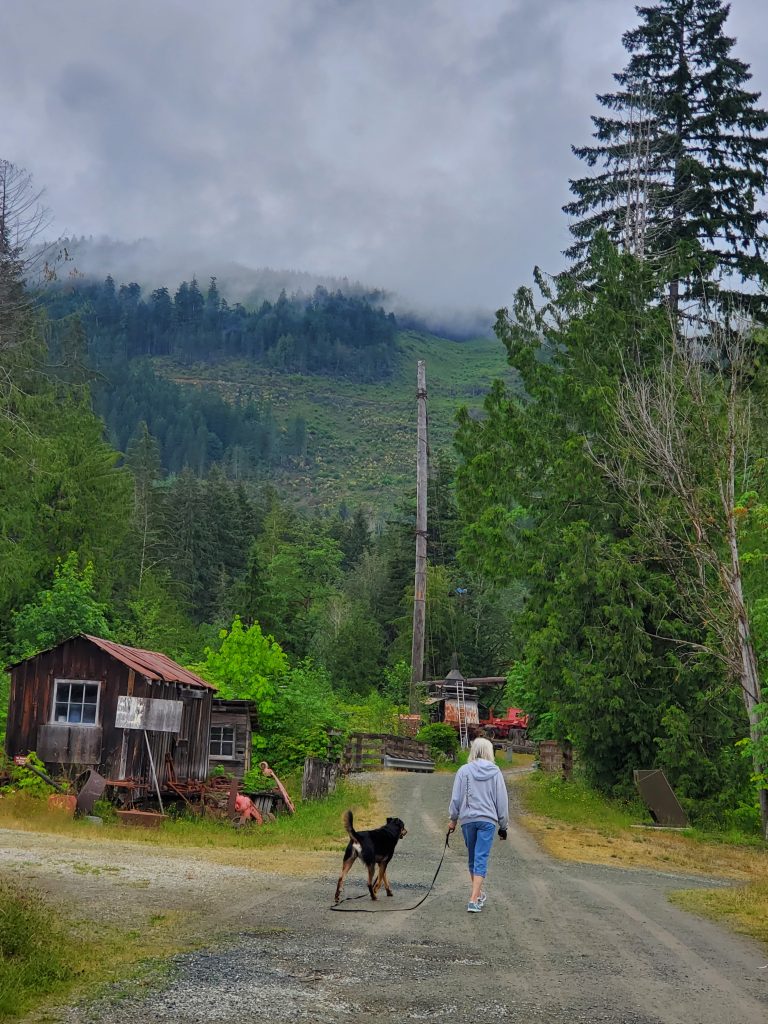
I walk. To counter daily build ups of stress, I need to walk until my body feels release. And yes, I can find these times. I am retired.
Sleep: This one is also getting lots of attention. Most of the discussion is around the how-much-is-enough question. Seven hours tends to win out as an average. In my working years, when the day’s anxiety tightened my body and mind, I found it hard to get my 7-hour quota. So I worried, with reason, that I would fall asleep while driving home after work if I didn’t get enough sleep. And yes a few times I hit the edge of the road. I had to start telling myself that most days I was fine and that I would catch up the next night. Worrying less about sleep has helped to give me more of it; lucky me, for I am no longer governed by an alarm clock.
Therapies: Two issues dog this one – cost and questions of efficacy (Barbara Ehrenreich’s Bright-sided). Several writers, even while authoring a book on their particular take on a therapy, somewhat abashedly also acknowledge these two problems. Nonetheless, currently there seems to be consensus that CBT or cognitive behavioural therapy or Positive Psychology, while likely no less costly, do appear to be helping people. There are also many DIY therapies to refocus your perspective. Journaling, retraining your brain to be consciously grateful or immersing yourself in mindfulness or being ‘in the now’ or focusing on what you are in the moment experiencing or becoming absorbed by Mihaly Csikszentmihaly’s “flow state”[vii] or … working with apps.
One more update: it is probably best to balance all these self-help books with a read of Marianne Power’s Help Me: my perfectly disastrous journey through the world of self-help and Yiyun Li’s Things in Nature Merely Grow.
Final thoughts
And here is where I return to where this sidebar began – with Claire Weekes’ book, HOPE AND HELP FOR YOUR NERVES. Her message helped and I found that essentially it was the message of all the books I read. Dr. Claire Weekes connected with me when she pointed out that anxiety is fear of fear. Our thoughts impact our reality.
We may continue to struggle with anxiety for much of our lives as Harry Chapin sings in “Circle”.
It seems like I’ve been here before, I can’t remember when
But I got this funny feelin’ that I’ll be back once again
There’s no straight lines make up my life and all my roads have bends
There’s no clear-cut beginnings and so far no dead-ends.
That tiger may bound across our landscape time and again, but maybe it’s hopeful that there are ‘so far no dead-ends’.
Gary Shteyngart mentions in Little Failure a story of Russian peasants who were just glad they made it through the day; I too am thankful some days that I simply made it through the day. I love someone whose journey on earth is a tough one and I am not always able to look at my life positively though I know I am expected to find peace with that reality in my own life. I have tools that help. And I am comfortable with that because while I am not necessarily stronger in the face of stress, I do see how my life experience is making me more compassionate for I am actually living human experience and learning from it. I have opportunity and resources now that I am personally testing out.
In A Brief History of Anxiety Patricia Pearson leaves the reader with a challenge. She rephrases Pascal’s wager which says, “If you erroneously believe in God, you lose nothing (assuming that death is the absolute end), whereas if you correctly believe in God, you gain everything (eternal bliss)”.
She updates Pascal with “Dare to be irrational (because guess what, you already are) and wager that your life has a purpose, a meaning, an overarching story. And imagine within yourself a light or spark or Lord that will show you the way”.[viii] Or maybe just some techniques to help you make it through the day.
Last night we watched Lion. Saroo’s mother tells him she adopted him and his brother because she saw it as her purpose in life. It seems by her sense of being blessed that she saw the attendant struggles as part of the package. She likely has learned some techniques.
Footnotes
[i] Weekes, Dr. Claire Hope And Help For Your Nerves, Signet Books, 1969, 24, 25
[ii] Medical News Today www.medicalnewstoday.com/info/anxiety
[iii] Mayo Clinic http://www.mayoclinic.org/diseases/conditions/depression/basics/definition/con-20032977
[iv] Melemis, Steven I Want to Change My Life: How to Overcome Anxiety, Depression and Addiction Modern Therapies, 2010, 192.
[v] Stewart, Sherry, PhD, Steven Taylor PhD and Margo Watt PhD Overcoming the Fear of Fear: How to Reduce Anxiety Sensitivity New Harbinger Publications, 2008
[vi] Weekes, Dr. Claire Hope And Help For Your Nerves, Signet Books, 1969, Chapter 4
[vii] Warner, Priscilla Learning to Breathe: my yearlong quest to bring calm to my life Atria Books, 2012
Tolle, Eckhart The Power of Now: a guide to spiritual enlightenment Raincoast Books, 2004
Csikszentmihalyi, Mihaly Flow: the psychology of optimal experience Harper Pernnial, 1991
Oprah July, 2014, 62 and August, 2016
Harris, Dan Meditations for Fidgety Skeptics Harmony, 2018
Newberg, Andrew and Mark Robert Waldman How God Changes Your Brain: breakthrough findings from a leading neuroscientist Ballantine Books, 2010
Li, Yiyun Things In Nature Merely Grow Farrar, Straus, and Giroux, 2025
Power, Marianne Help me: my perfectly disastrous journey through the world of self-help Harperavenue, 2018
Frankl, Viktor E. Man’s Search For Meaning Washington Square Press, 1946
[viii] Pearson, Patricia A Brief History of Anxiety (Yours and Mine) Random House Canada, 2008, 172.