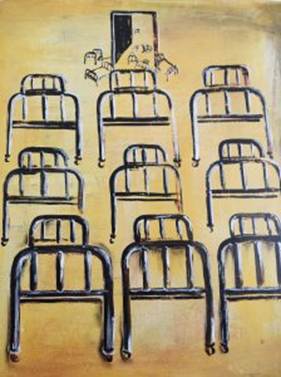
Psychology asks how we find ways of being in the world that we can live with, homeostasis. It seeks a way to adapt to the world whether a person has a sense of safety or not, can trust or not, believes he or she is accepted or rather is seen as less than, does or doesn’t belong, is unloved or loved.
Spirituality asks a different question. It asks about the meaning, purpose, connections[i] behind the desire to find a way to adapt.
Were Yasik’s adaptations evidence of a new or reconstructed narrative, a narrative of evolving meaning, purpose, connection, a sense of belonging and being loved, and what could ultimately be trusted?
Yasik’s spiritual mindset pre-adoption
The chaos following the collapse of the Soviet regime was not only political and economic. It was also a turn from atheism back to religion, perhaps trying to make sense of the collapse. For those who took it upon themselves to restructure Russia, it seemed a good idea to reinstitute the Russian Orthodox Church and, maybe in attempt to not leave any stone unturned, welcome international protestant missions.
Given this endorsement, the Russian Orthodox Church would visit orphanages to hold services, baptize children and teach them basic catechesis. I have no doubt this was a sincere attempt to fill what they recognized to be a spiritual and identity void among young orphans. Soviet portraits were taken down and holy icons set up, offering a visual of where a child might turn for help or hope. For a brief time, according to Human Rights Watch, international protestant church missions were allowed to distribute Bibles and educational booklets to children in orphanages. These missions, both Russian Orthodox and Protestant, also sought to show care through teachings of Jesus’ love and through gifts to the orphanages[ii].
And whether only ostensibly for the children but really to entertain the staff, in the 1990s, TVs were on all day. Apparently not to children’s programs but to American, Mexican or Brazilian soap operas. This might have been a secular spiritual substitute, offering its own brand of meaning, purpose and connection or maybe, simple escape into a fantasy meaning or connection. I find it hard to draw a purpose from this avenue to the spiritual. Still… maybe a child might.
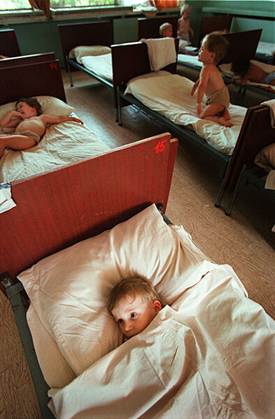
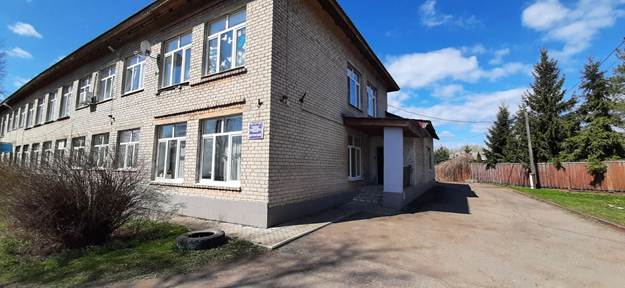
Did Yasik get any religious exposure which might have offered him some meaning and connection, maybe even purpose? Google suggests perhaps. Yaroslavl is historically a religious hub in Russia. In hopes of economic help if not always interest in the spiritual well-being of orphans, the Russian Orthodox Church and international Protestant missions were welcomed in Yaroslavl’s orphanages in the 1990s. Considering that I remember Yasik’s orphanage to have been somewhere near the center of Yaroslavl, I can assume he was exposed to religious teaching, icons and humanitarian aid. He may even have been baptized. During this time icons were mass produced images to be hung on walls. Wallet-sized cards were laminated or plastic-backed to be given to each child for something of their own. One icon often handed out was the Guardian Angel icon showing children that they were watched over and not alone.

Might a pocket-sized icon of his very own have comforted Yasik?
Did he, even before being given a poppa and momma of his own, see some family meaning and connection in religious teaching, and icons? Or was learning to self-soothe by rocking and singing to himself, sharing his life with his peers, hoarding what he could his avenue to meaning making? How he understood connection?
When I was young, I often heard the Roman Catholic adage: “Give me a child until he is seven and I will show you the man”. It is a phrase the church apparently no longer uses, but the concept of the impact of those early years of neuronal growth remains a given[iii].
In those first four years, Yasik may have absorbed a sense that family was a protective angel or his little peers or only himself. Yet with the snap of a magician’s finger the world he was born into had simply disappeared. The magician had called another image of family into being. Going forward, what would ‘I have a poppa and momma now’ have meant to him, offered him?
Yasik’s spiritual mindset post-adoption
Dave and I each had religious backgrounds that left us at this stage in our lives with a belief in a loosely defined higher power. We found meaning, purpose and connection in family and careers. We prayed but we did not particularly observe many religious dictates. I cannot know what Yasik believed in at five or six. I do know we encouraged Yasik to pray to ‘Dear God’ just as he may have done in the orphanage. Dear God was an invisible entity but Yasik saw the possibility in enlisting Him to help him on a spelling test. When he got all the words spelled right, in his prayer that evening he wanted Dear God to know.
We encouraged a firm belief in other invisible entities as well, Santa and the Tooth Fairy. At five Yasik and I were out sledding and saw a man dressed as Santa sneaking around the side of a house. We hurried home to get ready for when Santa got down to our block. If some understanding of a Guardian Angel/Dear God held meaning and connection for him, Santa likely was no leap of faith.
But as the years went by Yasik began testing Santa’s telepathy by keeping his wants from us. We went to great lengths to outsmart him at that point. But the time came when magic and reality started to argue for Santa got a Gameboy mixed up. Another time, we forgot to replace a tooth with money. That one last time, we put 46 cents under his pillow the next night and told him the tooth fairy went cheap because it was irritated with his lack of faith. The time came when he also let us know he no longer wanted to pray with us. Probably thought what was the point if even the tooth fairy was a grouch.
Whatever narrative of things spiritual he had was being questioned. Where had things spiritual for him moved on to? Where would he now place his trust? I do know that while he gave up on prayers to Dear God, he has continued to plug into music. Perhaps this has continued to be his way of communing with the spiritual.
For the first years of his life Yasik understood connection, particularly to belonging in a family, as unstable at best. Now he was either going to build on that meaning or reconstruct it. Did having a poppa and momma signify meaning and connection?
I once asked Yasik, now an adult, who he would say was his ‘Higher Power’, the AA label for help with meaning, purpose and connection. He said Dave and I and his bio-sister were his Higher Power. We are often told, in quite a literal sense, parents are a child’s first representation of a higher power. Perhaps for some of the difficult parts of becoming an adult, it remains an option.
We do know having a poppa and momma meant Yasik had his own shoulder to cry on. He could ask about things that troubled him and not be shut down. He still belonged. He had rights. There was no need any longer to hide his toys. Even when he was disciplined, he received continued love. If there was a boogie man, he could crawl into bed with his poppa and momma.
He was not alone. He may not have known that he was about to age out of the baby house while at the orphanage, but he saw children leaving his orphanage and not returning. Now as far as he could tell, he now had a home and would not be someday expected to move on. Family, both nuclear and extended, was an assumed, everyday part of the fabric of his life now. Family gave him meaning, purpose and connection now. Yes family as a higher Power may also mean that higher powers are not omnipresent, omniscient or omnipotent, but they aren’t abandoning either.
Sharon Stone was lying in a hospital bed, dying of a stroke when her grandmother appeared from beyond the grave to tell her that ‘they’ on the other side had not yet figured out how to help her live, “But they were working on it.”[iv] For me, that is definitive family. Not always up to the hopes but there, sticking around and wanting to help.
Again I cannot tell you what his mindset was. I simply believe it is human to want to find meaning, purpose and connection. In what Yasik has expressed to us, in choices he has made, in his adaptations, I believe he was moving from uncertainty about his place in the world to new hopes of family, a sense of belonging and being loved, and what could ultimately be trusted. He was choosing Pokémon over Pushkin.
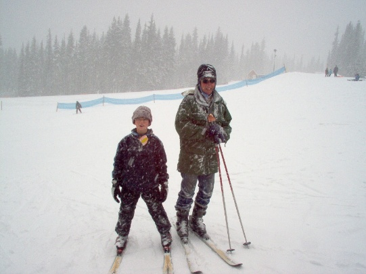

Yeah but, – No but: the years ahead would test his meaning, connection and purpose. Was the old narrative entirely dissolved? [v]
I don’t speak my Father’s native tongue…
I don’t know where I belong
Would the struggle suggested by the song, Native Tongue by Mo ‘Ju[vi] continue to make finding meaning and connection difficult? Yasik, as an adult, did once say, “I just wish I’d had a say”, referring to his adoption. I did not ask what he might have wanted us to know.[vii]
Footnotes
[i] “Making Meaning (Part 2): What does Spirituality Have to do with Meaning-Making?” December 19, 2023 https://thethrivecenter.org/meaning-making-part-2-what-does-spirituality-have-to-do-with-meaning-making/
Tix, Andy, Ph.D. “7 Ways People Experience Spirituality” Psychology Today, June 30, 2025 https://www.psychologytoday.com/ca/blog/the-pursuit-of-peace/202506/7-ways-people-experience-spirituality
Delagran, Louise, MA, MEd. “What is Spirituality?” https://www.takingcharge.csh.umn.edu/what-spirituality
[ii] Fish, Will “A Russian Christmas Story: “For Always” Eternal Perspectives with Randy Alcorn December 1, 1999
https://www.epm.org/resources/1999/Dec/1/russian-christmas-story-always
Golovko, Oksana “Bishop Philip of Karasuk Saves Orphans and Baptizes Children with Active TB” Pravmir.com, March 9, 2015 https://www.pravmir.com/bishop-philip-of-karasuk-saves-orphans-and-baptizes-children-with-active-tb/
[iii] Edlund, Matthew J., M.D. “Give Us A Kid Till She’s 7 and We’ll Have Her For Life” The Power of Rest Psychology Today March 7, 2013 https://www.psychologytoday.com/ca/blog/the-power-rest/201303/give-us-kid-till-shes-7-and-well-have-her-life
Lipton, Peter Ask Philosophers November 11, 2006
https://www.askphilosophers.org/question/1443
“Give me a child till he is seven years old”
Source, Commonweal, 08/01/2016
Miles, Dr. Helen ‘Give me the child until he is 7 and I will give you the man’ — Psychologically informed reflections on the importance of early life experiences on later life…’ Medium Jun 25, 2021
[iv] Stone, Sharon The Beauty of Living Twice Knopf, 2021,18
[v] “Orphans’ Lonely Beginnings Reveal How Parents Shape A Child’s Brain” HEALTH NEWS FROM NPR February 24, 2014 https://www.npr.org/sections/health-shots/
[vi] https://genius.com/Moju-native-tongue-lyrics
[vii] Johnson, Lesli “10 Things Adoptees Want You to Know” The BLOG U.S. Edition HuffPost November 1, 2019 https://www.huffpost.com/entry/adoption_b_2161590
Gray, Deborah D. Attaching in Adoptions: practical tools for today’s parents Perspectives Press, Inc. 2002, 151