‘They’ say we are social beings, maybe on a spectrum from extrovert to ambivert to otravert to introvert to …, BUT most of us do seem to want people in our lives.[i]
Being part of a group, with family ties and community provides protection, access to resources, and opportunities for cooperation.
For the individual in the social group, being accepted by others, feeling valued and having a social identity within a group tends to ensure better physical and mental health helping us climb a notch or two higher up Maslow’s ladder to a sense of self-worth.[ii] A setting seeding a mindset.
For his first four years, Yasik had family and community. What mindset was being constructed from these connections for him?
Year one, 1992-1993 approximately: Yasik is in the bosom of his bio-family, with parents, an older half-brother now going to school at the age of 6, and two sisters, one a half-sister and the other his full sibling, born a year earlier.
Sometime around his first birthday, social services found Yasik in his crib unattended. His parents were working in a factory and being given food and china made at the factory to sell. As I wrote in the post, Court Proceedings, we were only told that his mother “moved around a lot”. Boris Yeltsin’s Article 13 of the Family Code allowed social services to rescue/apprehend children when parents “shirk duties involved in his/her upbringing and maintenance, for over six months”. A Yaroslavl court spelled it out when examining Yasik’s parents care for their children. This court concluded that “the parent’s neglect their children, do not care for their lives, do not support them”.
It would seem I can be justified in saying these rulings imply a lack of infant care. Let’s assume that Yasik did his bit, crying for care and getting his bio-mother’s oxycontin juices flowing. Her breasts should have been leaking, tingling with heaviness and wanting a letdown.[iii] Not feeding him, she may have been packing around some painful breasts, perhaps even infecting them.
Yasik’s mom knew what to do with packed and painful breasts. The greater pain was left to an infant to absorb. Something as simple as skin-to-skin contact would have washed away stress and added protection against a physical backlash of infection and the possibility of hindering brain and body development. Oxytocin which “reduces feelings of threat and enables trust” would have been offered in the breast milk. Eye contact would have would have not only increased his feeling of being loved but would have begun to stretch his nascent theory of mind as he looked where she looked and at the things she might have pointed to. Had his mother picked him up when he was crying, not only would she have halted his crying, but she would have helped him relax and sleep better. Long term she would have encouraged his growth hormone and directed his mindset to trust the caregivers in his life.[iv]
Year two, 1993-1994 approximately: social services stepped in to take the children from the family. The older brother brought the family to social services’ attention with his bruised body and his plea not to be returned to the family. Yasik was taken to a hospital, almost certainly low on staff and supplies. There is no good way to note that his mother actually came to visit Yasik at the hospital to seek money designated for his care. She stopped coming to visit her youngest son when she was denied this money. And with no family money to pay for expenses, Yasik would have been given second-class treatment in a struggling hospital[v]. He was not given the opportunity to learn to walk while he was there. Rescue, rinse, repeat.
Year three to four and half, 1994- 1997 approximately: Yasik was moved to an orphanage as a ‘social orphan’. He had family. Once again there is no good way to say that to sell the factory china the parents needed to travel past the care homes three of their children were in. Not once did they stop to check in on their children.
A Russian doctor with years of experience working with orphanages called the baby house orphanages “Gilded Cages”. They received international attention and appeared better equipped than the average orphanage for older or disabled children.[vi]
But an orphanage is still an orphanage. An orphan, social or totally without family, faces prejudicial stereotypes: the stigma of abandonment.[vii]
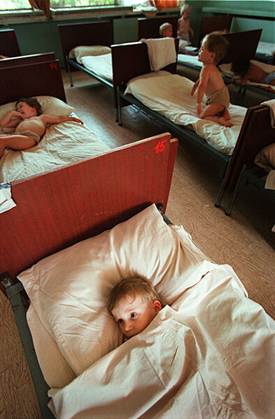
Someone’s children in a Russian orphanage
The mindset Yasik was forming of family may have been written in one word: abandonment.
What of community? Orphanages were state institutions. State institutions still held the collective Soviet philosophy of the group over the individual. There was no reason to offer orphans personal possessions for most would have a hard time acquiring much once they left the orphanage. Case in point: Yasik’s dirty, too small, pink runners. This is also where a mindset to hoard geminates. While the orphanage proudly shared that Yasik had given to the other children our first gifts to him (code for they were taken from him?) the things we gave him as we tourist- parented in Moscow were hidden behind the apartment piano.
Even in the best case, children who are closest to normal health at birth become [socially, intellectually, emotionally and physically stunted] to some degree after these four years of collective living, deprived of individual nurture. Even the nannies who “love” them, treat them mostly—really like pets. They do not really see that there is a person inside who could think, or learn something. [viii]
Even when a staff is concerned enough to try to give the children some concept of family, it can often confuse or add pain. After meeting us for a short time on our first visit, Yasik was heard to say, “I have a poppa and momma now.” What understanding had he of parents and family with no memory of his own family and with, at best, only glimpses of others’ family life?
From our earliest infancy, we are absorbing a mindset and a theory of mind. We watch where our caregivers’ eyes are looking, where their hands and bodies are moving, particularly in relation to us. We are coming to understand how we are cared for and what that means for our place and value in our world.
Yeah but, – No but… At four and half, Yasik was part of a group with family ties and then orphanage community. You could say he had been provided with protection, resources and opportunities for cooperation.
Henry Wellman, a psychologist, makes an interesting observation about the development of our theory of mind, and I would include, our mindset. He reasoned that by the time a child is four years old, he or she is equipped to know when “what someone else thinks is mistaken.”[ix]
[i] Perina, Kaja “Why Most Crave Connection—and Why Some of Us Don’t” https://www.psychologytoday.com/ca/blog/beyond-school-walls/202408/why-we-crave-connection-and-why-some-of-us-dont September 12, 2024
[ii] Cherry, Kendra “Understanding collectivist Cultures: individualism vs collectivism” https://www.verywellmind.com/what-are-collectivistic-cultures-2794962 June 4, 2026
“The Importance of Connection on our Well-being” https://executive.berkeley.edu/thought-leadership/blog/importance-connections-our-well-being
“Social connection linked to improved health and reduced risk of early death” https://www.who.int/news/item/30-06-2025-social-connection-linked-to-improved-heath-and-reduced-risk-of-early-death 30 June 2025
[iii] Martino, Jessica, Jennifer Pegg, Elizabeth Pegg Frates “The Connection Prescription: Using the Power of Social Interactions and the Deep Desire for Connectedness to Empower Health and Wellness” American Journal of Lifestyle Medicine 2015 Oct 7;11(6):466–475. doi: 10.1177/1559827615608788
https://pmc.ncbi.nlm.nih.gov/articles/PMC6125010/Top of Form
[iv] Kumar, Karthik, MBBS, Medical Reviewer: John P. Cunha, DO, FACOEO “How Do Hugs Make You Feel?” MedicineNet, Inc. 11/4/2024 https://www.medicinenet.com/how_do_hugs_make_you_feel/article.htmTop of Form
Alloway, Tracy P, Ph.D. “What 20 Seconds of Hugging Can Do for You” Psychology Today, January 19, 2022
Hare, Brian and Vanessa Woods Survival of the Friendliest: understanding our origins and rediscovering our common humanity Random House, 2020, 74, 97
[v] Human Rights Watch “IV. THE “GILDED CAGE” OF THE DOM REBYONKA: INFANCY TO FOUR YEARS” https://www.hrw.org/legacy/reports98/russia2/Russ98d-05.htm
[vi] IBID
[vii] IBID
[viii] Human Rights Watch “II. THE ODYSSEY OF A RUSSIAN ORPHAN” https://www.hrw.org/legacy/reports98/russia2/Russ98d-03.htm
Paddock, Richard C. “The Grim Face of Russia’s Orphanages” World and Nation Dec. 17, 1998 https://www.latimes.com/archives/la-xpm-1998-dec-17-mn-54995-story.html
“Orphanage experience alters brain development” University of Wisconsin – Madison News February 17, 2003 https://news.wisc.edu/orphanage-experience-alters-brain-development/
Cacioppo, Stephanie Wired for Love: a neuroscientist’s journey through romance, loss, and the essence of human connection Flatiron Books, 2023, 21, 23
[ix] Hare, Brian and Vanessa Woods Survival of the Friendliest: understanding our origins and rediscovering our common humanity Random House, 2020, 57, 89, 91
Orphanage Risks adoptionasfamily.org
Leave a Reply