Author: admin

  • Set and Setting: social, first Russia

    ‘They’ say we are social beings, maybe on a spectrum from extrovert to ambivert to otravert to introvert to …, BUT most of us do seem to want people in our lives.[i]

    Being part of a group, with family ties and community provides protection, access to resources, and opportunities for cooperation.

    For the individual in the social group, being accepted by others, feeling valued and having a social identity within a group tends to ensure better physical and mental health helping us climb a notch or two higher up Maslow’s ladder to a sense of self-worth.[ii] A setting seeding a mindset.

    For his first four years, Yasik had family and community. What mindset was being constructed from these connections for him?

    Year one, 1992-1993 approximately: Yasik is in the bosom of his bio-family, with parents, an older half-brother now going to school at the age of 6, and two sisters, one a half-sister and the other his full sibling, born a year earlier.

    Sometime around his first birthday, social services found Yasik in his crib unattended. His parents were working in a factory and being given food and china made at the factory to sell. As I wrote in the post, Court Proceedings, we were only told that his mother “moved around a lot”. Boris Yeltsin’s Article 13 of the Family Code allowed social services to rescue/apprehend children when parents “shirk duties involved in his/her upbringing and maintenance, for over six months”. A Yaroslavl court spelled it out when examining Yasik’s parents care for their children. This court concluded that “the parent’s neglect their children, do not care for their lives, do not support them”.  

    It would seem I can be justified in saying these rulings imply a lack of infant care. Let’s assume that Yasik did his bit, crying for care and getting his bio-mother’s oxycontin juices flowing. Her breasts should have been leaking, tingling with heaviness and wanting a letdown.[iii] Not feeding him, she may have been packing around some painful breasts, perhaps even infecting them.

    Yasik’s mom knew what to do with packed and painful breasts. The greater pain was left to an infant to absorb. Something as simple as skin-to-skin contact would have washed away stress and added protection against a physical backlash of infection and the possibility of hindering brain and body development. Oxytocin which “reduces feelings of threat and enables trust” would have been offered in the breast milk. Eye contact would have would have not only increased his feeling of being loved but would have begun to stretch his nascent theory of mind as he looked where she looked and at the things she might have pointed to. Had his mother picked him up when he was crying, not only would she have halted his crying, but she would have helped him relax and sleep better. Long term she would have encouraged his growth hormone and directed his mindset to trust the caregivers in his life.[iv]

    Year two, 1993-1994 approximately: social services stepped in to take the children from the family. The older brother brought the family to social services’ attention with his bruised body and his plea not to be returned to the family. Yasik was taken to a hospital, almost certainly low on staff and supplies. There is no good way to note that his mother actually came to visit Yasik at the hospital to seek money designated for his care. She stopped coming to visit her youngest son when she was denied this money. And with no family money to pay for expenses, Yasik would have been given second-class treatment in a struggling hospital[v]. He was not given the opportunity to learn to walk while he was there.  Rescue, rinse, repeat.

    Year three to four and half, 1994- 1997 approximately: Yasik was moved to an orphanage as a ‘social orphan’. He had family. Once again there is no good way to say that to sell the factory china the parents needed to travel past the care homes three of their children were in.  Not once did they stop to check in on their children.

    A Russian doctor with years of experience working with orphanages called the baby house orphanages “Gilded Cages”. They received international attention and appeared better equipped than the average orphanage for older or disabled children.[vi]

    But an orphanage is still an orphanage. An orphan, social or totally without family, faces prejudicial stereotypes: the stigma of abandonment.[vii]

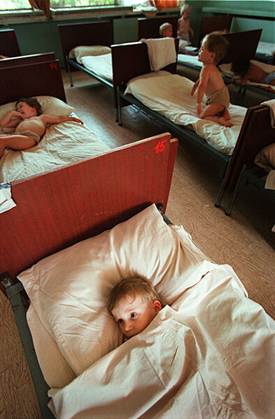
    Someone’s children in a Russian orphanage

    The mindset Yasik was forming of family may have been written in one word: abandonment.

    What of community? Orphanages were state institutions. State institutions still held the collective Soviet philosophy of the group over the individual.  There was no reason to offer orphans personal possessions for most would have a hard time acquiring much once they left the orphanage. Case in point: Yasik’s dirty, too small, pink runners. This is also where a mindset to hoard geminates. While the orphanage proudly shared that Yasik had given to the other children our first gifts to him (code for they were taken from him?) the things we gave him as we tourist- parented in Moscow were hidden behind the apartment piano. 

    Even in the best case, children who are closest to normal health at birth become [socially, intellectually, emotionally and physically stunted] to some degree after these four years of collective living, deprived of individual nurture. Even the nannies who “love” them, treat them mostly—really like pets. They do not really see that there is a person inside who could think, or learn something. [viii]

    Even when a staff is concerned enough to try to give the children some concept of family, it can often confuse or add pain.  After meeting us for a short time on our first visit, Yasik was heard to say, “I have a poppa and momma now.”  What understanding had he of parents and family with no memory of his own family and with, at best, only glimpses of others’ family life?

    From our earliest infancy, we are absorbing a mindset and a theory of mind. We watch where our caregivers’ eyes are looking, where their hands and bodies are moving, particularly in relation to us. We are coming to understand how we are cared for and what that means for our place and value in our world.

    Yeah but, no but. At four and half, Yasik was part of a group with family ties and then orphanage community. You could say he had been provided with protection, resources and opportunities for cooperation.

    Henry Wellman, a psychologist, makes an interesting observation about the development of our theory of mind and I would include, our mindset. He reasoned that by the time a child is four years old, he or she is equipped to know when “what someone else thinks is mistaken.”[ix]

    Footnotes 


    [i] Perina, Kaja “Why Most Crave Connection—and Why Some of Us Don’t” https://www.psychologytoday.com/ca/blog/beyond-school-walls/202408/why-we-crave-connection-and-why-some-of-us-dont September 12, 2024 

    https://www.linkedin.com/pulse/introvert-extrovert-ambivert-you-might-what-think-wanda-thibodeaux-co2fc

    [ii] Cherry, Kendra   “Understanding collectivist Cultures: individualism vs collectivism” https://www.verywellmind.com/what-are-collectivistic-cultures-2794962 June 4, 2026

    “The Importance of Connection on our Well-being” https://executive.berkeley.edu/thought-leadership/blog/importance-connections-our-well-being

    “Social connection linked to improved health and reduced risk of early death” https://www.who.int/news/item/30-06-2025-social-connection-linked-to-improved-heath-and-reduced-risk-of-early-death 30 June 2025

    [iii] Martino, Jessica, Jennifer Pegg, Elizabeth Pegg Frates   “The Connection Prescription: Using the Power of Social Interactions and the Deep Desire for Connectedness to Empower Health and Wellness” American Journal of Lifestyle Medicine 2015 Oct 7;11(6):466–475. doi: 10.1177/1559827615608788

    https://pmc.ncbi.nlm.nih.gov/articles/PMC6125010/Top of Form

    [iv] Kumar, Karthik, MBBS, Medical Reviewer: John P. Cunha, DO, FACOEO   “How Do Hugs Make You Feel?” MedicineNet, Inc. 11/4/2024 https://www.medicinenet.com/how_do_hugs_make_you_feel/article.htmTop of Form

    Alloway, Tracy P, Ph.D.  “What 20 Seconds of Hugging Can Do for You”  Psychology Today, January 19, 2022

    Hare, Brian and Vanessa Woods   Survival of the Friendliest: understanding our origins and rediscovering our common humanity Random House, 2020, 74, 97

    [v] Human Rights Watch “IV. THE “GILDED CAGE” OF THE DOM REBYONKA: INFANCY TO FOUR YEARS” https://www.hrw.org/legacy/reports98/russia2/Russ98d-05.htm

    [vi] IBID

    [vii] IBID

    [viii] Human Rights Watch “II. THE ODYSSEY OF A RUSSIAN ORPHAN” https://www.hrw.org/legacy/reports98/russia2/Russ98d-03.htm

    Paddock, Richard C. “The Grim Face of Russia’s Orphanages” World and Nation Dec. 17, 1998 https://www.latimes.com/archives/la-xpm-1998-dec-17-mn-54995-story.html

    “Orphanage experience alters brain development” University of Wisconsin – Madison News  February 17, 2003​​  https://news.wisc.edu/orphanage-experience-alters-brain-development/

    Cacioppo, Stephanie   Wired for Love: a neuroscientist’s journey through romance, loss, and the essence of human connection   Flatiron Books, 2023, 21, 23

    [ix] Hare, Brian and Vanessa Woods   Survival of the Friendliest: understanding our origins and rediscovering our common humanity Random House, 2020, 57, 89, 91

    Orphanage Risks  adoptionasfamily.org

  • Set and Setting: culture, language, religion

    If you had asked us point blank, we would have assured you that we were going to honour Yasik’s Russian heritage.  I guess by going to Russian meet-ups and by eating piroshkies, but in reality – likely because we gave it no conscious thought to what retaining his Russian heritage might mean – we were going to be turning Yasik into a Canadian with little pretense of retaining his Russian beginnings. He was going to adapt to or take on Canadian society’s behaviours, language, art and institutions to showcase Canadian values, ideas or beliefs.

    Again the question, what were we missing of Yasik’s mindset already in place?

    Culture

    Maybe it is not particularly common to smile at others while walking about downtown Vancouver, but in our small town, we smile as we weave in and out of others on the street or at the grocery store. Downtown Moscow, we felt a bit affronted that when we smiled, we received non-committal, even frowning, return stares. Apparently it was considered rude to smile automatically at strangers. Smiling was reserved for connection that is just not there with a stranger. Connection is with family. Perhaps because their history is soaked in hardship and distrust of strangers.[i]

    Yet with Yasik in our arms on the Metro, people gave up their seats to us, just as they did for Dave carrying a sleepy Yasik home at the end of a day in Canada.

    Would it not inspire pride in Yasik’s heart if we were to stoke whatever embers of first-culture awareness remained?

     adopting older children: a practical guide to adopting and parenting children over age four[ii] provides a list of suggestions for how adoptive parents might strengthen ties to a child’s first cultural heritage.  We would have loved to take him on a holiday to Russia or found more people to spend time with who were culturally Russian.  Other suggestions were over the top for us, ranging from reserving a special night each week to soak in all things first-country, or hunting down a barbershop or salon that catered to the child’s first world. 

    And so it was that there was no trip to Russia though we have always encouraged friendships with people from Russia whenever we encountered them.  But it dribbled to a stop there. Our adoption organization offered continued Russian connection, but other than one or two visits, we did not maintain this connection.  Yasik showed little interest and Dave and I are not extroverted enough to seek out those kinds of social events.

    We allowed Yasik to be swallowed up by Canadian culture instead as limited as that seems to be.

    Perhaps because we Canadians see ourselves as a mosaic of cultures, off hand, only a couple of customs stand out. We say sorry all the time. We are also known to say ‘Eh’ at the end of our greetings and we take our shoes off at the door. No resistance actually for Yasik as, maybe because Russia and Canada are well above the equator, Russians take their shoes off at the door too. 

    As a family we celebrate Christmas on December 25, not January 7, the Russian Christmas, and have fun or sleep in on most of the rest of Canada’s statutory holidays.

    Music, Art, Literature

    Yaroslavl is the birthplace of the professional Russian theater. Fyodor Volkov founded the first permanent public theater there in 1750.

    Canada’s cultural scene had no need of an art museum the size of the Hermitage in Saint Petersburg,

    Dave worked on art with a motorcycle focus; I read where ever my current interests took me.  Neither Dave nor I have the sense of holiness that Europeans seem to have for art and literature. It should also be noted that we had no idea what stories or fairy tales had been told or read to Yasik in the orphanage though my orphanage interview notes say he liked to be read to and learned poems by heart.  Someone was taking time with him.  Yasik was given a Pushkin story before we left Russia; we were scarcely aware of who Pushkin was to Russia.  Because we had little idea of these aspects of Russian culture, beyond a beginner’s understanding of art and literature, and did not sign Yasik up for weekend classes, he had almost no exposure to Russian music or art or literature.

    Acknowledging this, we may be coming off as intransigent boors with our lack of engagement in Yasik’s culture. Still with maybe a slight shrug, I can comfortably note that soon Yasik was collecting Pokemon cards, not more Pushkin.  Besides which Attaching in Adoption: practical tools for today’s parents[iii] notes that Russian children have been told things like: “Close your eyes at night or the witches will come to peck them out“.  Not so different from our “The boogie man will get you“.

    We were told he was attuned to music, but the orphanage staff did not elaborate other than to encourage us to put him in music classes.  We did that.  As these classes advanced, they were more and more directed to classical piano.  By the age of 12, Yasik was pleading to be freed of them although it could be argued that he started to give strong hints almost from the start as he flopped his head down on the piano keys and moaned.  He wanted music but whatever the radio gave him to bounce and chant along with in sounds perhaps between Russian and English. Maurice Mierau’s youngest did the same, making “tuneless word-sounds that were neither English nor Ukrainian”.[iv] Be that as it may, Dave and Yasik were listening to a CD while driving somewhere one day.  Dave noticed Yasik in tears and parked, pulling Yasik into his arms.  Yasik broke into serious sobs even though Dave assured him it was only a song.  That was the power of music for him.

    Food, Clothing

    If Yasik’s orphanage was as Russian as we have to assume, he ate a fair bit of the staples of a northern climate: cabbage, beets, and potatoes or borscht, lucky kid. To help Yasik transition, our friend Tony directed us to some sausage shops and a store that made great piroshkies. Yasik definitely was into these and so were we. I am not sure Canada has any truly recognizable Canadian dish other than maybe poutine and lots of fish. Again, no problem for a kid who started life next to the Volga River. Yasik had no interest in MacDonald’s in Moscow but he soon cottoned on. And maybe Kraft macaroni and wieners are a Canadian dish. He adapted to that dish very quickly.

    Clothing was pretty much jeans, T-shirts and hoodies across the globe so that was never an issue.

    Language:

    Being Slavic means belonging to the largest ethnolinguistic group in Europe, with over 300 million people sharing ancestral roots and languages like Russian, Ukrainian, Polish.[v]

    Via language, values, attitudes and worldviews are communicated. Here are two cherry-picked proverbs from the languages listed above, all of which use the Cyrillic alphabet.

    Не имей сто рублей, а имей сто друзей

    Translation: Don’t have a hundred rubles, have a hundred friends.

    With hardship a given for many Russians throughout their history, this proverb would likely have nurtured the value of having friends. How might that have been messaged to an orphan, even a social orphan?

    Не выноси сор из избы

    Translation: Don’t take trash out of the hut.

    In Russian culture, family and private matters are to be kept within the home. It implies that exposing personal problems to outsiders is inappropriate and potentially shameful.

    Could this have been why the orphanage never provided much detail about the bio-parents shameful behaviour? Did Yasik pick up on anything shameful in connection with his family?

    I do not diss a language as rich as Russian. But learn it to ease Yasik into our life? We were adopting well before the possibilities now available in language-learning. Not that we were not encouraged to try. Our translator tried to screw a few phrases into our brains as we drove toward the orphanage. Yasik used words that were easily connected to motorcycles, airplanes and the need to pee. But slipping in a little suggestion like “Also, perhaps learn his native language before you bring him home… Learn your child’s language while he learns yours might be a bit over the top.[vi]

    Getting an invitation to adopt may only arrive 6 weeks before the adopters are expected to fly over to the child’s country.  Maybe I am old school but I continue to believe that even with all the aids available today, to learn the child’s native language requires some serious investment. I googled just to be sure. With apps, Russian generally takes 11 to 14 months of daily study to reach a level just below intermediate, which would be enough to get to know your child. Much adoption literature, perhaps more ‘practical’ in this regard, notes that most adoptees will become comfortable with the language of their adoption within months of arrival.

    Yasik, thanks to Forest Gump (and yes, other sources), managed just that. Hidden Potential: the science of achieving greater things by Adam Grant suggests that “kids tend to absorb foreign languages faster than adults.[vii]

    Their brains enjoy more plasticity, less prior knowledge to convolute and little to no fear of making mistakes. Dave and I, with at best 10 Russian words between us, only remember having fun with his renditions of words, like “sillyphone” for telephone.  We saw no bother on his face when we giggled at his chatter.  We did not look for a school offering weekend lessons in Russian.  

    The time also came when he was quite certain he did not remember any Russian, although my brother-in-law maintains a fantasy that he heard teenage Yasik talking up some visiting, and very pretty, Russian girls at a hockey game.

    And yes, long term and for that matter even short term, that was/is a loss for Yasik.  If at some point in his life he has the opportunity to spend time with his half-brother and half-sister in Russia, any connection of depth will be hampered by the need for a translator.

    Religion: 

    Yasik may have had some experience with the Russian Orthodox church. One in Rybinsk has been around for quite a while, if 1697 qualifies.  That it is still there speaks to a long and deep partnership between the church and the government.  

    Dave and I, like many Canadians of our generation, had moved away from organized religion into a less structured belief in God.  Some of this generation move back into religion for a stable social world for their children but we could not see any viable reason to make such a choice.  We played together on Sundays.

    And we were not particularly unusual in our casual attitude to Yasik’s heritage.  John Brooks in The Girl Behind the Door:

    Casey never showed much curiosity during [conversations about her origin story].  She never asked about her birth mother, whether she had siblings or who her birth father could have been.  Much to [her Polish-origin adoptive mother’s] dismay, she had little interest in Polish culture, never watched the hours of video [her adoptive parents] shot during [their] trip [to adopt her in Poland], and when asked if she wanted to meet her birth mother someday waved [them] off, annoyed…. As time passed, the orphanage became a distant memory.  [The adoptive father] hoped it had been completely erased from Casey’s consciousness.  She was a member of [their] family now – no different from a biological child in [their] minds …. But in truth, [they] had no idea how [their] words resonated in her sharp little mind.[viii]

    We cannot be certain we are making the best long-term decisions when we don’t offer more access to our child’s first heritage. Maurice Mierau’ father was born in Ukraine. It is understandable then that in Detachment: an adoption memoir Mierau writes that he and his wife enrolled their children in a Ukrainian language nursery school for a few of months and took them to a Ukrainian store for goodies.[ix] But quickly the couple were introducing birthday parties, celebrated with their Ukrainian speaking babysitter and several Ukrainian friends and buying goofy outfits for Halloween.[x]  “The only religion in [their] house since the boys arrived was Star Wars”.[xi] Within a year of their adoption, the younger son thought of Ukraine as part of a long distant babyhood and the older son said he wanted to be a Canadian.[xii]

    Nonetheless Mierau’s older son, who was adopted at 5, had no memories from before his life in an orphanage yet “he’d told [his adoptive parents] about a dream that seemed to go further back”.[xiii] In the dream an image approaches the child whom he believes is his mother but this image vanishes when the child tries to come closer to it. Would more connection to the culture of origin have helped the boy gain a sense of contact with the past or given the parents a deeper awareness of his mindset?

    This exploration of our child’s heritage has uncovered some awareness of where the Russian distrust of strangers comes from. Why did Yasik show so little of that after knowing us for only an hour or so? Had he picked up enough understanding of family that his little mind was firmly set on it? Had his mind been given enough prompting to have some sense of a ‘higher power’? Dare I say a god? Would it have been too onerous to ferret out more Russian literature from our public library?

    Footnotes


    [i] Sheldon K. M., Titova L., Gordeeva T. O., Osin E. N., Lyubomirsky S., Bogomaz S.

    “Russians Inhibit the Expression of Happiness to Strangers: Testing a Display Rule Model”

    Journal of Cross-Cultural Psychology. 2017. Vol. 48. No. 5. P. 718–733.

    [ii]  Bosco-Ruggiero, MA, Gloria Russo Wassell, MS, LLMHC and Victor Groza, PhD. Adopting older children: a practical guide to adopting and parenting children er age four. New Horizon Press,2014, 82.

    [iii] Gray, Deborah D. Attaching in Adoption: practical tools for today’s parents. Jessica Kingsley Publishers, 2002, 151.

    [iv] Mierau, Maurice. Detachment: an adoption memoir. Freehand Books, 2014, 102,103.

    [v] Sheldon K. M., Titova L., Gordeeva T. O., Osin E. N., Lyubomirsky S., Bogomaz S.

    “Russians Inhibit the Expression of Happiness to Strangers: Testing a Display Rule Model”

    Journal of Cross-Cultural Psychology. 2017. Vol. 48. No. 5. P. 718–733.

    [vi] Bosco-Ruggiero, MA, Gloria Russo Wassell, MS, LLMHC and Victor Groza, PhD. Adopting older children: a practical guide to adopting and parenting children over age four. New Horizon Press, 2014, 64.

    [vii] Hidden Potential: the science of achieving greater things by Adam Grant suggests that “kids tend to absorb foreign languages faster than adults.” (55)

    [viii] Brooks, John. The Girl Behind the Door: a father’s quest to understand his daughter’s suicide. Scribner, 2016, 55,56.

    [ix] Mierau, Maurice. Detachment: an adoption memoir. Freehand Books, 2014, 103.

    [x] Mierau, Maurice. Detachment: an adoption memoir. Freehand Books, 2014, 131.

    [xi] Mierau, Maurice. Detachment: an adoption memoir. Freehand Books, 2014, 161.

    [xii]Mierau, Maurice. Detachment: an adoption memoir. Freehand Books, 2014, 133.

    [xiii] Mierau, Maurice. Detachment: an adoption memoir. Freehand Books, 2014, 176.

  • Set and Setting: Physical

    In my mid-teens I was on a train coming from Edmonton and headed to my home in the Fraser Valley for the Christmas holidays. I’d fallen asleep and woke in the early morning as the train was pulling into the Blue River station which was right up against a mountain. That mountain assured me that I was again surrounded by mountains; my entire body slipped into its comfort zone. I was home. My aunt, on the other hand, a lifelong prairie woman, found it hard to breathe when she visited us in Chilliwack.  Back on the ‘bald prairie’ she was home. In Yasik’s mind, what is ‘home’?

    The physical worlds Yasik inhabited

    Yasik began life in what we understood to be a ‘small village’ in the Yaroslavl oblast, Rybinsk.

    Maybe it was a small village in Russian terms, but even in the 1990s, Rybinsk had a population over 200,000.

    Yasik’s bio sister’s family sent us the two following pictures, taken on their visit to Yaroslavl a few years ago. Yasik’s family lived in an apartment that may be one the buildings in these pictures.  Perhaps this was much as it looked in the 1990s. Perhaps by this time it was an abandoned building in need of much repair.

    When the social services took Yasik from the apartment around his first birthday, they first placed him in one of the hospitals, maybe in Rybinsk, maybe in Yaroslavl, and maybe one that offered pediatric care. Whether Rybinsk or Yaroslavl, because it was the early 1990s all over Russia, the hospital would have been struggling with overcrowding and basic medical shortages.

    By the time he was two, he was living in an orphanage for young children.  The orphanage seemed to be off a dirt road, back a bit of beyond.  Perhaps similar to the one pictured, a Yaroslavl orphanage in later decades.

    There was a piece at the side of the house that looked worn enough to likely have been a playground. It reminds me of how Tony describes the playground of his orphanage in 1930s Saskatoon (A Canadian Story of Adoption in the 1930s).

    On any outing he would have been part of at the orphanage, it would have been hard to miss at least a glimpse of the Volga River. The longest river in Russia and in Europe, it runs through the entire oblast. The land on either side of this river all through the Yaroslavl oblast was a mix of urban and rural, farm and forest, though with birch and aspen, it looks more like central and northern prairies. It feels more like the prairies, as well, with warmer warm and colder cold seasons.

    A plane ride and he entered a city of roughly 50,000 but so closely tied to a larger urban region, it took a moment to think which city we were in on any outing. We had a comparable river running through it but instead of aspens and a more prairie look, we were surrounded by mountains.  Our climate saw more rain but much less snow.

    Whether any of that registered with Yasik, our 50s era home with a small backyard, did.  After just three hours in his new home, when Dave wanted to simply rearrange parking, Yasik thought he was being made to leave this home. He howled.

    Our background playground wasn’t scruffy; it was non-existent as neither Dave nor I had yet given much thought to the yard.  But now we had Yasik. We had a yard and we needed to see what we could do.  Or Yasik very quickly, very naturally, rearranged our thinking and awareness of what might please him.  Or we fell back on what our parents did with us. Whatever… the environment our house and yard offered became kid oriented. 

    We attempted some gardening, built igloos the odd year we had sufficient snowfall and played itsy-bitsy soccer on the front lawn. The house was tucked in among a string of streets trying to be a suburb but so infused with businesses and institutions that there was little point in denying it was part of a much larger urban setting, with cars everywhere. Nonetheless Yasik learned to ride a bike in the alley between our house and the Chevron station and biked on sidewalks running alongside a street that boasted 40,000 cars a day.

    At the bottom of our little tree-lined street, on the other side of the river of traffic, the elementary school had the word ‘Community’ in its title and across from the school was a park with baseball diamonds, a swimming pool and even a creek bordered by trees and picnic tables. An hour or two out of town our bodies and minds could ‘heed the call of the wild’ with hiking or swimming in rain-forested provincial parks.

    When the city began to feel just that, a city, we moved ‘out to the country’, the bedroom city of Maple Ridge, settling into a half-acre piece bordered by muskeg, bush, trees that fringed the coastal range circling the Fraser Valley.

    The physical body Yasik inhabited

    People see my mother’s face stamped on mine. Likewise for my siblings, you can see my parents on their bodies. Yasik can see that he shares facial features with his bio-sister but it is very unlikely he will ever hear someone say, “Oh you look just like your mother” or “Yes, he looks just like his dad”.

    His birthplace though is evident. While it is disputable that there is a Slavic DNA, it is interesting that in the UK and some other places, Slavic ethnic groups are sometimes viewed as distinct cultural minorities rather than part of the dominant white majority. So DNA or not, he does carry some of the features considered Slavic: oval-face, straight nose, fair-skin, hazel eyes and blond hair that aged into sandy. All these features were fashioned into one cute little human being.

    Whatever the combination is for cuteness, it can come in handy.

    Cuteness is the signal nature sends to us that says that a creature is young, vulnerable and needs nurturing.  Seeing cuteness is usually pleasurable and cues us to interact positively with children...[i]

    But put bluntly, for Yasik, cuteness was not enough to draw his biological father and mother to dote on him. Nor was the fact that he had been put together with genes from their parents and themselves.   We know that he was found in a bed, unattended as an infant. Our child carried their genes and experienced their lack of nurture. We would be parenting a child bearing the expression of genes that were developed over generations of oppression and whose infancy was soaking in that atmosphere.  Added to this, the early, caring nurture that helps a child develop resistance to stress and encouragement of the growth hormone was lacking for Yasik.

    We cannot therefore ignore the possibility that their lack of care was pre-natal as well as post. It is possible they were uncaring because alcohol was their ‘go to’ in the difficulties of their days. It is possible that Yasik’s mother was drinking while pregnant. It is equally possible that it mattered that his father was drinking for it is now accepted that a father’s drinking can also infect the fetus.[ii]

    I see no reason to do other than leave this section with the following for whether we know details how Yasik’s genes were developed or what epigenetics were in play with a poor start to life, we do know this:

    …[I]f stressful events occurred during certain trigger periods in a child’s life, they would leave an epigenetic imprint on that child’s genes…[iii]

    …For instance, early brain growth depends in part on diet… Brain growth slows and complexity advances less if an infant or toddler is deprived of protein. During the first three years or so, the problematic development of the malnourished child can be corrected to some extent if the child is given a better diet, with milk, meat, eggs, or other good protein sources included. Catch-up growth can then help bring the brain closer to normal size, although the child’s stature may always be short.[iv]

    On Yasik’s first doctor visit he was pronounced physically fit, perhaps, because he’d built up a strong immunity to childhood diseases in his orphanage and likely because the orphanage did its best to provide a better diet.

    Days after we returned to Canada, our facilitator met us at a café to put together the post- adoption paperwork. She herself did not plan to adopt as her husband was wary of adopting a child who might not be quite as perfect as the child they had birthed. Was the direction she then moved the conversation an attempt to smooth over this admission from a cache of comments offered to new adoptive parents? She marveled at how much Yasik look like Dave, and to draw me in, she pointed out that he had my eyes.  Not a hard sell. We both have Slavic origins as well according to our histories. John Brooks and his wife wanted their girl to think she looked like Brook’s mother as a young girl.[v]

    Why do we adopters want a child who does not have our genes to, if at all possible, appear to have them? What if the only adoption route open to us at the time was China?

    Yasik was growing, pink cheeked and fortunately or unfortunately, depending on which member of the family you asked, unable to miss much school time due to illness.  Yasik, with his button nose and soft blond hair, also came into the family cute enough that on a pumpkin patch trip he so mesmerized the staff they end up leaving another child in the field, but they certainly had lots of pictures of Yasik and the pumpkins. This did not, in this case ‘manage stress’ or ‘soothe’ the other child’s mother.

    Maurice Mierau and his wife were told something similar by one of the women at the boys’ Ukrainian nursery: “Your boys are so good-looking, and that’s an asset in life, you know”.[vi] Mierau felt encouraged by the comment. 

    So there you have it. The natural environments of Yasik’s birthplace and the world he moved to at four and half shared some similarities. The bigger difference would have come in each place that was home for a short time, the apartment, the hospital, the orphanage and finally our home.  I do know that of all the places he has lived, that little house in New West meant the most to him. The word ‘home’ for him may be accompanied by a picture of the little house on Kelly Street.

    Footnotes


    [i] Perry, Bruce MD, PhD. and Maia Szalavitz. The Boy Who Was Raised As A Dog: what traumatized children can teach us about loss, love and healing. Basic Books, 2017, 369-370.

    [ii] https://jheor.org/post/2235-new-research-points-to-dad-s-drinking-as-a-significant-factor-in-fetal-alcohol-syndrome

    [iii] Bosco-Ruggiero, MA, Gloria Russo Wassell, MS, LLMHC and Victor Groza, PhD. Adopting older children: a practical guide to adopting and parenting children er age four. New Horizon Press,2014, 64.

    Letourneau, Dr. Nicole with Justin Joschko. Scientific Parenting: what science revels about parental influence. Dundurn Press, 2013, 173.

    [iv] Mercer, Jean. Thinking Critically About CHILD DEVELOPMENT: examining myths & misunderstandings, 3rd ed.  Sage Publications, 2016, 156.

    [v] Brooks, John. The Girl Behind the Door: a father’s quest to understand his daughter’s suicide. Scribner, 2016, 56.

    Gray, Deborah D. Attaching in Adoption: practical tools for today’s parents. Jessica Kingsley Publishers, 2002, 151.

    [vi] Mierau, Maurice. Detachment: an adoption memoir. Freehand Books, 2014, 103.

  • Set and Setting: Historical, Political, Economic

    Parenting an Adopted Child reminds us “that children’s lives do not begin the day they are adopted.  Regardless of the type of adoption, children have biological relatives and genetic histories of their own”[i].

    When seeking to know an adoptee’s mindset it is likely in the best interests of adopters to acquaint themselves with anything available of the child’s origins.  Though when the child is not yet 5 years old and from an unstable home in a country with bigger concerns than the life of one social orphan, there may be little information offered.

    That doesn’t mean I can’t sift the bits available to better understand the dynamics of family via adoption.

    Yasik was plucked out of a historical setting designed over centuries. With all this time, Russia had also run the gamut from monarchy to authoritarian government.  Unfortunately, all that time did not lead to ideas for a healthier economy.

    This is not about trying to compare Russian history with Canadian history, Russian politics with Canadian politics, Russian economy with Canadian economy.

    It is nonetheless worth examining for some of the history, politics and economy would be written in his genes. Some of the history, politics and economy would be impacting those genes via the nurture he received as it came through to him in the tiny world offered by his orphanage in the 1990s.

    Historical setting

    History is the narrative of human experience in time and place.  We have, as I have mentioned often, only a bare history of Yasik’s life in Russia, things adopters are now heartily encouraged to check out. Yasik was born in Rybinsk, a city within the Slavic region, Yaroslavl Oblast. Had we checked, we would have found that Yaroslavl Oblast is part of the ‘Golden Ring’ with a history that began as the birthplace of Russian statehood and developed into a craft and trade center. It is also the region where Peter the Great built a flotilla that became the foundation of the Russian navy. (Wikipedia). Dating back to the westward movement of Germanic tribes in the 5th and 6th centuries, the Slavs acquired their name and identity either because for centuries they were an enslaved people or because the word ‘Slavic’ comes from ‘slovo’ which means ‘word’ or ‘speech’ and identified Slavs as a people who spoke the same language. Either way, as I have said before, Yasik is steeped in a long Slavic story and there is every reason to appreciate and honour his history.

    Marion Crook understood this about her adopted children. When one child pulled off a “stupid prank’, someone saw it as what must be expected of an adoptee. Crook shot back that both the child’s bio-parents and adoptive parents “…are thoroughly ashamed of him at the moment!”  How dare he imply my son’s heritage was inferior![ii].

    Yeah But, No But. I will add a comment from Born For Love which is focusing on the conditions in Russia as they impact children raised in orphanages there. Examining the period of Russian history from the fifteenth to the seventeenth centuries, Richard Hellie, a professor of history, ties that period of darkness to the present day as having “replicated itself as each generation continued to traumatize the next and build brains for reaction, not thought[GV1] ”[iii].  Just as Jewish history has marked Jews with a tendency to anxiety, Russian history has marked Russians with a sense of fatalism; suffering uplifting. Offering us some cultural preparation for our trip to Russia, our adoption facilitator shrugged while warning us against smiling in public for “We [Russians] have unsolvable problems”. Is ‘grin and bear it’ embedded in Yasik’s pysche?

    .

    Yasik was carried through immigration to a country not yet two centuries old with a history that has rarely failed to put high school students to sleep. A country with a history played out on a landscape somewhat smaller than Russia’s but contested over much more recently.

    It is the landscape that would most impact Yasik’s new experience of history: picnics by the lake, hikes up the mountain, and long commutes to everywhere unlike the country side around Yaroslavl which was more central- Alberta-like. And the commutes themselves expressed a different history. There were the universals for a child: school, hockey rinks and soccer fields to be seen everywhere but there would be no very old monasteries and towers standing solemnly between.

    Political setting

    Those old Kremlins, monasteries and towers were the first icons along that gamut Russian governments have run from monarchies to the Soviet regime. As we witnessed during our short stay, the Soviet period shunned the ornate icons, preferring “gray concrete boxes” messaging a political ideology showcasing efficiency and standardization.

    Then the Soviet regime came undone. Could the next icon have been a tank?

    Yasik was unlikely following the news when Yeltsin ordered tanks to bomb the parliament, constitution be damned, leaving Russia fragile. The agenda he was pushing was an attempt to move from authoritarian to more democratic agendas, but it turns out showing up with tanks is not quite enough to change political agendas overnight. It all takes money and that was in short supply.

    This had both a negative and positive (depending on your point of view) ‘trickle-down effect’ on Yasik’s orphanage life.  America came to Russia’s aid offering money and business connections with the West. So while Yasik’s bio-family were destitute, and orphanages had limited budgets, Russia was very open to international adoption.

    The reader is left to decide.  Are international adoptions in aid of a struggling country a viable option or the kidnap of Mother Russia’s future?

    Meanwhile, whether Yasik knew a quasi-democracy from a constitutional democracy or not, he now moved to Canada which, for a mere 130 years at the time of Yasik’s arrival, had stuck with a constitution based on democracy.

    Dave and I would be his guides into a good democratic Canadian mindset. When Yasik was yet well below the voting age, we would take him with us to get up close and personal with his right to vote for candidates offering the Canadian version of a choice from left to right. We wanted him to see we were not squandering our democratic right to vote. However, … we did not always do our homework beforehand, so what the heck, we would let Yasik choose for us.

    Economic setting

    However Yeltsin understood democracy, he too may not have done all his homework. At about the time Yasik was born, in the 1990s, Russia’s economic classification was (the now abandoned term, Second World) or Transition Economy with Lower-Middle class incomes. On the advice of Western economists, he instituted ‘shock therapy’, sudden and radical transition to free-market policies, flipping on the switch for a wild roller coaster ride. This may be why Yasik’s parents, while working at a factory, were being paid in food and china they were free to peddle, why poverty was evident everywhere. Russia’s reputation as a poor country became such a given assumption in the pool of common knowledge that even Jennifer Traig, in her book on hypochondria, Well Enough Alone, uses Russia as an example of somewhere you might expect to find people with bad teeth. She is writing of her own gray-coloured tooth, and wonders how the tooth turned on her. “I’d known other people with discolored teeth, but they’d always had a story. They’d fallen face-first into a tree, or grown up in Russia”.[iv]

    Considering that Yasik was given over to us with not one item he might have called his own, we can assume that he was living below the poverty line.  His parents had left him nothing; the orphanage would not let him take anything. 

    But did that necessarily mean that Yasik had a sense of deprivation in the orphanage? Perhaps with nothing to compare and three squares a day, he was unconcerned about his economic state.  Yet as we packed for the return trip to Canada, we found he had been hiding his toys, a kind of hoarding common among institutionalized children.

    When we landed in Vancouver we may have been at the airport for almost an hour. The drive to our home in new Westminster may have take about an hour. Sitting down with family for a meal may have taken an hour. So maybe three hours after landing in Canada, Yasik was showered with more gifts than, we assume, he had been given in his first four years. He was now in (the now abandoned term, a First World) or Developed Nation.

    Adopting older children: a practical guide to adopting and parenting children over age four reminds adopters: “Remember your child has gone through many losses; the loss of their biological family, the loss of caretakers and friends, the loss of culture, foods, familiar smells, sights etc. They are sometimes overwhelmed when they come to their new family and home…”[v]

    How does a child with too small shoes comprehend shoes that fit, clothes of his own, and toys, lots of toys of his own?

    Overwhelmed Yasik may have been, but as Daniel Gilbert, a social psychologist, reminds his readers in Stumbling On Happiness, moving farther up the money scale doesn’t make a lot of happiness difference. Coming out of desperate poverty does.[vi]  Perhaps Yasik saw a child’s reason for shifting his mindset from an adaptation to his economic situation in Russia to happy adaptation to his new economy.

    Yasik defined his economic state this way: he said he got all he wanted one Christmas and then wished we were rich so he could get everything he wanted. What was that about I thought at the time.

    And yeah, yeah, I know, all the adoption guides say don’t swamp him with stuff.

     Footnotes


    [i]Lancaster, Kathy, PhD. Parenting an Adopted Child, 2nd ed.  Barrons Educational Series, Inc., 2009, 37.

    [ii] Crook, Marion. Thicker than Blood: adoptive parenting in the modern world. Arsenal Pulp Press, 2016, 131.

    [iii] Szalavitz, Maia & Bruce D. Perry, MD, PhD. Born For Love: why empathy is essential – and endangered. William Morrow, 2010, 119.

    [iv] Traig, Jennifer. Well Enough Alone: a cultural history of my hypochondria. Riverhead Books, 2008, 163.

    [v] Bosco-Ruggiero, MA, Gloria Russo Wassell, MS, LLMHC and Victor Groza, PhD. Adopting older children: a practical guide to adopting and parenting children over age four. New Horizon Press,2014, 65.

    [vi] Gilbert, Daniel. Stumbling on HAPPINESS. Vintage Canada,2006, 239.


     [GV1]

  • Introduction to Set and Setting

    Yasik was now a Canadian Vincent.  It was time to move from his Russian nurture to his nurture in our family, not ignoring that he would be bringing his Russian-transferring-to-Canadian nature and nurture along.

    I heard Dr. Phil once say, in a context I may be misconstruing, that ‘it’ (life/relationships) is all about perspective or perception. Likely he made this statement in the context of whomever he was interviewing in the time frame of his show.  It seems to me that we have to get a bit snoopier than to simply look at the beliefs or perceptions and perspectives that energize a person’s experience of life. We have to take a look at the root holding up the bunch of leaves, flowers and fruit of the belief bush. We have to ask what generates our perspectives, perceptions, and ultimately our beliefs. 

    I was reading Louise Penny’s A Fatal Grace this morning while waiting for the house to heat up enough to start the day comfortably. It’s nice to slip into the world she has created in the small village of Three Pines, murders be damned.  Chief Inspector Gamache is talking with Myrna, a former psychologist, in her cozy little bookstore about a child who has been abused by her parents. Myrna says the young girl may be damaged for life by the beliefs instilled her about herself by her parents. This brings to Gamache’s mind a quote by Mahatma Gandhi:

    Your beliefs become your thoughts

    Your thoughts become your words

    Your words become your actions

    Your actions become your destiny.[i]

    We have made the case that Yasik is a person, not a parent’s stuffie. How has Yasik come to the beliefs or perspectives he holds?

    Set, as in ‘mindset’, and setting are terms for a theory that refers to the psychological, social and cultural parameters which shape the response to psychedelic experience.[ii]  I would like to apply that thought to the perceptions of an adoptee with ‘mindset’ being both the genetics and the perspective or perceptions the adoptee brings to family and ‘setting’ as all that influences the development or nurture of the adoptee’s ‘mindset’: historical and cultural, language, political, economic, social, physical, economic and spiritual environment that impact the relationship (even with a list like that I probably missed something).

    To have a good psychedelic trip both mindset and setting must be taken into account. To have a good understanding of the way each individual handles his or her life journey again mindset and setting must be examined.

    As I seek to understand the ‘setting’ for Yasik’s mindset, I begin with a point being made by Siddhartha Mukherjee, a physician and oncologist, in The Gene: an intimate history about the interconnectedness of genes and environment.

    …. whether nature predominates or nurture is not absolute, but depends quite acutely on the level of organization one chooses to examine.… in the estuarine plains of crisscrossing information, history, society, and culture collide and intersect with genetics, like tides.  Some waves cancel each other, while others reinforce each other.  No force is particularly strong – but their combined effect produces the unique and rippled landscape that we call an individual’s identity.[iii]

    Mukherjee comes back at the end of the book to “recall the scientific, philosophical, and moral lesson of [the] history [of the gene]” in 13 points. In point #6, he offers a good example of how Nature and Nurture are seen as working together.

    #6. It is nonsense to speak about “nature” or “nurture” in absolutes or abstracts.  Whether nature – i.e., the gene- or nurture – i.e., the environment – dominates in the development of a feature or function depends, acutely, on the individual feature and the context.  The SRY gene determines sexual anatomy and physiology in a strikingly autonomous manner; it is all nature.  Gender identity, sexual preference, and the choice of sexual roles are determined by intersections of genes and environments – i.e., nature plus nurture. The manner in which “masculinity” versus “femininity” is enacted or perceived in a society, in contrast, is largely determined by an environment, social memory, history, and culture; this is all nurture.[iv]

    I happened to read both The Gene and The Myth of Normal at the same time.  The Gene gave me some understanding of Nature and The Myth of Normal focused on Nurture. In The Myth of Normal, Gabor Maté, a physician who specializes in childhood development and trauma, warns against diagnosis for those elements of our humanity that are not “all nature” as Mukherjee says above.

    …. [A]study looked at the prescription records of almost one million B.C. schoolchildren over an eleven-year period and found that kids born in December were 39 percent more likely to be diagnosed with ADHD than classmates born the previous January. The reason? December kids entered the same grade nearly a year younger than their January counterparts – they were eleven months behind in brain development. They were being medicated not for a “genetic brain disorder” but for naturally delayed maturation of the brain circuits of attention and self-regulation.[v]

    Jerome Kagan, a developmental psychologist at Harvard, put the idea this way: “Genes and family may determine the foundation of a house, but time and place determine its form” for as Dr. Nicole Letourneau, who focuses on predictors of child health, says on the preceding page, “Genetics may determine how easy it is to push a person’s buttons, but the finger that actually pushes them belongs to the early caregiving environment – how a person was parented.”  ” … regardless of who raised them“.

    Dr. Nicole Letourneau and Justin Joschko explain it further as entwined in this way:

    To divide traits into genetically determined and environmentally determined compartments is to misunderstand how genes work.  Consider hair colour, a trait that, on the surface, seems to be determined solely by a person’s genes.  A child’s hair is seldom a colour that does not have some familial precedent.  By contrast, the influence of the environment on one’s hair seems nonexistent.  Blonde Nordic children adopted by Chinese families do not spontaneously develop black hair.  However, this does not mean genes alone are responsible for a person’s hair colour.  After all, genes can really only do one thing: instruct cells, … genes cannot, on their own, dictate the colour of a person’s hair.  Hair colour is determined by melanin, … However, in hair the degree of melanin accumulation is decided in part by the concentration of copper to the cells producing that hair.  When that cell has more copper, the hair is darker.  Should the intake of copper be reduced to below a certain threshold, hair generated by the same follicle will be lighter than it was previously, when copper supplies were plentiful…. Such is the case with thousands of environmental factors we take for granted….[vi]

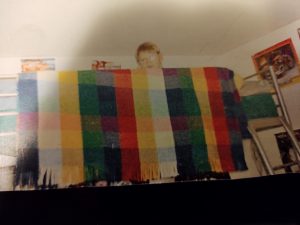
    I guess all of this allows me to continue to use the set and setting metaphor. It also allows me to stand back to better see the overall effect of a tapestry showcased at a craft show, to see what the entwining of set and setting have created.  Yasik has moved into a new setting, one that will also be threading a perspective on his mindset. I will begin to consider the world, the setting Yasik has moved into, and its part in the development of his mindset.

    As we strove to parent in a way that we thought offered love and care to Yasik, what perception was he forming of family?

    When we took this person, Yasik, to the park to ride the teeter totter, he was a tidy little package of 40 inches by 40 pounds and whichever one of us got on the opposite side of the teeter totter that stood a mere 2 feet above ground was north of 3 times 40 by 40. Sometimes Yasik was in danger of being tossed into the air; other times he could be stuck on the ground as we and all that pertained to his new world of family strove to find a good experience on life’s teeter-totter. Riding together with tiny on one side and extra-large on the other can still be wonderful fun if extra-large is caring and responsible and the mechanism that holds the teeter totter together and the playground it has been set in are copacetic (a weird word Dave used to love).

    davevincent.com

    I will look at our set and setting in the next posts by laying out our setting of family via adoption with the hopes of culling some awareness of the perceptions Yasik was developing.

    Maybe the only gift is a chance to inquire,

    to know nothing for certain.

    An inheritance of wonder and nothing more.

    ― William Least Heat Moon[vii]

    Footnotes


    [i] Penny, Louise Thorndike Press, GALE, 2006, 391-392

    [ii]https://journals.sagepub.com/doi/10.1177/2050324516683325?__cf_chl_f_tk=wx6hqyVqb0RnV29Gf0GY1iteYWJvyMH8sq_TQ9AEMvk-1783019840-1.0.1.1-cZK3lldW7m0xg6YL2M6OaxdRDhoyJWzL9tdXr.gB.F0

    [iii] Mukherjee, Siddhartha. The Gene: an intimate history. Scribner, 2016, 368-9.

    [iv] Mukherjee, Siddhartha. The Gene: an intimate history. Scribner, 2016, 481.

    [v] Maté, Gabor with Daniel Mate. The Myth of Normal: trauma, illness & healing in a toxic culture. Knopf Canada, 2022, 241-243.

    [vi] Letourneau, Dr. Nicole with Justin Joschko. Scientific Parenting: what science revels about parental influence. Dundurn Press, 2013, 56,57,70,34,35.

    [vii] Heat Moon, William Least. Blue Highways. Eine Reise in Amerika. https://www.goodreads.com/work/quotes/1383812-blue-highwasy-a-journey-into-america

  • Our Son is a Person

    I know we tend to pickle memories in a brine that renders them more rosy-shaded than blood-red.   Nonetheless my journal is a record of how I viewed my world at the time, a primary source with hopefully less cherry-picking than my mind might remember now.  Still, reading those journal pages 25 years later, it seems they might have been wrapped in pink cellophane, oh yes, the ‘honeymoon period’.  And I am not alone, at least as far as I could tell from the one or two books I came across in those early years.  One book I remember was written by a woman a year or two after adopting her ‘forever child’. The book was rosy from cover to cover.  We would have written the same and if Kisses from Katie[i] is anything to go by, people still are.

    Recently I heard the Avett Brothers on Jimmy Kimmel singing a song that asks, “How long is now?”. The song, full of hope and happiness, answers with the word, “Forever”.  It brought this time to mind, singing of the wonderful days in a lifetime.

    This post will offer vignettes of that good time as I seek to establish something that may seem obvious but, at perhaps a less than conscious level, is not always firmly embedded. Yasik is person, not merely a set piece or accessory in the arrangement called family.

    I was wondering how to approach understanding who Yasik was showing himself to be as our son and how that might help to reveal his perception of himself and his new world.  I googled with the words that came to mind: personality traits, that sort of thing.  Google led me to philosophical sites of all things: the idea of personhood.[ii]

    It appears we as persons are physical and mental beings who develop networks of beliefs that impact how we calculate and think about our environment and social relationships, using reflection and language to make autonomous choices and engage in actions. My journal entries allow me to work backwards from Yasik’s actions to uncover the person he was/is.

    But why examine such abstract philosophical and psychological concepts?  I had been considering sharing some bits from the journal that I later recognized were best kept private to the family. “Yeah but …, No but…” CHILD CATCHERS: rescue, trafficking, and the new gospel of adoption[iii] by Kathryn Joyce deals with a variety of movements that have led to bartering in orphans for their souls, for money, for prestige, or to fill some personal hole in their lives.  Christians rescuing heathen, governments looking for financial gain or political pawns, couples looking to place a family portrait on the mantle.  John Brooks in The Girl Behind the Door[iv] says, “We treated Casey as if she were our new pet”. At times in the ‘honeymoon period’, as I bring forward in the post Parents? Yet Tourists?, our child was our pet. We may not have seen our child as a commodity, but it can’t be denied that some part of us, wanting family, did not initially see our child as a distinct and individual person but as a piece to finish a look we imagined completed our image of ourselves and our lifestyle.

    Perhaps we can hone an awareness of the orphan as a person in his or her or their own right by thinking very specifically about what makes each of them a person. Perhaps then we will recognize each child caught in the liminal (a word new to me but I like its eeriness) state of orphan as an individual whose personhood must be valued.

    Physical being

    Numbers-wise there was not much of the ‘physical being’ about Yasik at the start: essentially 40 inches by 40 lbs.  But whatever little there was, it was packed into a well-proportioned body, capped with soft blond hair.    We had a cherry tree in the front yard with branches like big arms about four feet off the ground.  Dave tucked into the arms one evening to hide in a game of Hide and Seek but those 40 inches of bursting energy were just not up to the hunt. Dave sat right in front of Yasik in the cherry tree, but 20 inches short of the tree’s arms, he could not see Dave.

    Where it mattered, of course, and especially with the adjustment a pair of glasses made, Yasik could see just fine.  We watched a video with Yasik one evening about where kids come from. It made the observation that a woman has breasts, showing a cartoon woman with straight out breasts and nipples.  Later I said to Yasik, “See, I have breast too”.  He said, “No, yours don’t stand up.”  He could see. Yasik could hear (he loved listening to music with earphones) which was later confirmed as hearing issues are usually checked as part of an assessment of learning difficulties; Yasik could smell (well we assume so for I have no concrete examples recorded); Yasik could taste (at first only familiar foods – which shows discrimination, right?); Yasik knew the message of touch (holding our hands and cuddling); and that sixth one, proprioception, appeared to be working just fine as his very effective fine and gross motor skills demonstrated despite Orphanage Risk Factors’ mention that often institutionalized kids are clumsy.  From leaping around on the park dragon to hitting the T-ball to biking, he showed skill and prowess.  Of course, there was that one time just after Yasik got comfortable on his bike, we biked around the block. On Braid St. he biked into a telephone post. He got a bit disgusted and said, “Tomorrow they have to move it over there” – meaning across the street. But clumsiness or awkwardness of movement have never been evident.  He knows where his arms and legs are and where they are headed – exactly where he wants them to go.

    And as for that one bug-a-boo, size, the material on Orphanage Risk Factors notes that institutionalized kids make size gains within months of adoption. I noted sometime after Christmas of that first year that “he keeps growing.   He wants to be measured a lot to check if he’s grown and usually he has – he is growing steadily but he is still the littlest kid in the school”.   Attaching in Adoption: practical tools for today’s parents takes concern for size seriously, saying children can feel embarrassed about being short.  They may see it as mocking their drive for independence from being needy[v].  Getting glasses centered his right eye but being little was an on-going concern.

    Notes from our ‘getting to know Yasik’ meeting with orphanage staff say Yasik had dealt with rickets, poor nutrition and a lack of Vitamin D due to little exposure to a world beyond his crib. He also had what they called an infant allergy or intolerance to sweets. The staff assured us the rickets and allergy and their after effects were now gone, as is most often the case once diet and exercise needs are met.

    He did have a secret power though – when chicken pox banged at the door, the doctor thinks the resistance to infection spawned in the orphanage made him quite invincible to many childhood illnesses. Other than a mild diarrhea, he was free to play in the park for the week he was quarantined from school. His body was also well adjusted to the rhythms of life for he slept well, ate well, especially sausages, piroshkies and fruit in the early months. The fruit kept things humming so well that we would occasionally ban apples. Loving fruit, Yasik would have us check to see if his poop was firm enough to lift the apple ban.

    Mental being

    And the ‘mental being’?  A Google definition says it is about memory, emotion, intention, desire, pain experience, perception, and belief. I would like to add as a separate concept, the gift of curiosity we are given.

    For whatever emotional, psychological or neurological reason, Yasik says he has no memory of his life before the flight to Canada. Yet ….. while we waited for our pre-dawn flight home in the Moscow airport, facing out into flat river valley, a harvest moon arose.  It was huge.  One evening, a few months into his first year with us, he and Dave were on the computer.  Dave was making supper and Yasik was playing on the computer. A large moon came up on the screen.  Yasik called Dave over and pointed to it, “Papa that is where Yasik is from”.  He explained that “They pulled the string” (like maybe a bus stop string?) and he came down on an airplane.  His memory system was doing what memories are to do – providing him with a narrative. He came from the moon.

    It is the only memory he shared other than recognizing the little kids pictured waving good bye to him from the orphanage front porch.  Sadly, or simply the by-product of embracing a new life, there came a day when he no longer wanted to look at their pictures before bed.  John Brooks talks of the same with his daughter, Casey.   John and his wife Erika had created a “scripted fantasy story” about Casey’s bio mom loving her but wanting her to have a better life and so the Brooks “went all the way to Poland to find” Casey. (I bet they dragged that word ‘all’ out).  But Casey showed little curiosity about her bio family or the orphanage, or Poland[vi].  And yes, more could be said re: the fantasy story and magical thinking as per the Child Catchers: rescue, trafficking, and the new gospel of adoption[vii].

    We could not deny he had emotions either, from robust anger to sweeping happiness.  Angry that he must obey, laughing so freely when happy, yelling, “Yee Haw” while biking, excited and giggling playing Hide and Seek. He had us outside, having one of us hiding while he had the other counting and helping him hunt, but it was all his when the hunted one was spotted as he broke into a determined run to kick the can; he burst with pride at handling bumper cars with Kyle; he entered into T-ball games wholeheartedly – no standing on the sides, no matter who played. Yet come the evening, he slipped into cuddly mode.

    Yasik fell from a stand at his last T-ball game and he was leaning against the fence trying not to cry. Dave went over and picked him up from behind. He turned into Dave’s neck and cried his heart out. But again, all in the same day, he might punch your bum and leap on you. He would leap on my back while I was crouched at the fridge and get me in a strangle hold.

    Erik H. Erikson, student of life, according to Daniel Levinson[viii], and person who never knew his bio-father and never felt fully accepted by his step-father, designed a theory of human life rather like a train on a railway line with 8 stations along the way.  Yasik should have, at this point, passed the stop of Trust vs. Mistrust (infant) and Autonomy/Independence vs Shame and Doubt (toddler) and if all was going well, was in the stage of Initiative vs Guilt (pre-school).  Orphanage Risk Factors suggest that often children who begin life in an orphanage are emotionally delayed.  So, was the train of life carrying Yasik getting to each stop on time and leaving on time?  Can adoptive parents even tell this early in an adoption? Were we going to see Yasik trusting us as his parents? Sara Nović saw her adoptive son’s freedom to say ‘No” as “[trusting] us enough to know we wouldn’t disappear at the first sign of non-compliance.”[ix]  Was he confident enough to take up challenges?  Was he becoming more and more skillful and able to make decisions that show a growing control of his impulses?[x]

    Not to gloss over the Orphanage Risk Factors I have noted here and there, I might add that we did watch Yasik self-soothe by rocking on the couch while watching TV or listening to music and when in the car.  I’d also say there was some self-parenting when he could get a bit bossy, telling us to stop doing something that irritated him or becoming indignant when disciplined.  But he was not having obvious problems with impulse control other than making sure we knew his negative opinions as clearly as his positive opinions.  He did not come to us cowed by orphanage punishment though he would show initial hesitancy when encouraged to try new things like testing out the slide at the playground or learning to ride his bike. Nonetheless, there was no evidence of a ‘learned helplessness’ for with encouragement, he tried whatever challenge was offered.   Was he indiscriminately friendly? I don’t think so for it took little for him to be willing to make friends.  When visiting in the home of his buddy, the buddy’s mom found him to be more cuddly than her son. But there was no going off with strangers or seeking a stranger’s attention.  And if you watched him watching ‘Forrest, Forrest Gunk’ you could rest assured he was able to hold a concentration or focus. He was acting like a happy little boy. He seemed to have enough trust and independence to beetle on into anything.

    Maybe the mental being marker of intention will provide some answers. Dave’s birthday came along in March.  Yasik and I went shopping for a gift for him.  He got Dave a plastic foldable set of swords – for lots of sword fights with himself. On another day, Dave suggested Yasik pick flowers for me.  The next day Yasik was mad at Dave for a reprimand.   On the way to school I told Yasik that Dad did so because he loves him.  Yasik goes “Oh”, stopped and picked a buttercup, saying, “This is for my daddy”.  As an afterthought, he picked one for me so I picked one for him and again he said. “Ooh” – both ‘Ohs’ in awe. (I kept that little flower in the journal for many, many years).

    Any organism, if it is alive, demonstrates desire, so it can be no surprise that desire burbled in Yasik’s breast.   Right from the start we could tell he was into long-haired girls.

    We were visiting friends in Chilliwack whose only child was a beautiful, long-haired girl. Yasik fell in love with her, not reciprocated of course, for she was several years old than him, but she played with him and that was good enough.

    I have read here and there that curiosity is a special gift tucked into the bundle of personality traits of the lucky. I am not so sure; it seems to me that whether it is slipping into a shop to see an item we are dreaming of or questions we have about the connection between nature and nurture which leads us to Nobel prize honours, we likely each have some measure of curiosity.  Even our dog shows curiosity most days, sticking his nose in here and there on our walks.  Yasik too, has always poked his nose into things around him: how to drive the car, checking out what might be hidden in dense bush, even if it meant getting dirty to find out, figuring out how to help some fish get upstream.

    It is harder to pin point his experience of pain for he rarely seemed bothered by confrontations with pain. Much of what would have others cry out seemed to bounce off him. Or maybe his physical dexterity came to his aid, allowing to him slip past most potential accidents.

    Perception it seems is the expression of the physical and genetic attributes as they entwine with the mental attributes which together lead to a way of regarding, understanding or interpreting something.  Or better yet, we as persons are physical and mental beings who develop networks of beliefs that impact how we calculate and think about our environment and social relationships, using reflection and language to make autonomous choices and engage in actions, with the right to be accountable for our choices.

    I think Belief, in a narrow definition, is chain-linked to perception so will check it off the list as essentially being dealt with as perception.

    I hope to discover Yasik’s attribute of perception as I work through the next few posts.  Other than that, the bases are covered.

    So yeah, he is a person.

    Footnotes


    [i] Davis, Katie with Beth Clark   Kisses For Katie: a story of relentless love and redemption  Gale Cengage Learning, 2011.

    [ii] Camilleri, Adrian. “What are the Characteristics of Personhood?”  Philosphymthttps://philosophymt.com/what-are-the-characteristics-of-personhood/.  January 7, 2022.

    [iii] Joyce, Kathryn.    the Child Catchers: rescue, trafficking, and the new gospel of adoption.   Public Affairs,2013, 67

    [iv] Brooks, John   The Girl Behind The Door: a father’s quest to understand his daughter’s suicide.  Scribner, 2016.

    [v] Gray, Deborah D.  Attaching in Adoption: practical tools for today’s parents. Perspectives Press, Inc., 2002, 37-39.

    [vi] Brooks, John.   The Girl Behind The Door: a father’s quest to understand his daughter’s suicide.  Scribner, 2016, 55-56.

    [vii] Joyce, Kathryn    the Child Catchers: rescue, trafficking, and the new gospel of adoption.   Public Affairs, 2013, 75 – 127.

    [viii] Levinson, Daniel J.  The Seasons of a Man’s Life. Harper & Row, 1979.

    [ix] Nović, Sara   Mother Tongue: a memoir   Random House, 2026, 219

    [x] Wade, Carol et al.  Psychology: custom edition for Thompson Rivers University.  Pearson, 2007.

  • Stick to a Routine

    Institutions of all sorts dress themselves in routines. It is certainly a given for orphanages whether George Mueller’s Ashley Down in 1849 or SOS Children’s Villages today.

    Routine at Ashley Down Orphanage 1849 – 1958.[i]

    TimeActivity
    6:00 AMWake-up, washing, dressing, and chores (making beds and cleaning floors)
    7:00 AMMorning preparatory work – girls at knitting or sewing, boys reading
    8:00 AMBreakfast
    8:30 AMMorning devotion (Bible reading and prayer)  
    10:00 AMSchool commenced, covering subjects like reading, arithmetic, geography, and hymn singing
    1:00 PMDinner (the main midday meal)  
    Afternoon to 4:00 PMSchool resumed until 4:00 PM, followed by an hour and a half of play or outdoor exercise
    6:00 PMTea
    Evening“Useful work.” Girls worked on their needlework and mending; boys were assigned to gardening or learning trades
    8:00 PMYounger children went to bed.  
    9:00 PMOlder children went to bed  

    Routine at a SOS Children’s Village in Tanzania, 2023.[ii]

    TimeActivity
    6:45 AMWake-up and morning prep
    7:30 AMBreakfast
    8: 00 AMSchool starts
    2:00 PM  School is out – play, naps and homework time
    6:00 PMSnack time
    7:30 PMDinner time  
    EveningRelaxation
    9:00 PMBedtime

    Routines in Russian orphanages

    Were the orphanage routines in Russia in the 1990s as airtight as the George Muller Orphanages’ routine or did they resemble the routines of SOS Children’s Villages today? Did Russian orphanages include education and leisure or creative activities as well as food and bed times?

    Human Rights articles affirm that Russian orphanages do offer education as well as meeting the physical need of the children.   Nonetheless, a study of two St. Petersburg orphanages reported a 2 care-giver to 4 child ratio. Staff at these orphanages worked 40-hour weeks.  Routine is implied, even if possibly weighted in favour of staff demands over child needs of individualized care.[iii]

    One day doing some ‘gentle art of Swedish death cleansing’, I rifled our ‘important papers’ box. I came across some notes I took in the one meeting we had with staff before Yasik became ours. His schedule may have been:

    TimeActivity
    7:30 AMWake-up, wash, dress, exercise
    8: 00 AMBreakfast
    8:30 AMLessons: drawing, clay modelling, constructing houses, playing with cars, learning poems by heart – education for two- to four-year-olds
    12:00 AMLunch
    1:30 – 3:10 PMToilet and nap
    3:30 PMSnacks of cookies, buns, yogurt and fruit
    4:30 – 6:00 PMWalks, swimming, being read to
    7:00 PMDinner, games, cartoons, toilet
    8:30 PMBedtime

    His routine appears not so different from today’s SOS Children’s Villages, not even so far off from George Muller’s orphanages.

    Routines for Families

    And not so different from the way responsible parents anywhere in the world manage the lives of their children.   There is no ‘Breaking News’ to the place of routine in the lives of families whether biological or adoptive. A routine aids in meeting the demands on the lives of children and the demands on their parents. Routine is a glove slipped on whether a child has never known a conflict-filled home or is coming from a life filled with destabilizing events.

    Routines for adoptive families

    I doubt there is a manual for adopters out there that does not urge routines.  “Routines provide essential predictability, but the quality of relationships within them determines their true impact on a child’s development”, according to Grok.

    Most offer advice similar to this:

    Children crave structure and routines. It helps give them a sense of control and allows them to develop trust. Having set bedtime rituals for a younger child, or a weekly family movie night for an older child, are great ways to establish a connection. Routines establish a solid foundation to grow from. In turn, your child will bond with you more easily![iv] 

    The Adoptive Parents’ Handbook quotes a researcher:

    Children who have experienced complex trauma frequently have lived in an environment void of structure and routines.  They form a perception that the world is an unpredictable and dangerous place, and their capacity for developing competencies though self-exploration and mastery become inhibited by fear.  One of the key principles for restoring a sense of safety for a child is implementing predictable daily routines that establish safety, help children organize experience, and develop mastery.[v]

    Routines shifting from institutional to family

    How does a child whose earliest life experience has been shaped by institutional routine see becoming part of a family routine?  How is ‘family routine’ different from institutional routine? Is it all so different?

    Free of jet lag, adoptees will get up more or less at the same time, at least on week days.  They will dress, eat and head off to whatever the day demands. They will be given opportunities to play and regular times depending on the whether it is a week day or a weekend. They will eat at roughly the same times and head to bed at times encouraged by child authorities the world around. Routines are accepted as part of any well-functioning life.

    The difference is that they will do so with less people and a higher adult to child ratio.  Many will be in a 2 parent to one child ratio – much more parent than peer orientation.  The experience will be new; these new staff members are strangers; there will be adjustments but hey, the new staff have come bearing gifts and goodies and are offering lots of attention.

    During one pre-adoption interview, I volunteered that having a bio-baby was not fully excised from my mind. Our case manager’s eyebrows went into steep arch.  No, no, no. We could not be thinking of having a child, as if there was even a serious possibility of a baby from my past prime body. Our sole focus must be given to this child. I promised to go on the Pill.

    And we, with little conscious thought that routine was a must, slipped into family routine: morning, daytime and evening musts and wants, decided both by us and him. He wanted time to watch Forest Gump. We wanted to tuck in some educational moments, working with Yasik on the alphabet. Well, we had bought this cute little easel to hold big paper.  So OK, begin to establish routines as soon as needed, but the whole perfect-parent-molding-the-perfect-child plan might need to be spaced out a bit

    We found a night time routine that worked for us: play, watch a video, bathe, read a bit,[vi]kiss a lot.  Born for Love says for someone who has lacked such attention is, “Like an addict with a tolerance, it takes a higher “dose” to get the same effect”.[vii] Yasik initiated the kisses as easily as we did, taking our faces in his hands or blowing a kiss at us and beaming.

    We did put together a photo album of the orphanage and the kids there.  He looked at it often in the early days.  I would end the evening with a little prayer to ‘Dear God’ with him and he was out.  We were not inclined to incorporate church-going into our life style but I wanted Yasik to have some awareness of a god. Praying was what I did and passed on to him.

    Routines to thwart

    be

    What happens in an institution when a child doesn’t want to comply with the routine? Having too much fun at play time, dawdling over a meal, not wanting to go to bed? It can be called ‘being silly’; it can be called ‘non-compliance’.  It can elicit a happy face or one of those downward dog faces.  It can be a good laugh; it can trigger an appointment with the behaviour changing squad shouldering back packs filled with therapy tactics, empathic or draconian.

    Yasik certainly did his best to thwart family level efforts of routine barely 24 hours away from his daily experience of orphanage routine.  In a whole new world of light switches and tv remotes in the apartment in Russia, eating and sleeping were not high on his agenda. Being given a whole bedroom and all its wonders made sleep seem even more unfair. Other parts of routine were more acceptable, at least if the food was familiar.

    For all those little attempts to adjust routine, for the most part Yasik knew he was sticking to a routine. When we later began to ask Yasik what he did at school, he seemed quite accepting, quickly recognizing that there was routine, “Work, work, play, work, play, play, work.”  He’d accepted that everybody in his world was sticking to routine.

    And our routine was given the ‘stamp’ of approval by our social worker/case manager. The first post-adoption report put our early days with Yasik in social workese,”[Yasik] likes to have structure”.  She knew what the adoption advice manuals promoted. We were all comfortable with slipping on the glove, sticking to a routine.

    Footnotes             


    [i] https://www.facebook.com/watch/?v=367933023629309   or https://www.mullers.org/history

    [ii] https://www.facebook.com/watch/?v=367933023629309   or https://www.mullers.org/history

    [iii] Tsvetkova, L.A., Grigorenko, Elena, L., Rifka J. Muhanedrahimov, Arintcina, I. A., Solodunova, M.Y., Anikina, V.O., Vasilyeva, M.J., Chernego, D.I.   “Structural characteristics of the institutional environment for young children”. Developmental Psychology, Volume #9, 2016. https://psychologyinrussia.com/volumes/?article=5351

    [iv] https://www.adoptionchoices.org/bonding-with-your-adopted-child/

    [v] Tantrum, Barbara Cummins. The Adoptive Parent’s Handbook: a guide to healing trauma and thriving with your foster or adopted child. North Atlantic Books, 2020, 85-86.

    [vi] Szalavitz, Maia, and Bruce D. Perry, M.D., Ph.D.  Born for Love: why empathy is essential and endangered. William Morrow, 2010, 312.

    [vii] Szalavitz, Maia, and Bruce D. Perry, M.D., Ph.D. Born for Love: why empathy is essential and endangered. William Morrow, 2010, 135.

  • Forming a Family 

    Library shelves in the 21st century continually showcase new books being written about adoption scandals coming to light in countries from China to Canada to Argentina to
    Britain. Each speaks to horrors that make international protections of vulnerable children understandable.  In 1997 we could not have imagined following the dots from the need for such protective measures to our personal experience of adoption. When that young judge in Russia pronounced us acceptable parents, we understood that Yasik was indisputably our son.

    Forming a Family involves interviews and paperwork

    That heavy word ‘however’ now comes into play. At least in the language of legal documents, he was not yet entirely our son. We likely huffed and puffed about that revelation at the time, but as I write today, I understand. A mere four days into being family in Canada, we were told we also had another 10-day wait period before Yasik was truly, truly, truly our son, perhaps part of the wait period begun in Russia. 

    In all the joy of those days, months and years of the ‘honeymoon period’ the uncertainty continued to rattle, a reminder that adoption was its own kind of family. Yasik became our son in 1997 but not until September 2000, having completed 5 interviews, at the going rate for a social worker, and the cost for translation to Russian, were we assured there would be no more post-placement interviews. 

    The BC Adoption Act and Financial Administration Act: Adoption Regulation, last amended March 30, 2022, appears to request only one report now. 

    Our first interview/report in November 1997 concluded with this statement: “I recommend that this placement continue to proceed.  It appears to be an excellent match and all are enjoying forming a new family together”.  

    What if it had not been recommended to ‘continue to proceed’ three months after Yasik came into our lives? 

    Little caveat here: after the five interviews, release from yearly interviews came when Dave wrote to the adoption agency that we thought we had made sufficiently plain that Russia need no longer worry about Yasik’s unshakeable place in our hearts and lives.  The BC adoption agency wrote back to say that the number of post-adoption reports came at the request of Russia which had experienced a few ‘rehomings’ or returning the adoptee to Russia.  We were but a part of a greater concern for the welfare of vulnerable children and should be grateful that Russia was doing its homework.

    Added to the interviews, in this two-week parental leave, we began to get Yasik’s Canadian paper work together when we ran into one of the hiccups I had noticed at work particularly with Sri Lankan students.  At the top of his landing papers, the government had written Yasik’s name using the Cyrillic alphabet.  At the bottom of the paper his name was written in the letters we call the ‘right’ ones.  The government was going to use the letters at the top on his citizenship card and his care card.  The person on the other end of the telephone would not budge, telling us that it would require a change by an office in Victoria and would cost $225.00.  Immigrants with limited financial resources and hesitancy to make waves regularly found themselves with names that included the tribal name, a part of their name these prospective new Canadians did not use even in their former country. This would add letters to a name which then became too long for computers to accommodate. But we were people much more secure in our rights as Canadians.  Dave called Victoria and told them quite firmly that there was no sense to using the Cyrillic alphabet in Canada.  The preferred spelling at the bottom of the page was as clearly written as the Cyrillic.  The voice on the other end of the phone acquiesced. I have not discovered if this remains a problem for the newly arrived.

    Forming a family involves hesitancy

    My journal can be annoyingly honest at times. It admits that both Dave and I did have an ‘adjustment’ moment wondering if we could really do this, even wondering, did we want to!?!  Yes, it warrants an exclamation mark accompanied by a question mark.  Note though it was a ‘feeling’, not anything we acted on for the next line goes on to reassure that the feeling petered out.  Yasik had the resolution “weighted unfairly in his favour”.  He beamed at us and it was game overDr.Bruce Perry tells us our brain reward system sinks us.

    What could prompt parents to give up sleep, sex, friends, personal time, and virtually every other pleasure in life to meet the demands of a small, often irritatingly noisy, incontinent, needy being?  The secret is that caring for children is, in many ways, indescribably pleasurable.….  What we call “cuteness” is actually an evolutionary adaptation that helps ensure that parents will care for their children, … the important neurobiological “glue” that bonds and creates healthy relationships[i].

    And now it was the first week of September, 1997, the September week that Mother Theresa died, and even more absorbing for the globe, Princess Diana died. Over a decade later, we would share another eventful week with the royal family.

    Forming a family involves concern over deviations from expectations 

    There were two disconcerting pieces to this otherwise wonderful beginning.  I noticed at the park how quickly other children pointed out how small Yasik was, his inability to speak English and that he had one lazy eye.

    With this, and too readily for Dave, Yasik would at times hit or try to bite me in unacceptable excitement.  Where did the biting and hitting come from? 

    Let’s get the hysterical response out of the way first. Yasik had been institutionalized in his most formative years; if he was hitting and biting, he must have RAD, reactive attachment disorder, so say the fear-mongers. This ‘diagnosis’ for adoptees ‘acting up’ was one of the first I heard.  Was Yasik being a bully?

    Initially, as adopters sought to understand their adopted children who were not acting particularly perfectly, RAD was a handy blanket explanation. In time the messaging was studied. Now adoptive parents are warned against jumping on this bandwagon too quickly. It is considered by many researchers to be rarer than first thought[ii].  For us having to deal with a couple of tantrums would have made rushing to a diagnosis of RAD ridiculous. 

    Was Yasik simply trying to take care of himself as he understood self-protection, a survival response learned in the orphanage? Hold On To Your Kids led me to wonder if this was a learned behaviour in the orphanage environment where children would of necessity be more peer-oriented than parent-oriented in learning social behaviours[iii]. Attaching in Adoption says, “Children who lived with busy orphanage workers or with depressed or drug-affected birth parents learned to get louder, more persistent, more irritating, or more charming, to get basic needs met … [therefore]“The rule of thumb is that, when first placed, children will relate to new parents in much the same way that they related to former parents or orphanage workers[iv].

    Or did it come from the trauma of the first four years?  “The aggression and impulsivity that the fight or flight response provokes can … appear as defiance or opposition, when in fact it is the remnants of a response to some prior traumatic situation ….[v].  Our minds default to choices based on associations to memories.

    The brain tries to make sense of the world by looking for patterns.  When it links coherent, consistently connected patterns together again, it tags them as “normal” or “expected” …[vi].

    Orwas this anti-social behaviour a child’s way to express the separation/the strangeness of all the newness jumping up in front of him like goofy characters on a subterranean canal ride at a theme park, an inappropriate response but perhaps the only one he knew.  Maybe hitting or biting were simply overload reactions to not having enough language to cope.   How could he ‘use his words’?[vii]

    Or was Yasik testing a love he did not yet understand or trust? How does a child understand a parental love he or she has never yet experienced?  How is trust generated in someone who has only ever been a client, not a family member? Pretty much every book I’ve read about nurturing an adoptee will make note of children who test boundaries as a way to test the strength of the love being offered to them[viii]. Appearing to prove they are not loved or loveable but yearning deep within to be proved wrong. As Bruce Perry says, it takes a whole lot of love but the message of love can find secure hold in a hungry heart.

    Some of Dr. Perry’s understanding of the need for a whole lot of extra loving came from watching a caregiver named Mama P. She saw even older children as yet emotional babies still needing loving cuddling to allow catch up for those areas of a loved-deprived child’s psyche still underdeveloped[ix].

    Our response to this behaviour: at first when he hit out, kicked, spit, slapped or punched, we held him down, put him in bed and even spanked him once.  He would cry but then calm down and all would be fine again for our little newcomer with little language living in a world still very strange to him.  By the end of the first week, we hit on the ‘novel’ idea to put a chair in a corner and have him sit there to cool down. 

    Attaching in Adoption says “If children throw tantrums, hold them close…. to … comfort them”.[x] 

    Brodie in need of one last cuddle, Oct 08, 2020 – June 23, 2026

    Born for Love reminds parents, when your attachment is still insecure then

     … social punishments like a “Time-Out” [can be] less effective.  Being less loved – or having repeated early experience of loss … can also make loving itself harder and less satisfying.  Like an addict with a tolerance, it takes a higher “dose” to get the same effect…. neglected children or those with other attachment disruptions are much harder to soothe or to teach….[xi]

    Were we just plain lucky that one or two opportunities to explore a time out and a nod toward the chair led Yasik to cool it?

    I have come back time and again to this encouragement from Perry: “although early deprivation is damaging, the worst outcomes can be mitigated”. He is referring to monkeys here … but then he finishes with, “Fortunately, this is often true for humans as well.”[xii]

    Forming a family involves social dilemmas

    These first two weeks as a family came between the end of summer classes and the beginning of the fall semester; there was no opportunity to access my union’s allowed three days ‘parental leave’ for adopters.  It was time for school. 

    Luckily I guess, that particular year I had evening classes so the first days of September gave me a schedule that allowed me to be at home with Yasik in the morning.  Dave dropped some of his course load, taking only morning classes three days a week.  Yasik’s needs were directing his art education. I stuffed Yasik into his car seat and worked against afternoon homeward bound traffic to Emily Carr University, picking Dave up. He took the driver’s seat and headed further into Vancouver to my school after which Dave and Yasik caught the bus home while I taught.  Two weeks into the school year with this schedule and we furrowed our brows. Perhaps we ought to just see about a possible kindergarten for Yasik.

    We called the school to make an appointment, and Yasik was a new kindergarten student by the end of the day.

    The journal says “And childhood is over – the staff at the community school down the street urge starting kindergarten as best for him for socializing, school prep, and ESL (the kindergarten teacher spoke some Russian).  And he has been watching the kids at the park – we feel he is ready”.  We would be keeping our promise to the Russian judge for this was not (God forbid) abandoning him to day care.

    And what do the experts say about that: most say don’t rush into a wider social world. Keep your child close for enough time to build a secure sense of family. Might sending Yasik off to an institutional setting, even one as cozy as our little community school be heading right back into a peer-oriented, rather than family-oriented, environment?[xiii]  Some specifically adoption advice books were quite blunt: “As a new adoptive parent you should take time off from work after your child comes home… building trust is a process that cannot be rushed”.[xiv] Even in the face of “A social dilemma [which] already exists about the balance of career versus adequate time for infant attachment.  When older children are adopted, there is even less appreciation for the generous amount of time needed for parents and children to form attachment.[xv]

    For us specifically, the ‘social dilemma’ seems to have come down to bowing to the dollar over the hopes of the heart strings.  We had to find a way to pay off the adoption debt and the mortgage and Dave’s education, and the life we promised to provide this child, but we did also believe we would be meeting Yasik’s language needs and the social needs we understood a child of his chronological age needed.  And once again we were working with our lack of awareness of the emotional impact of his past.

    Adopting Older Children shrugs a bit “You also need to give yourself permission to not be a perfect person or a perfect parent.  Sometimes you will just be a “good enough’ parent and that’s okay”.[xvi]

    We chose to send him to kindergarten.

    Footnotes


    [i] Perry, Bruce D., MD, PhD, and Maia Szalavitz  The Boy Who Was Raised As A Dog: and other stories from a child psychiatrist’s notebook.  Basic Books, 2017, 90-91.

    [ii] Mercer, Jean   Understanding Attachmenty: parenting, child care, and emotional development   Praeger, 2006, 109-112

    Perry, Bruce D., MD, PhD, and Maia Szalavitz  The Boy Who Was Raised As A Dog: and other stories from a child psychiatrist’s notebook.  Basic Books, 2017, 229

    [iii] Neufeld, Gordon, PH.D. and Gabor Maté, M.D.  Hold On To Your Kids: why parents need to matter more than peers.  Vintage Canada, 2005, 65.

    [iv] Gray, Deborah D.  Attaching in Adoption: practical tools for today’s parents   Perspectives Press, Inc., 2002, 81-2, 24

    [v] Perry, Bruce D., MD, PhD, and Maia Szalavitz   The Boy Who Was Raised As A Dog: and other stories from a child psychiatrist’s notebook.  Basic Books, 2017, 52.

    [vi] Perry, Bruce D.. MD, PhD, and Maia Szalavitz   The Boy Who Was Raised As A Dog: and other stories from a child psychiatrist’s notebook.  Basic Books, 2017, 26

    [vii] Gray, Deborah D.  Attaching in Adoption: practical tools for today’s parents   Perspectives Press, Inc., 2002,73

    [viii] Mercer, Jean   Understanding Attachmenty: parenting, child care, and emotional development   Praeger, 2006, 119

    [ix] Bruce D. Perry, MD, PhD, and Maia Szalavitz   The Boy Who Was Raised As A Dog: and other stories from a child psychiatrist’s notebook.  Basic Books, 2017, 152, 153.

    Gray, Deborah D.  Attaching in Adoption: practical tools for today’s parents   Perspectives Press, Inc., 2002, 275

    [x] Gray, Deborah D.  Attaching in Adoption: practical tools for today’s parents   Perspectives Press, Inc., 2002, 231

    [xi] Szallavitz, Maia, Bruce D. Pery, M.D., Ph.D.  Born For Love: why empathy is essential- and endangered   William Morrow, 2010, 135

    Tantrum, Barbara Cummins. The Adoptive Parent’s Handbook: a guide to healing trauma and thriving with your foster or adopted child. North Atlantic Books, 2020, 78

    [xii] Szallavitz, Maia, Bruce D. Pery, M.D., Ph.D.  Born For Love: why empathy is essential- and endangered   William Morrow, 2010, 56

    [xiii] Neufeld, Gordon, PH.D. and Gabor Maté, M.D.  Hold On To Your Kids: why parents need to matter more than peers.  Vintage Canada, 2005, 33, 65.

    [xiv] Bosco-Ruggiero, Stephanie, MA, Gloria Russo Wassell, MS, LMHC, and Victor Groza, PhD Adopting Older Children: a practical guide to adopting and parenting children over age four  New Horizon Press, 2014, 67

    [xv] Gray, Deborah D.  Attaching in Adoption: practical tools for today’s parents   Perspectives Press, Inc., 2002,22

    [xvi] Bosco-Ruggiero, Stephanie, MA, Gloria Russo Wassell, MS, LMHC, and Victor Groza, PhD Adopting Older Children: a practical guide to adopting and parenting children over age four  New Horizon Press, 2014, 222

  • Émigré to Immigrant

    Checklist: get landed

    Taking Yasik through immigration, Dave was asked, “Is your wife landed?”  Dave assured him, “Yes, yes, she is just over there, waiting by the luggage”.  The customs officer tried again, “No, is she landed?” And Dave proudly repeated, “Yes, we both went to get our son and she is waiting by the window.”  Did the officer’s training finally kick in?  He clarified, “No. Is she a citizen?”

    davevincent.com

    And we were back in Canada.  My parents, brother and his family, sister and her husband were there to pick us up and hustle our son into his new family, taking pictures, hugging and talking.  We felt so full at this moment, with love, family, satisfying occupations and interests, sufficient money coming in to keep the roof over our head and the bills paid.  We drove home to find my sister, Barb, had streamers, balloons, welcome signs, new toys, clothes, a car seat, and a big meal ready….  Book after expert advice book on adoption cautions against overstimulating a new adoptee with people, parties and presents, just so you know.

    After eating, we gave the wrapped toys to Yasik to open.  He picked up a gift but the wrapping stumped him.  Goggle told me only recently that generally Russian gift giving etiquette says that cheaper gifts are not expected to be wrapped in paper, only expensive ones. It is safe to say that any gift he may have received up to that point came unwrapped.

    For most of my twenties and thirties I lived in other cultures.  At work I often talked with our foreign-born students about their experiences and the impact of culture shock on their hearts, minds and bodies.  Nor was I personally a stranger to culture shock.  Yet it did not occur to me or any of the other adults in the room, half of whom had dealt with as much culture shock as I, that Yasik, now in Canada for roughly three hours might be dealing with this phenomenon as well. It was merely cute that he needed his 3-year-old cousin, Kyle, to show him what to do with gift wrapping. Were Dave and I given any heads up about an international adoptee’s perspective on a new culture?  Not likely as our adoption prep seminars focused on adopting locally.  And remember, we had little time to prepare for an international adoption.  Does that hold up as an excuse?  Adopters today appear to have much more information to prepare them.   Try a quick Google search for sites dealing with international adoptees and culture shock. You will find advice giving adoption sites and journals providing research of the issue.

    Happily in this case, a little culture shock didn’t slow Yasik. He studiously set about practicing the gift unwrapping lesson Kyle offered. Any diffidence at being the center of attention in an unfamiliar social setting disappeared. The little gift-wrapping hiccup turned out so positively for him, he moved on to giving his new Aunt Rena Russian language lessons, laughing at her pronunciation.  Some of our family’s first observations were that the orphanage must have taught him manners for he was polite.

    After the meal as everyone prepared to leave, Dave scooped Yasik up, thinking he might have fun helping Dave move our vehicle out of the way.  Yasik burst into tears.  Given the lack of sleep and jet lag it shouldn’t have been a surprise but I noted the outburst in the journal because the tears stopped as soon as Dave returned from the driveway.  This was one party he did not want to leave. Or could we dare to imagine it was an attachment hook we could hang hopes on?

    My mom and dad gave Yasik a teddy bear almost as big as him.  Dave found him at 4:30 a.m. the next morning hugging and talking away to it.  Studies in Attachment began early in the twentieth century.  Dr. Rene Spitz a psychoanalyst studying hospitalized infants

    [observed that] these babies [abandoned infants who received little individual attention in group care] developed odd reactions to strangers, .… the usual behaviour was replaced by something that could vary from extreme friendliness to any human partner combined with anxious avoidance of inanimate objects to a generalized anxiety expressed in blood-curdling screams which could go on indefinitely”[i].

    But he liked his teddy….

    Checklist: look for kid fun, visit the dentist, visit the doctor

    Having only a few days left of ‘parental leave’, we tucked in some family picnics and we slipped quickly into what most families in our neighbourhood seemed to do; we took him to the playground.  Other than a bit of experimenting with a play water pump on the periphery, he simply stood to the side holding our hands, watching other kids playing.  Getting him to actively engage took commandeering Kyle and climbing ourselves up the no-thrills slide the length of our own bodies.

    We tucked in some introductions to our friends as well in those first days. As the first post-adoption report notes, initially Yasik “appeared reluctant to let [his parents] out of his sight“. Yet Yasik was quickly overcoming shyness around others.  One relationship that particularly warmed our hearts was with Tony who himself was raised in Canada’s early adoption and foster system, one that was very difficult for him (SeeA Canadian Story of Adoption in the 1930s, Becoming Family). Tony showed Yasik his bee hives and he went home with a jar of fresh honey.

    The honey bit is not a segue way into a dentist visit. Yasik’s first dental appointment was on the checklist regardless. He seemed to take lying in the dental chair in stride but he looked to me so defenseless that I found the experience more emotional than I had expected.  He did not have the language needed to understand what was happening or to express his thoughts about what was happening.  Heart strings were pulled and then snapped back a bit.

    It was also actually imperative to introduce Yasik to our family doctor. The Hague Convention requires countries, of which Russia is one, to provide a translated medical report but adoption handbooks warn that this could be incomplete or possibly even inaccurate[ii].   Our pre-adoption medical report listed convergent strabismus (glasses were needed), adenoids enlarged (left to re-adjust on their own), dermatitis (never noticed it), speech delay (normal), short for age.  His motor skills were in line with his age as were his eating and sleeping habits.

    Our doctor agreed that other than being small for his age, a common side effect of orphanage life, he was quite healthy.  It was the doctor’s opinion that he may have built up a strong immunity by more exposure to bacteria and whatever else did not have to battle Purell.  And that seemed a good conclusion for he was never sick with any of the childhood plagues other children battled each year.  

    Odd, isn’t it?  Impervious to bacteria yet not getting enough nourishment to meet standard growth charts.  And it isn’t merely a matter of a lack of veggies and salmon as the experiment conducted by the German king, Frederick II, demonstrated in the 13th century.  His curiosity about the development of language led to his forbidding care-givers in an orphanage to speak to or hold the infants in their care.  The babies all died. Updating from the 13th century, here is a rather unequivocal research statement from the Psychology In Russia journal: The research literature suggests that institutions for children left without parental care do not provide environments that adequately promote children’s development, and that characteristics of orphanages should be considered as an environmental factor influencing developmental difficulties in children living in institutions and later in post-institutional families.[iii] Institutionalized children come into their adoptive families often pre-packaged with deficits biological, psychological and social. What was that doing to our son’s young heart, mind and body?

    Born for Love gives Chapter Three[iv] to an examination of the repercussions of early life in an orphanage.  The focus in this chapter is a girl adopted from a Russian orphanage but some of the research behind her story is taken from studies of Romanian children who spent their early years in orphanages during the time and under the experiments of President Nicolae and Deputy Prime Minister Elena Ceausescu. Not to sound like a snob but the deputy prime minister came equipped for this research with an elementary education and likely a doctorate obtained with the help of a professor. One of the charges for which they were ‘summarily executed’ as the saying goes, was the claim of their ‘research’ “that children will develop just fine without individualized attention and affection”.

    The 25-year study at SFU on the Romanian orphans meets the appropriate definition of research. A paper which came out of this study under a heading titled “Physical Growth”[v] says:

    While the malnutrition of institutionalized children contributes to their growth deficiency, another contributing factor may be the poor quality of interaction and stimulation offered by the low caretaker-to-child ratio in these institutions.  This type of growth deficit, known as psycho-social dwarfism [now referred to as psycho-social short stature], can be very serious.  However, upon removal from stressful or neglectful conditions, children suffering from psycho-social dwarfism tend to make tremendous gains in both height and weight….

    Contrary to Deputy Prime Minister Elena Ceausescu’s ‘research’ findings, this article and others in this search make the point that lack of nurture in infancy and early childhood compromise physical growth. 

    Quoting Little Britain’s Vicky Pollard’s “Yeah but, No but…”[vi], it’s nice to be able to rebut that this can be mitigated once a child is placed in nurturing care.  At our first post–adoption interview it was noted that Yasik “appears to need much cuddling” but that over the course of the three years of post-adoption interviews he went from 39.5 inches to 47 inches.  Okay, so still not the class giraffe but also not the only one in the front row of the class photo.

    Checklist: Forget the past?

    We don’t know how much Yasik understood of his situation as a ‘social orphan’, for about those years, Yasik continues to say he remembers nothing or next to nothing before the jet ride to Canada. Did stress or even trauma from the first four years shrink his hippocampus, or put him in a dissociative state in order to cope with the lack of consistent nurture?[vii]  Yasik had definitely experienced physical and emotional neglect, likely physical and emotional abuse, and had definitely been exposed to domestic violence and household substance abuse.  See Orphanage Risk Factors for more on this issue.

    Is it not possible to think that becoming a member of a family in a strange new world has added a further level of stress, however delightful the stress, to a young and still developing mind.  The stress of transition to an entirely new life, now heaped on top of separation from first caregivers and accustomed living conditions, abusive or otherwise, may stymie memory.  And then again, a young brain still developing, may not have retained these memories.[viii] 

    Two strangers are what he perhaps came to understand he was to hope for.  I have read here and there that for children in institutional care, the hope of having parents is the Holy Grail. How is a Holy Grail imagined to a 4- or 5-year-old?

    All of these strangers’ attention is solely on him and any desire he manages to communicate, but everything is new and mostly impossible to explain when these two strangers have neither language or culture awareness to reach out to him.  Attaching in Adoption cautions: “The comfort and competence that children feel in their own culture is lost as they enter a new surrounding”[ix].

    Checklist: start the re-education program

    Those shoes Yasik wanted to put on the moment he awoke in Moscow. We bought him new runners and tried to make the shoes disappear for they were already cramping his toes.  That evening we got the shoes off him and set them by the door. He wailed.  He seemed to have the idea that taking off his shoes meant bed time, probably an orphanage routine. The wailing stopped when no one headed him off to bed. Taking his shoes off at the door like a good Canadian became a new routine he comfortably settled into.  Like a proud mother, I also note in the journal that he was happy to help with household chores.  And like a proud mother who believed in education I have noted that in those first few days we taught him A and B.

    Yasik had now moved from émigré to immigrant in less than a week.  He had moved from an orphanage setting to a residential home, no one but him in a large bedroom.  Routines had been dismantled and recreated; cultural changes had been made with absolutely no orientation; no one spoke the only language he knew other than about 10 words to cover the necessities of life; he was interacting with two strangers whom he had been told are his mama and poppa; little of the food was familiar other than macaroni and sausages, and what about jet lag? All this newness at every hand and he was handling it entirely alone.

    Footnotes


    [i] Mercer, Jean.  Understanding Attachment: parenting, child care, and emotional development.  Praeger, 2006, 33-34.

    [ii] Bosco-Ruggiero, Stephanie, MA, Gloria Russo Wassell, MS, LMHC, and Victor Groza, PhD.  Adopting Older Children: a practical guide to adopting and parenting children over age four. New Horizon Press, 2014, 162.

    [iii] Structural characteristics of the institutional environment for young children. Developmental Psychology, Volume #9, 2016

    [iv] Szalavitz, Maia, and Bruce D. Perry, M.D., Ph.D.  Born for Love: why empathy is essential and endangered. William Morrow, 2010, 53.

    [v] Le Mare, Lucy, PhD, Karyn Audet MA

    A longitudinal study of the physical growth and health of postinstitutionalized Romanian adoptees

    file:///C:/Users/jacka/Downloads/A_longitudinal_study_of_the_physical_growth_and_he.pdf,

    ‘Psycho Social Dwarfism’ https://pubmed.ncbi.nlm.nih.gov/6741153/ 

    [vi] BBC production, Little Britain

    [vii] Perry, Bruce D. MD, PhD and Maia Szalavitz   The Boy Who Was Raised As A Dog: and other stories from a child psychiatrist’s notebook   Basic Books, 2017, 49-50

    Szalavitz, Maia, and Bruce D. Perry, M.D., Ph.D.  Born for Love: why empathy is essential and endangered. William Morrow, 2010, 255

    [viii] https://www.healthline.com/health/why-cant-i-remember-my-childhood

    [ix] Gray, Deborah D.  Attaching in Adoption: practical tools for today’s parents   Perspectives Press, Inc., 2002, 149

  • Introductions

    And then it was time to take one last trip through Moscow in the middle of the night, arriving at the airport when a full moon was filling the waiting room. 

    The airplane offered even more technical curiosities for Yasik.  We caught the wonder of earphones in the picture included here.

    While waiting in Frankfurt for our next leg of the trip, we met an American couple who had just adopted two kids and a woman who came across as a self–appointed authority on orphanages.  She was part of a church mission to help orphanages by setting up children’s camps.  At that time Russia was quite open to foreign help, religious or otherwise.

    One last leg of the flight and we were back home in Canada. Well, two of the members of this new nuclear family were returning home.  The third member was only about to be introduced to a new home.

    Yasik

    So let me jump off that word ‘introduce’ and take a moment to do just that. I have shared fairly liberally what we knew/came to know over time of Yasik’s background. I will round out what has been shared with some of the physical data of the child Dave carried off the airplane: Yasik was 35 inches tall and weighed 35 pounds, roughly the weight of our one-year-old niece and shorter than our three-year-old nephew.  He had convergent strabismus in his left eye.  He had soft, very light blond hair, a perfect nose and a tad over blown ears.  His eyes remain hazel brown even though his passport has them marked down as green.  Like I said, he was beautiful.

    And the other two in this family?  As I have exposed Yasik, it is only democratic to provide a basic sketch of Dave and me.  Dave first.

    Dave

    At the time of our adoption, Dave was 40, five foot 11 inches, not overweight but not skinny either as he had given up smoking the year before.  Our adoption home study says he has “blue eyes and glasses, balding short reddish blond hair”. 

    He was born in Calgary, Alberta to a couple whose marriage barely made it past his birth, their second child together.  At the time of the home study, we understood his mother’s heritage was Metis and his father was of Scottish heritage.  He remained with his mother who moved on to various uncles, two more marriages and 3 more children, half siblings to Dave and his brother.  His relationship with his biological father was not much more than a single letter.  The first step-father was simply criminally abusive.  The second step-father, who legally adopted Dave and his siblings, was anyone’s definition of a dedicated, working-class father, although it is possible to say that a man Dave met later in life offered the kind of mentoring that qualified as the most impactful fathering of all.  His mother, coming into a loaded adulthood poorly prepared, was, at times, supportive and, at times, unable or unwilling to be the mother she needed to be.

    In his late teens Dave sustained a serious car accident which left him with visible facial scars and two years of intensive rehabilitation mentally, emotionally and physically, but as he healed, he was imbued with a strong desire to get back into life. He went on to train in welding and motorcycle technology even while still paying for the impact of his childhood and accident by going into a marriage ill-prepared and rather quickly abandoned.  He also had many years training and working with challenged people which is where we met.

    For a year or so we were little more than passing acquaintances. One fine morning he came to the group home to pick up a client for a day program. I was finishing up a night shift before heading off to the school where I taught. In greeting, I mentioned I was soon leaving the group home.  He came back with an offer of a ‘farewell’ coffee on a Friday evening; we went for a drive that led to some house hunting, marriage, and moving into a house together a little over 3 months later.  And whew …., this usually ill-advised route to marriage worked for us.  A year after we married, Dave was accepted into Emily Carr University of Art and Design (ECUAD); he was going to school full time, working a weekend shift with a challenged client and practicing his interests in art and motorcycles in his spare time at home.

    He was about to start the second year of study and part-time employment when we flew off to Russia.

    Gail

    And me?  In preparation to writing this post, I wrote some preliminary notes and went off on a rampage about the religious world I was born into.  I will spare the reader.  In August 1997 I was 47, 5 foot, 6 inches tall and respectable weight-wise.  Our adoption study says I had, “long brown hair with bangs, green eyes”. 

    I was born in Chilliwack, BC, to a couple who remained married their entire lives but were not well-equipped to maintain a healthy marriage.  Both my parents had a few generations to deepen their Canadian roots but as was common in the 50s held on to their origins: mother’s family were British and Scottish; Dad’s family were German and Polish.  Guess which one in post-war Canada was a source of pride and which one was best whispered? 

    Both came from families somewhere between fundamentalist and evangelical Protestantism.  Whenever a question arose about what choice to make about most things from daily activities to finances to things more global, the tilt was toward the fundamentalist explanation of God’s truth.  Was bowling a sin? Most definitely, until, of course, someone thought it was possible to skirt around the sinful dangers. 

    But we were a family and each of us, myself, my brother and two sisters, knew that our parents loved us and wanted us to be happy.  Maybe they were too unsophisticated to be able to guide us toward to a conventionally successful future, but they would have resisted little of our inclinations, other than what was ‘evidently’ evil.  Mini skirts made Dad squirm; drugs freaked him out. 

    I use the plural for this part of my life because we siblings were each a year apart.  We all finished high school more or less and moved on to likely Canada’s largest fundamentalist Bible School.  We each graduated and went into missionary service.  I was in Northern Canada with my youngest sister and then we two joined my brother and other sister in the Philippines.  

    In what can only be considered ironic, it was getting up close and personal with the human beings we were attempting to rescue from the grasp of hell, that shook my understanding of such a mission. These were good people I could no longer see a loving God condemn to hell. Even if I worried that God was holding a flaming lightning bolt over me, I had had enough. 

    I returned to Canada and enrolled in Simon Fraser University along with my brother and one sister.  We each found jobs caring for the challenged and settled into completing our studies until two years before Dave and I married.  In those two years, although I continued working in a group home, I also began teaching in adult education in Vancouver.  I lucked out, finding a career I had only dreamed of in the days when I was certain God would not hear of me leaving what I had believed He considered the highest calling.

    I was about to return to a full-time position as a high school English teacher when we flew off to Russia.

    Ahhh ….. and a Canadian government site for prospective adopters offers a summary of the average adopters: over 30, generally financially stable and with no parenting experience.  Sounds like we were pretty normal and ready to go.

    But maybe the African proverb “Tell me who you love and I’ll tell you who you are” is enough info.