Yasik was now a Canadian Vincent. It was time to move from his Russian nurture to his nurture in our family, not ignoring that he would be bringing his Russian-transferring-to-Canadian nature and nurture along.
I heard Dr. Phil once say, in a context I may be misconstruing, that ‘it’ (life/relationships) is all about perspective or perception. Likely he made this statement in the context of whomever he was interviewing in the time frame of his show. It seems to me that we have to get a bit snoopier than to simply look at the beliefs or perceptions and perspectives that energize a person’s experience of life. We have to take a look at the root holding up the bunch of leaves, flowers and fruit of the belief bush. We have to ask what generates our perspectives, perceptions, and ultimately our beliefs.
I was reading Louise Penny’s A Fatal Grace this morning while waiting for the house to heat up enough to start the day comfortably. It’s nice to slip into the world she has created in the small village of Three Pines, murders be damned. Chief Inspector Gamache is talking with Myrna, a former psychologist, in her cozy little bookstore about a child who has been abused by her parents. Myrna says the young girl may be damaged for life by the beliefs instilled in her about herself by her parents. This brings to Gamache’s mind a quote by Mahatma Gandhi:
Your beliefs become your thoughts
Your thoughts become your words
Your words become your actions
Your actions become your destiny.[i]
We have made the case that Yasik is a person, not a parent’s stuffie. How has Yasik come to the beliefs or perspectives he holds?
Set, as in ‘mindset’, and setting are terms for a theory that refers to the psychological, social and cultural parameters which shape the response to psychedelic experience.[ii] I would like to apply that thought to the perceptions of an adoptee with ‘mindset’ being both the genetics and the perspective or perceptions the adoptee brings to family and ‘setting’ as all that influences the development or nurture of the adoptee’s ‘mindset’: historical and cultural, language, political, economic, social, physical, economic and spiritual environment that impact the relationship (even with a list like that I probably missed something).
To have a good psychedelic trip both mindset and setting must be taken into account. To have a good understanding of the way each individual handles his or her life journey again mindset and setting must be examined.
As I seek to understand the ‘setting’ for Yasik’s mindset, I begin with a point being made by Siddhartha Mukherjee, a physician and oncologist, in The Gene: an intimate history about the interconnectedness of genes and environment.
…. whether nature predominates or nurture is not absolute, but depends quite acutely on the level of organization one chooses to examine.… in the estuarine plains of crisscrossing information, history, society, and culture collide and intersect with genetics, like tides. Some waves cancel each other, while others reinforce each other. No force is particularly strong – but their combined effect produces the unique and rippled landscape that we call an individual’s identity.[iii]
Mukherjee comes back at the end of the book to “recall the scientific, philosophical, and moral lesson of [the] history [of the gene]” in 13 points. In point #6, he offers a good example of how Nature and Nurture are seen as working together.
#6. It is nonsense to speak about “nature” or “nurture” in absolutes or abstracts. Whether nature – i.e., the gene- or nurture – i.e., the environment – dominates in the development of a feature or function depends, acutely, on the individual feature and the context. The SRY gene determines sexual anatomy and physiology in a strikingly autonomous manner; it is all nature. Gender identity, sexual preference, and the choice of sexual roles are determined by intersections of genes and environments – i.e., nature plus nurture. The manner in which “masculinity” versus “femininity” is enacted or perceived in a society, in contrast, is largely determined by an environment, social memory, history, and culture; this is all nurture.[iv]
I happened to read both The Gene and The Myth of Normal at the same time. The Gene gave me some understanding of Nature and The Myth of Normal focused on Nurture. In The Myth of Normal, Gabor Maté, a physician who specializes in childhood development and trauma, warns against diagnosis for those elements of our humanity that are not “all nature” as Mukherjee says above.
…. [A]study looked at the prescription records of almost one million B.C. schoolchildren over an eleven-year period and found that kids born in December were 39 percent more likely to be diagnosed with ADHD than classmates born the previous January. The reason? December kids entered the same grade nearly a year younger than their January counterparts – they were eleven months behind in brain development. They were being medicated not for a “genetic brain disorder” but for naturally delayed maturation of the brain circuits of attention and self-regulation.[v]
Jerome Kagan, a developmental psychologist at Harvard, put the idea this way: “Genes and family may determine the foundation of a house, but time and place determine its form” for as Dr. Nicole Letourneau, who focuses on predictors of child health, says on the preceding page, “Genetics may determine how easy it is to push a person’s buttons, but the finger that actually pushes them belongs to the early caregiving environment – how a person was parented.” ” … regardless of who raised them“.
Dr. Nicole Letourneau and Justin Joschko explain it further as entwined in this way:
To divide traits into genetically determined and environmentally determined compartments is to misunderstand how genes work. Consider hair colour, a trait that, on the surface, seems to be determined solely by a person’s genes. A child’s hair is seldom a colour that does not have some familial precedent. By contrast, the influence of the environment on one’s hair seems nonexistent. Blonde Nordic children adopted by Chinese families do not spontaneously develop black hair. However, this does not mean genes alone are responsible for a person’s hair colour. After all, genes can really only do one thing: instruct cells, … genes cannot, on their own, dictate the colour of a person’s hair. Hair colour is determined by melanin, … However, in hair the degree of melanin accumulation is decided in part by the concentration of copper to the cells producing that hair. When that cell has more copper, the hair is darker. Should the intake of copper be reduced to below a certain threshold, hair generated by the same follicle will be lighter than it was previously, when copper supplies were plentiful…. Such is the case with thousands of environmental factors we take for granted….[vi]
I guess all of this allows me to continue to use the set and setting metaphor. It also allows me to stand back to better see the overall effect of a tapestry showcased at a craft show, to see what the entwining of set and setting have created. Yasik has moved into a new setting, one that will also be threading a perspective on his mindset. I will begin to consider the world, the setting Yasik has moved into, and its part in the development of his mindset.
As we strove to parent in a way that we thought offered love and care to Yasik, what perception was he forming of family?
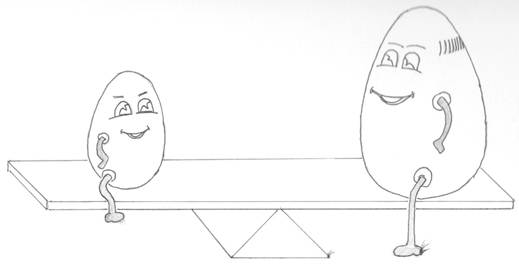
When we took this person, Yasik, to the park to ride the teeter totter, he was a tidy little package of 40 inches by 40 pounds and whichever one of us got on the opposite side of the teeter totter that stood a mere 2 feet above ground was north of 3 times 40 by 40. Sometimes Yasik was in danger of being tossed into the air; other times he could be stuck on the ground as we and all that pertained to his new world of family strove to find a good experience on life’s teeter-totter. Riding together with tiny on one side and extra-large on the other can still be wonderful fun if extra-large is caring and responsible and the mechanism that holds the teeter totter together and the playground it has been set in are copacetic (a weird word Dave used to love).
davevincent.com
I will look at our set and setting in the next posts by laying out our setting of family via adoption with the hopes of culling some awareness of the perceptions Yasik was developing.
Maybe the only gift is a chance to inquire,
to know nothing for certain.
An inheritance of wonder and nothing more.
― William Least Heat Moon[vii]
Footnotes
[i] Penny, Louise Thorndike Press, GALE, 2006, 391-392
[ii]https://journals.sagepub.com/doi/10.1177/2050324516683325?__cf_chl_f_tk=wx6hqyVqb0RnV29Gf0GY1iteYWJvyMH8sq_TQ9AEMvk-1783019840-1.0.1.1-cZK3lldW7m0xg6YL2M6OaxdRDhoyJWzL9tdXr.gB.F0
[iii] Mukherjee, Siddhartha. The Gene: an intimate history. Scribner, 2016, 368-9.
[iv] Mukherjee, Siddhartha. The Gene: an intimate history. Scribner, 2016, 481.
[v] Maté, Gabor with Daniel Mate. The Myth of Normal: trauma, illness & healing in a toxic culture. Knopf Canada, 2022, 241-243.
[vi] Letourneau, Dr. Nicole with Justin Joschko. Scientific Parenting: what science revels about parental influence. Dundurn Press, 2013, 56,57,70,34,35.
[vii] Heat Moon, William Least. Blue Highways. Eine Reise in Amerika. https://www.goodreads.com/work/quotes/1383812-blue-highwasy-a-journey-into-america
Leave a Reply