Library shelves in the 21st century continually showcase new books being written about adoption scandals coming to light in countries from China to Canada to Argentina to
Britain. Each speaks to horrors that make international protections of vulnerable children understandable. In 1997 we could not have imagined following the dots from the need for such protective measures to our personal experience of adoption. When that young judge in Russia pronounced us acceptable parents, we understood that Yasik was indisputably our son.
Forming a Family involves interviews and paperwork
That heavy word ‘however’ now comes into play. At least in the language of legal documents, he was not yet entirely our son. We likely huffed and puffed about that revelation at the time, but as I write today, I understand. A mere four days into being family in Canada, we were told we also had another 10-day wait period before Yasik was truly, truly, truly our son, perhaps part of the wait period begun in Russia.
In all the joy of those days, months and years of the ‘honeymoon period’ the uncertainty continued to rattle, a reminder that adoption was its own kind of family. Yasik became our son in 1997 but not until September 2000, having completed 5 interviews, at the going rate for a social worker, and the cost for translation to Russian, were we assured there would be no more post-placement interviews.
The BC Adoption Act and Financial Administration Act: Adoption Regulation, last amended March 30, 2022, appears to request only one report now.
Our first interview/report in November 1997 concluded with this statement: “I recommend that this placement continue to proceed. It appears to be an excellent match and all are enjoying forming a new family together”.
What if it had not been recommended to ‘continue to proceed’ three months after Yasik came into our lives?
Little caveat here: after the five interviews, release from yearly interviews came when Dave wrote to the adoption agency that we thought we had made sufficiently plain that Russia need no longer worry about Yasik’s unshakeable place in our hearts and lives. The BC adoption agency wrote back to say that the number of post-adoption reports came at the request of Russia which had experienced a few ‘rehomings’ or returning the adoptee to Russia. We were but a part of a greater concern for the welfare of vulnerable children and should be grateful that Russia was doing its homework.
Added to the interviews, in this two-week parental leave, we began to get Yasik’s Canadian paper work together when we ran into one of the hiccups I had noticed at work particularly with Sri Lankan students. At the top of his landing papers, the government had written Yasik’s name using the Cyrillic alphabet. At the bottom of the paper his name was written in the letters we call the ‘right’ ones. The government was going to use the letters at the top on his citizenship card and his care card. The person on the other end of the telephone would not budge, telling us that it would require a change by an office in Victoria and would cost $225.00. Immigrants with limited financial resources and hesitancy to make waves regularly found themselves with names that included the tribal name, a part of their name these prospective new Canadians did not use even in their former country. This would add letters to a name which then became too long for computers to accommodate. But we were people much more secure in our rights as Canadians. Dave called Victoria and told them quite firmly that there was no sense to using the Cyrillic alphabet in Canada. The preferred spelling at the bottom of the page was as clearly written as the Cyrillic. The voice on the other end of the phone acquiesced. I have not discovered if this remains a problem for the newly arrived.
Forming a family involves hesitancy
My journal can be annoyingly honest at times. It admits that both Dave and I did have an ‘adjustment’ moment wondering if we could really do this, even wondering, did we want to!?! Yes, it warrants an exclamation mark accompanied by a question mark. Note though it was a ‘feeling’, not anything we acted on for the next line goes on to reassure that the feeling petered out. Yasik had the resolution “weighted unfairly in his favour”. He beamed at us and it was game over. Dr.Bruce Perry tells us our brain reward system sinks us.
What could prompt parents to give up sleep, sex, friends, personal time, and virtually every other pleasure in life to meet the demands of a small, often irritatingly noisy, incontinent, needy being? The secret is that caring for children is, in many ways, indescribably pleasurable.…. What we call “cuteness” is actually an evolutionary adaptation that helps ensure that parents will care for their children, … the important neurobiological “glue” that bonds and creates healthy relationships[i].
And now it was the first week of September, 1997, the September week that Mother Theresa died, and even more absorbing for the globe, Princess Diana died. Over a decade later, we would share another eventful week with the royal family.
Forming a family involves concern over deviations from expectations
There were two disconcerting pieces to this otherwise wonderful beginning. I noticed at the park how quickly other children pointed out how small Yasik was, his inability to speak English and that he had one lazy eye.
With this, and too readily for Dave, Yasik would at times hit or try to bite me in unacceptable excitement. Where did the biting and hitting come from?
Let’s get the hysterical response out of the way first. Yasik had been institutionalized in his most formative years; if he was hitting and biting, he must have RAD, reactive attachment disorder, so say the fear-mongers. This ‘diagnosis’ for adoptees ‘acting up’ was one of the first I heard. Was Yasik being a bully?
Initially, as adopters sought to understand their adopted children who were not acting particularly perfectly, RAD was a handy blanket explanation. In time the messaging was studied. Now adoptive parents are warned against jumping on this bandwagon too quickly. It is considered by many researchers to be rarer than first thought[ii]. For us having to deal with a couple of tantrums would have made rushing to a diagnosis of RAD ridiculous.
Was Yasik simply trying to take care of himself as he understood self-protection, a survival response learned in the orphanage? Hold On To Your Kids led me to wonder if this was a learned behaviour in the orphanage environment where children would of necessity be more peer-oriented than parent-oriented in learning social behaviours[iii]. Attaching in Adoption says, “Children who lived with busy orphanage workers or with depressed or drug-affected birth parents learned to get louder, more persistent, more irritating, or more charming, to get basic needs met … [therefore]“The rule of thumb is that, when first placed, children will relate to new parents in much the same way that they related to former parents or orphanage workers”[iv].
Or did it come from the trauma of the first four years? “The aggression and impulsivity that the fight or flight response provokes can … appear as defiance or opposition, when in fact it is the remnants of a response to some prior traumatic situation ….”[v]. Our minds default to choices based on associations to memories.
The brain tries to make sense of the world by looking for patterns. When it links coherent, consistently connected patterns together again, it tags them as “normal” or “expected” …[vi].
Orwas this anti-social behaviour a child’s way to express the separation/the strangeness of all the newness jumping up in front of him like goofy characters on a subterranean canal ride at a theme park, an inappropriate response but perhaps the only one he knew. Maybe hitting or biting were simply overload reactions to not having enough language to cope. How could he ‘use his words’?[vii]
Or was Yasik testing a love he did not yet understand or trust? How does a child understand a parental love he or she has never yet experienced? How is trust generated in someone who has only ever been a client, not a family member? Pretty much every book I’ve read about nurturing an adoptee will make note of children who test boundaries as a way to test the strength of the love being offered to them[viii]. Appearing to prove they are not loved or loveable but yearning deep within to be proved wrong. As Bruce Perry says, it takes a whole lot of love but the message of love can find secure hold in a hungry heart.
Some of Dr. Perry’s understanding of the need for a whole lot of extra loving came from watching a caregiver named Mama P. She saw even older children as yet emotional babies still needing loving cuddling to allow catch up for those areas of a loved-deprived child’s psyche still underdeveloped[ix].
Our response to this behaviour: at first when he hit out, kicked, spit, slapped or punched, we held him down, put him in bed and even spanked him once. He would cry but then calm down and all would be fine again for our little newcomer with little language living in a world still very strange to him. By the end of the first week, we hit on the ‘novel’ idea to put a chair in a corner and have him sit there to cool down.
Attaching in Adoption says “If children throw tantrums, hold them close…. to … comfort them”.[x]
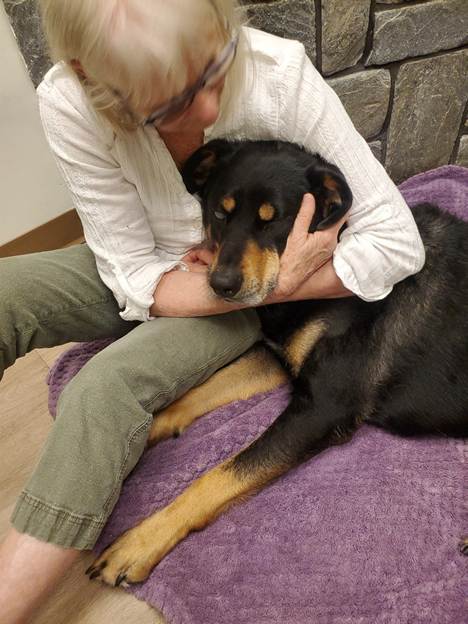
Brodie in need of one last cuddle, Oct 08, 2020 – June 23, 2026
Born for Love reminds parents, when your attachment is still insecure then
… social punishments like a “Time-Out” [can be] less effective. Being less loved – or having repeated early experience of loss … can also make loving itself harder and less satisfying. Like an addict with a tolerance, it takes a higher “dose” to get the same effect…. neglected children or those with other attachment disruptions are much harder to soothe or to teach….[xi]
Were we just plain lucky that one or two opportunities to explore a time out and a nod toward the chair led Yasik to cool it?
I have come back time and again to this encouragement from Perry: “although early deprivation is damaging, the worst outcomes can be mitigated”. He is referring to monkeys here … but then he finishes with, “Fortunately, this is often true for humans as well.”[xii]
Forming a family involves social dilemmas
These first two weeks as a family came between the end of summer classes and the beginning of the fall semester; there was no opportunity to access my union’s allowed three days ‘parental leave’ for adopters. It was time for school.
Luckily I guess, that particular year I had evening classes so the first days of September gave me a schedule that allowed me to be at home with Yasik in the morning. Dave dropped some of his course load, taking only morning classes three days a week. Yasik’s needs were directing his art education. I stuffed Yasik into his car seat and worked against afternoon homeward bound traffic to Emily Carr University, picking Dave up. He took the driver’s seat and headed further into Vancouver to my school after which Dave and Yasik caught the bus home while I taught. Two weeks into the school year with this schedule and we furrowed our brows. Perhaps we ought to just see about a possible kindergarten for Yasik.
We called the school to make an appointment, and Yasik was a new kindergarten student by the end of the day.
The journal says “And childhood is over – the staff at the community school down the street urge starting kindergarten as best for him for socializing, school prep, and ESL (the kindergarten teacher spoke some Russian). And he has been watching the kids at the park – we feel he is ready”. We would be keeping our promise to the Russian judge for this was not (God forbid) abandoning him to day care.
And what do the experts say about that: most say don’t rush into a wider social world. Keep your child close for enough time to build a secure sense of family. Might sending Yasik off to an institutional setting, even one as cozy as our little community school be heading right back into a peer-oriented, rather than family-oriented, environment?[xiii] Some specifically adoption advice books were quite blunt: “As a new adoptive parent you should take time off from work after your child comes home… building trust is a process that cannot be rushed”.[xiv] Even in the face of “A social dilemma [which] already exists about the balance of career versus adequate time for infant attachment. When older children are adopted, there is even less appreciation for the generous amount of time needed for parents and children to form attachment.[xv]
For us specifically, the ‘social dilemma’ seems to have come down to bowing to the dollar over the hopes of the heart strings. We had to find a way to pay off the adoption debt and the mortgage and Dave’s education, and the life we promised to provide this child, but we did also believe we would be meeting Yasik’s language needs and the social needs we understood a child of his chronological age needed. And once again we were working with our lack of awareness of the emotional impact of his past.
Adopting Older Children shrugs a bit “You also need to give yourself permission to not be a perfect person or a perfect parent. Sometimes you will just be a “good enough’ parent and that’s okay”.[xvi]
We chose to send him to kindergarten.
Footnotes
[i] Perry, Bruce D., MD, PhD, and Maia Szalavitz The Boy Who Was Raised As A Dog: and other stories from a child psychiatrist’s notebook. Basic Books, 2017, 90-91.
[ii] Mercer, Jean Understanding Attachmenty: parenting, child care, and emotional development Praeger, 2006, 109-112
Perry, Bruce D., MD, PhD, and Maia Szalavitz The Boy Who Was Raised As A Dog: and other stories from a child psychiatrist’s notebook. Basic Books, 2017, 229
[iii] Neufeld, Gordon, PH.D. and Gabor Maté, M.D. Hold On To Your Kids: why parents need to matter more than peers. Vintage Canada, 2005, 65.
[iv] Gray, Deborah D. Attaching in Adoption: practical tools for today’s parents Perspectives Press, Inc., 2002, 81-2, 24
[v] Perry, Bruce D., MD, PhD, and Maia Szalavitz The Boy Who Was Raised As A Dog: and other stories from a child psychiatrist’s notebook. Basic Books, 2017, 52.
[vi] Perry, Bruce D.. MD, PhD, and Maia Szalavitz The Boy Who Was Raised As A Dog: and other stories from a child psychiatrist’s notebook. Basic Books, 2017, 26
[vii] Gray, Deborah D. Attaching in Adoption: practical tools for today’s parents Perspectives Press, Inc., 2002,73
[viii] Mercer, Jean Understanding Attachmenty: parenting, child care, and emotional development Praeger, 2006, 119
[ix] Bruce D. Perry, MD, PhD, and Maia Szalavitz The Boy Who Was Raised As A Dog: and other stories from a child psychiatrist’s notebook. Basic Books, 2017, 152, 153.
Gray, Deborah D. Attaching in Adoption: practical tools for today’s parents Perspectives Press, Inc., 2002, 275
[x] Gray, Deborah D. Attaching in Adoption: practical tools for today’s parents Perspectives Press, Inc., 2002, 231
[xi] Szallavitz, Maia, Bruce D. Pery, M.D., Ph.D. Born For Love: why empathy is essential- and endangered William Morrow, 2010, 135
Tantrum, Barbara Cummins. The Adoptive Parent’s Handbook: a guide to healing trauma and thriving with your foster or adopted child. North Atlantic Books, 2020, 78
[xii] Szallavitz, Maia, Bruce D. Pery, M.D., Ph.D. Born For Love: why empathy is essential- and endangered William Morrow, 2010, 56
[xiii] Neufeld, Gordon, PH.D. and Gabor Maté, M.D. Hold On To Your Kids: why parents need to matter more than peers. Vintage Canada, 2005, 33, 65.
[xiv] Bosco-Ruggiero, Stephanie, MA, Gloria Russo Wassell, MS, LMHC, and Victor Groza, PhD Adopting Older Children: a practical guide to adopting and parenting children over age four New Horizon Press, 2014, 67
[xv] Gray, Deborah D. Attaching in Adoption: practical tools for today’s parents Perspectives Press, Inc., 2002,22
[xvi] Bosco-Ruggiero, Stephanie, MA, Gloria Russo Wassell, MS, LMHC, and Victor Groza, PhD Adopting Older Children: a practical guide to adopting and parenting children over age four New Horizon Press, 2014, 222
Leave a Reply