In my mid-teens I was on a train coming from Edmonton and headed to my home in the Fraser Valley for the Christmas holidays. I’d fallen asleep and woke in the early morning as the train was pulling into the Blue River station which was right up against a mountain. That mountain assured me that I was again surrounded by mountains; my entire body slipped into its comfort zone. I was home. My aunt, on the other hand, a lifelong prairie woman, found it hard to breathe when she visited us in Chilliwack. Back on the ‘bald prairie’ she was home. In Yasik’s mind, what is ‘home’?
The physical worlds Yasik inhabited
Yasik began life in what we understood to be a ‘small village’ in the Yaroslavl oblast, Rybinsk.
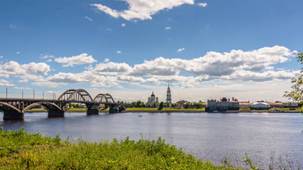
Maybe it was a small village in Russian terms, but even in the 1990s, Rybinsk had a population over 200,000.
Yasik’s bio sister’s family sent us the two following pictures, taken on their visit to Yaroslavl a few years ago. Yasik’s family lived in an apartment that may be one the buildings in these pictures. Perhaps this was much as it looked in the 1990s. Perhaps by this time it was an abandoned building in need of much repair.
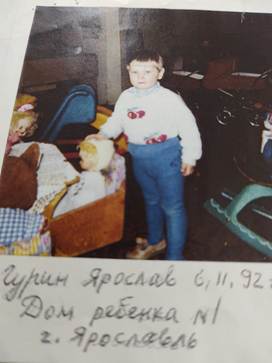
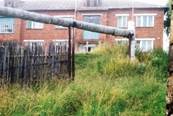
When the social services took Yasik from the apartment around his first birthday, they first placed him in one of the hospitals, maybe in Rybinsk, maybe in Yaroslavl, and maybe one that offered pediatric care. Whether Rybinsk or Yaroslavl, because it was the early 1990s all over Russia, the hospital would have been struggling with overcrowding and basic medical shortages.
By the time he was two, he was living in an orphanage for young children. The orphanage seemed to be off a dirt road, back a bit of beyond. Perhaps similar to the one pictured, a Yaroslavl orphanage in later decades.
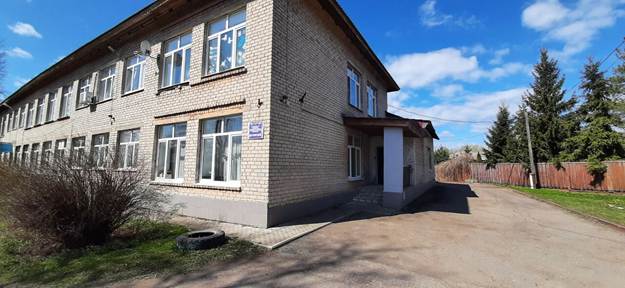
There was a piece at the side of the house that looked worn enough to likely have been a playground. It reminds me of how Tony describes the playground of his orphanage in 1930s Saskatoon (A Canadian Story of Adoption in the 1930s).
On any outing he would have been part of at the orphanage, it would have been hard to miss at least a glimpse of the Volga River. The longest river in Russia and in Europe, it runs through the entire oblast. The land on either side of this river all through the Yaroslavl oblast was a mix of urban and rural, farm and forest, though with birch and aspen, it looks more like central and northern prairies. It feels more like the prairies, as well, with warmer warm and colder cold seasons.
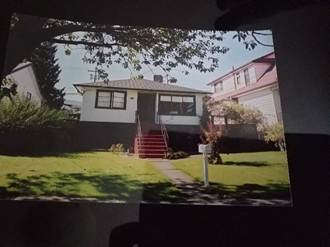
A plane ride and he entered a city of roughly 50,000 but so closely tied to a larger urban region, it took a moment to think which city we were in on any outing. We had a comparable river running through it but instead of aspens and a more prairie look, we were surrounded by mountains. Our climate saw more rain but much less snow.
Whether any of that registered with Yasik, our 50s era home with a small backyard, did. After just three hours in his new home, when Dave wanted to simply rearrange parking, Yasik thought he was being made to leave this home. He howled.
Our background playground wasn’t scruffy; it was non-existent as neither Dave nor I had yet given much thought to the yard. But now we had Yasik. We had a yard and we needed to see what we could do. Or Yasik very quickly, very naturally, rearranged our thinking and awareness of what might please him. Or we fell back on what our parents did with us. Whatever… the environment our house and yard offered became kid oriented.
We attempted some gardening, built igloos the odd year we had sufficient snowfall and played itsy-bitsy soccer on the front lawn. The house was tucked in among a string of streets trying to be a suburb but so infused with businesses and institutions that there was little point in denying it was part of a much larger urban setting, with cars everywhere. Nonetheless Yasik learned to ride a bike in the alley between our house and the Chevron station and biked on sidewalks running alongside a street that boasted 40,000 cars a day.
At the bottom of our little tree-lined street, on the other side of the river of traffic, the elementary school had the word ‘Community’ in its title and across from the school was a park with baseball diamonds, a swimming pool and even a creek bordered by trees and picnic tables. An hour or two out of town our bodies and minds could ‘heed the call of the wild’ with hiking or swimming in rain-forested provincial parks.
When the city began to feel just that, a city, we moved ‘out to the country’, the bedroom city of Maple Ridge, settling into a half-acre piece bordered by muskeg, bush, trees that fringed the coastal range circling the Fraser Valley.
The physical body Yasik inhabited
People see my mother’s face stamped on mine. Likewise for my siblings, you can see my parents on their bodies. Yasik can see that he shares facial features with his bio-sister but it is very unlikely he will ever hear someone say, “Oh you look just like your mother” or “Yes, he looks just like his dad”.
His birthplace though is evident. While it is disputable that there is a Slavic DNA, it is interesting that in the UK and some other places, Slavic ethnic groups are sometimes viewed as distinct cultural minorities rather than part of the dominant white majority. So DNA or not, he does carry some of the features considered Slavic: oval-face, straight nose, fair-skin, hazel eyes and blond hair that aged into sandy. All these features were fashioned into one cute little human being.
Whatever the combination is for cuteness, it can come in handy.
Cuteness is the signal nature sends to us that says that a creature is young, vulnerable and needs nurturing. Seeing cuteness is usually pleasurable and cues us to interact positively with children...[i]
But put bluntly, for Yasik, cuteness was not enough to draw his biological father and mother to dote on him. Nor was the fact that he had been put together with genes from their parents and themselves. We know that he was found in a bed, unattended as an infant. Our child carried their genes and experienced their lack of nurture. We would be parenting a child bearing the expression of genes that were developed over generations of oppression and whose infancy was soaking in that atmosphere. Added to this, the early, caring nurture that helps a child develop resistance to stress and encouragement of the growth hormone was lacking for Yasik.
We cannot therefore ignore the possibility that their lack of care was pre-natal as well as post. It is possible they were uncaring because alcohol was their ‘go to’ in the difficulties of their days. It is possible that Yasik’s mother was drinking while pregnant. It is equally possible that it mattered that his father was drinking for it is now accepted that a father’s drinking can also infect the fetus.[ii]
I see no reason to do other than leave this section with the following for whether we know details how Yasik’s genes were developed or what epigenetics were in play with a poor start to life, we do know this:
…[I]f stressful events occurred during certain trigger periods in a child’s life, they would leave an epigenetic imprint on that child’s genes…[iii]
…For instance, early brain growth depends in part on diet… Brain growth slows and complexity advances less if an infant or toddler is deprived of protein. During the first three years or so, the problematic development of the malnourished child can be corrected to some extent if the child is given a better diet, with milk, meat, eggs, or other good protein sources included. Catch-up growth can then help bring the brain closer to normal size, although the child’s stature may always be short.[iv]
On Yasik’s first doctor visit he was pronounced physically fit, perhaps, because he’d built up a strong immunity to childhood diseases in his orphanage and likely because the orphanage did its best to provide a better diet.
Days after we returned to Canada, our facilitator met us at a café to put together the post- adoption paperwork. She herself did not plan to adopt as her husband was wary of adopting a child who might not be quite as perfect as the child they had birthed. Was the direction she then moved the conversation an attempt to smooth over this admission from a cache of comments offered to new adoptive parents? She marveled at how much Yasik look like Dave, and to draw me in, she pointed out that he had my eyes. Not a hard sell. We both have Slavic origins as well according to our histories. John Brooks and his wife wanted their girl to think she looked like Brook’s mother as a young girl.[v]
Why do we adopters want a child who does not have our genes to, if at all possible, appear to have them? What if the only adoption route open to us at the time was China?
Yasik was growing, pink cheeked and fortunately or unfortunately, depending on which member of the family you asked, unable to miss much school time due to illness. Yasik, with his button nose and soft blond hair, also came into the family cute enough that on a pumpkin patch trip he so mesmerized the staff they end up leaving another child in the field, but they certainly had lots of pictures of Yasik and the pumpkins. This did not, in this case ‘manage stress’ or ‘soothe’ the other child’s mother.
Maurice Mierau and his wife were told something similar by one of the women at the boys’ Ukrainian nursery: “Your boys are so good-looking, and that’s an asset in life, you know”.[vi] Mierau felt encouraged by the comment.
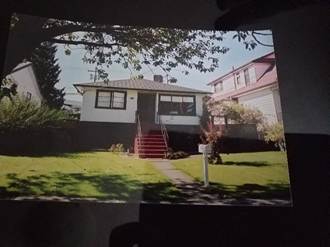
So there you have it. The natural environments of Yasik’s birthplace and the world he moved to at four and half shared some similarities. The bigger difference would have come in each place that was home for a short time, the apartment, the hospital, the orphanage and finally our home. I do know that of all the places he has lived, that little house in New West meant the most to him. The word ‘home’ for him may be accompanied by a picture of the little house on Kelly Street.
Footnotes
[i] Perry, Bruce MD, PhD. and Maia Szalavitz. The Boy Who Was Raised As A Dog: what traumatized children can teach us about loss, love and healing. Basic Books, 2017, 369-370.
[ii] https://jheor.org/post/2235-new-research-points-to-dad-s-drinking-as-a-significant-factor-in-fetal-alcohol-syndrome
[iii] Bosco-Ruggiero, MA, Gloria Russo Wassell, MS, LLMHC and Victor Groza, PhD. Adopting older children: a practical guide to adopting and parenting children er age four. New Horizon Press,2014, 64.
Letourneau, Dr. Nicole with Justin Joschko. Scientific Parenting: what science revels about parental influence. Dundurn Press, 2013, 173.
[iv] Mercer, Jean. Thinking Critically About CHILD DEVELOPMENT: examining myths & misunderstandings, 3rd ed. Sage Publications, 2016, 156.
[v] Brooks, John. The Girl Behind the Door: a father’s quest to understand his daughter’s suicide. Scribner, 2016, 56.
Gray, Deborah D. Attaching in Adoption: practical tools for today’s parents. Jessica Kingsley Publishers, 2002, 151.
[vi] Mierau, Maurice. Detachment: an adoption memoir. Freehand Books, 2014, 103.
Leave a Reply